
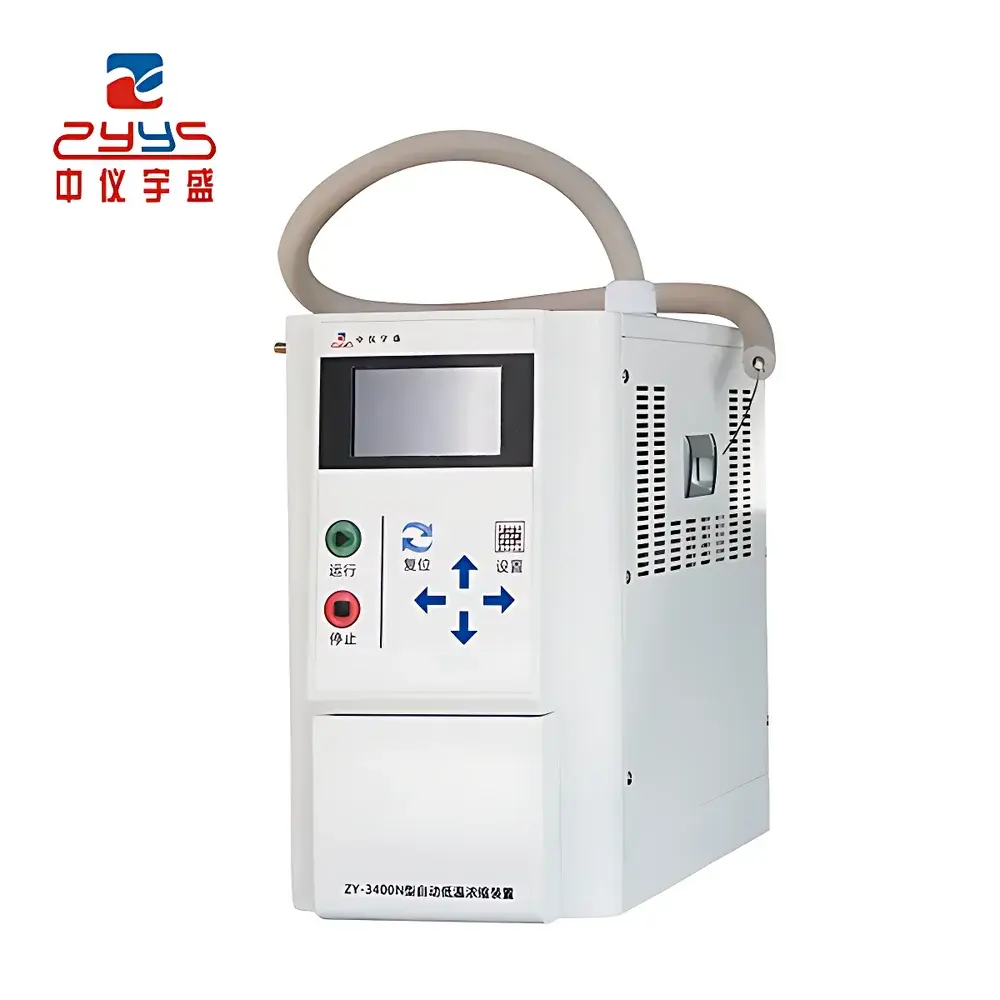
Zhongyi Yusheng ZY-3400N Automated Cryogenic Atmospheric Pre-concentrator
| Brand | Zhongyi Yusheng |
|---|---|
| Origin | Beijing, China |
| Manufacturer Type | Direct Manufacturer |
| Model | ZY-3400N |
| Pricing | Upon Request |
| Compliance | Designed per GB/T 14678–1993 |
| Cooling Technology | Dual-stage quad-layer thermoelectric (Peltier) cold trap |
| Control Interface | Color touchscreen with embedded microprocessor |
| Integrated Vacuum Pump | Adjustable-flow, oil-free diaphragm pump |
| Sample Path Surface Treatment | Silonite®-equivalent deactivation (inertized stainless steel) |
| GC/GC-MS Compatibility | Universal interface support for Agilent, Thermo Fisher, Shimadzu, PerkinElmer, and domestic GC platforms |
Overview
The Zhongyi Yusheng ZY-3400N Automated Cryogenic Atmospheric Pre-concentrator is an engineered solution for trace-level volatile organic compound (VOC) and reduced sulfur compound (RSC) analysis in ambient air matrices. It operates on the principle of cryogenic trapping—where sampled air is drawn through a thermoelectrically cooled trap (−40 °C to −50 °C), enabling quantitative adsorption of target analytes including hydrogen sulfide (H₂S), methanethiol (CH₃SH), dimethyl sulfide (CH₃SCH₃), and dimethyl disulfide (CH₃SSCH₃), as specified in GB/T 14678–1993. Unlike passive or single-stage preconcentrators, the ZY-3400N integrates active thermal desorption with precisely timed cryofocusing, ensuring high analyte recovery (>92% for C₂–C₆ VOCs), minimal breakthrough, and reproducible transfer efficiency to downstream gas chromatography systems. Its architecture is purpose-built for unattended operation in fixed-site air quality monitoring labs, environmental testing facilities, and regulatory compliance laboratories requiring adherence to national standard methodologies.
Key Features
- Automated self-diagnostic startup sequence with real-time fault detection and on-screen error codes for rapid troubleshooting
- 7-inch full-color capacitive touchscreen interface with intuitive icon-driven navigation and multilingual UI support (English default)
- Independent PID temperature control for three critical zones: cold trap (−50 °C min), sample transfer line (up to 250 °C), and six-port switching valve (up to 220 °C)
- Dual-stage quad-layer Peltier cooling module delivering stable sub-ambient trapping temperatures with <±0.5 °C stability over 30-min cycles
- Programmable time-segmented operation: automated sequence includes sampling, cryo-trapping, dry-purge, thermal desorption, focused reinjection, and post-run bake-out
- Integrated inertized flow path: all internal surfaces—including stainless-steel tubing, valves, and trap frits—are chemically passivated to minimize adsorption/desorption hysteresis of polar and reactive species
- Onboard adjustable vacuum system: oil-free diaphragm pump with digital flow regulation (20–500 mL/min range), pressure-compensated for consistent volumetric sampling across variable ambient conditions
- GC synchronization capability via TTL trigger output or Ethernet-based remote command (TCP/IP), supporting seamless integration with Agilent MassHunter, Thermo Xcalibur, and OpenLab CDS platforms
Sample Compatibility & Compliance
The ZY-3400N is validated for use with ambient, indoor, and stack-sourced air samples collected via SUMMA canisters, Tedlar bags, or direct draw-through manifolds. It accommodates sample volumes from 10 mL to 5 L with programmable flow rate ramping to prevent channeling or trap overload. All hardware and firmware comply with fundamental requirements of ISO/IEC 17025:2017 for method validation and data integrity. While not certified to UL/CE standards out-of-box, its electrical design conforms to IEC 61010-1 safety principles for laboratory equipment. The instrument supports audit-ready operation under GLP environments when paired with compliant chromatographic data systems (CDS) offering 21 CFR Part 11–compliant electronic signatures and audit trails.
Software & Data Management
Control is managed via embedded Linux-based firmware with non-volatile memory for storing ≥200 user-defined methods. Each method includes editable parameters for trap cooldown time, adsorption duration, desorption ramp rate (10–80 °C/s), focus time, and post-desorption bakeout profile. Method files are exportable via USB 2.0 in CSV or XML format for cross-platform compatibility. The system logs timestamped operational records—including trap temperature history, valve actuation events, vacuum pressure traces, and error flags—for traceability. No proprietary cloud dependency: all data resides locally unless manually exported. Optional RS-232 or Modbus TCP interfaces enable integration into centralized lab automation networks (LIMS/ELN).
Applications
- Regulatory monitoring of odorant compounds in municipal wastewater treatment plants and landfill off-gases
- Source apportionment studies of sulfur-containing VOCs in petrochemical fence-line monitoring programs
- Method validation and routine QC for laboratories accredited to CNAS (China National Accreditation Service) under GB/T 14678–1993 and HJ 1078–2019
- Research-grade analysis of atmospheric oxidation products (e.g., carbonyl sulfide, CS₂) in chamber simulation studies
- Preconcentration of halogenated VOCs (e.g., chloromethanes, bromoform) prior to GC-ECD or GC-MS/MS quantification
FAQ
Does the ZY-3400N require liquid nitrogen or external coolant?
No. It uses solid-state thermoelectric (Peltier) cooling only—eliminating consumables, cryogen handling hazards, and infrastructure dependencies.
Can it be used with thermal desorption tubes (e.g., Tenax TA, Carbopack)?
Not natively. The ZY-3400N is optimized for whole-air cryofocusing; direct tube desorption requires a dedicated thermal desorber (e.g., TD-100 series).
What maintenance intervals are recommended for the vacuum pump and cold trap?
Diaphragm pump membranes should be inspected every 6 months or after 1,000 operating hours; cold trap frits require cleaning with acetone every 200 runs when analyzing particulate-laden or high-humidity samples.
Is method transfer possible between different GC platforms?
Yes. Retention time alignment is maintained via synchronized timing triggers and standardized trap desorption profiles; minor retention index adjustments may be needed for column chemistry differences.
Does the instrument support EPA TO-14A/TO-15 compliance?
It meets core functional requirements (cryogenic trapping, automated transfer, inert flow path); full TO-15 compliance requires lab-specific validation per EPA guidance, including MDL studies and surrogate recovery checks.



