
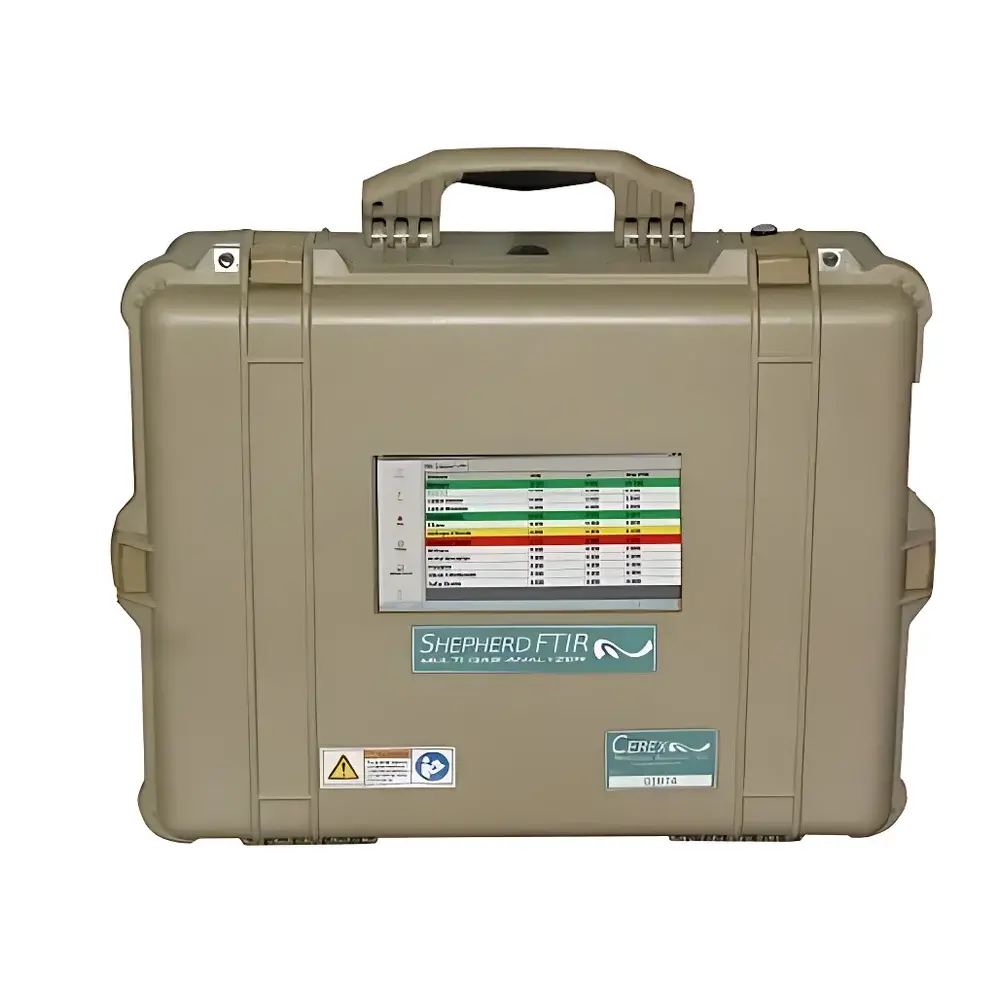
CerexMS Shepherd FTIR Portable Multicomponent Gas Analyzer
| Brand | CerexMS |
|---|---|
| Origin | USA |
| Model | Shepherd |
| Instrument Principle | Infrared Absorption Spectroscopy (FTIR) |
| Type | Portable |
| Response Time | <1 s |
| Repeatability | High for all IR-active species |
| Detection Range | Sub-ppb to % v/v |
| Gas Library | 385+ compounds (including >100 HAPs) |
| Optical Path Length | 20 m (fixed, multipass) |
| Detector | Liquid-nitrogen-free cryogenically cooled MCT |
| Data Output | Raw interferograms, calibrated spectra, concentration time-series, CSV export |
| Compliance | Designed for EPA Method 320 / ASTM D6348 / ISO 12039 alignment |
| Software | CMS Continuous Monitoring Software (Windows Embedded, touchscreen UI) |
| Connectivity | Wi-Fi, Ethernet, USB |
| Alarm Options | Visual, audible, email, remote notification |
| Calibration | Built-in reference cell + user-definable multi-point calibration |
| Maintenance | Two consumables only — IR source and thermoelectric cooler compressor |
Overview
The CerexMS Shepherd FTIR Portable Multicomponent Gas Analyzer is an advanced, field-deployable Fourier Transform Infrared (FTIR) spectrometer engineered for real-time, simultaneous quantification of up to dozens of infrared-active gases in complex matrices. Leveraging a high-fidelity, liquid-nitrogen-free cryogenically cooled Mercury Cadmium Telluride (MCT) detector and a robust 20-meter fixed-path multipass optical cell, the Shepherd delivers exceptional signal-to-noise ratio and spectral resolution—enabling reliable detection down to sub-parts-per-trillion (ppt) levels for many analytes and consistent sub-ppb sensitivity across its comprehensive 385-compound spectral library. Unlike dispersive or NDIR systems, FTIR spectroscopy captures full broadband mid-IR spectra (typically 600–4000 cm⁻¹) in a single scan, allowing unambiguous identification and quantification based on unique molecular vibrational fingerprints. This first-principles measurement approach eliminates reliance on pre-characterized surrogate standards or empirical correlations, supporting traceable, physics-based concentration reporting compliant with regulatory frameworks including EPA Method 320, ASTM D6348, and ISO 12039.
Key Features
- True real-time analysis: Full-spectrum acquisition and processing in under 1 second per measurement cycle
- Zero-sample-prep operation: Direct analysis of humid, particulate-laden, or corrosive gas streams without scrubbers, dryers, or carrier gas
- Embedded Windows-based computing platform with 10.1″ capacitive touchscreen interface
- Integrated dual-mode connectivity: Simultaneous Wi-Fi and Gigabit Ethernet for local control and secure remote telemetry
- Comprehensive onboard gas library: 385+ certified reference spectra—including >100 Hazardous Air Pollutants (HAPs), VOCs, SVOCs, fluorocarbons, CFCs, acid gases, combustion byproducts, and chemical warfare agent simulants
- Automated spectral deconvolution and quantitative fitting using proprietary CMS software algorithms
- Built-in QA/QC functionality: Automated background subtraction, water/CO₂ compensation, spectral residual monitoring, and drift correction
- User-configurable alarm logic: Threshold-triggered visual, audible, and SMTP-based email alerts with timestamped event logs
- Minimal maintenance architecture: Only two field-replaceable consumables—the broadband IR source and solid-state thermoelectric cooling module
Sample Compatibility & Compliance
The Shepherd operates effectively across diverse environmental and industrial sampling conditions: ambient air, stack effluents, soil vapor, headspace from contaminated media, and confined-space atmospheres. Its non-destructive, non-contact measurement principle ensures compatibility with reactive, condensable, or thermally labile compounds—including formaldehyde, hydrogen sulfide, ammonia, benzene, chlorinated solvents, and perfluorinated compounds. The system meets design requirements for GLP-compliant data acquisition, supporting 21 CFR Part 11–ready audit trails when deployed with CMS Enterprise licensing. All spectral data—including raw interferograms, calibrated absorbance spectra, and concentration time-series—are stored with immutable timestamps and operator metadata, satisfying chain-of-custody documentation needs for regulatory submissions (e.g., Title V monitoring, RCRA corrective action, or EU IED reporting).
Software & Data Management
CMS (Continuous Monitoring Software) serves as the analytical and operational core of the Shepherd platform. It provides a fully configurable GUI for method setup, calibration management, alarm definition, and real-time spectral visualization. Users can load custom spectral libraries, define dynamic background acquisition schedules, and apply matrix-specific interference corrections. CMS exports structured datasets in industry-standard CSV format—including concentration values, detection limits (IDL/MDL), spectral residuals, and full-resolution .SPE or .JDX files—ensuring interoperability with LIMS, SCADA, and third-party analytics tools. Remote access is supported via secure HTTPS or VNC, enabling instrument control, firmware updates, and diagnostic review from any network-connected workstation or mobile device. All data transfers are encrypted; optional FIPS 140-2 validated modules support federal agency deployment requirements.
Applications
- Ambient and fence-line air quality monitoring at chemical manufacturing facilities
- Real-time emissions verification during flare optimization or thermal oxidizer commissioning
- HAZMAT incident response and rapid plume characterization in emergency scenarios
- Indoor air quality assessment in laboratories, cleanrooms, and pharmaceutical production suites
- Soil vapor intrusion screening and landfill gas composition profiling
- Container and cargo hold screening at ports of entry
- Leak detection and repair (LDAR) program support for fugitive emission surveys
- Odor complaint investigation with speciated VOC attribution
- Process safety monitoring for solvent recovery units and distillation columns
- Research-grade speciation of complex hydrocarbon mixtures in combustion studies
FAQ
Does the Shepherd require external calibration gases or zero-air generators?
No. The system uses an internal reference cell for periodic spectral validation and supports user-defined multi-point calibrations using standard gas cylinders—but routine operation requires no consumable calibration gases or zero-air supplies.
Can the Shepherd identify unknown compounds not in its default library?
Yes. CMS includes spectral search and matching capabilities against NIST, EPA, and user-uploaded libraries; unidentified peaks can be flagged for further forensic analysis using residual spectrum inspection and library augmentation.
What is the expected lifetime of the MCT detector?
The thermoelectrically cooled MCT detector is rated for >10 years of continuous operation under typical field conditions, with no liquid nitrogen or mechanical cryocooler maintenance required.
Is raw spectral data accessible for offline reprocessing?
Yes. All interferograms and calibrated absorbance spectra are saved in open-format files (.CSV, .SPE) and can be reprocessed using third-party chemometric tools or MATLAB/Python-based spectral analysis workflows.
How does the Shepherd handle water vapor and CO₂ interference in ambient measurements?
CMS applies real-time, adaptive atmospheric compensation using dynamically updated background spectra and built-in H₂O/CO₂ absorption models—minimizing baseline drift and cross-sensitivity without sacrificing measurement speed or sensitivity.







