
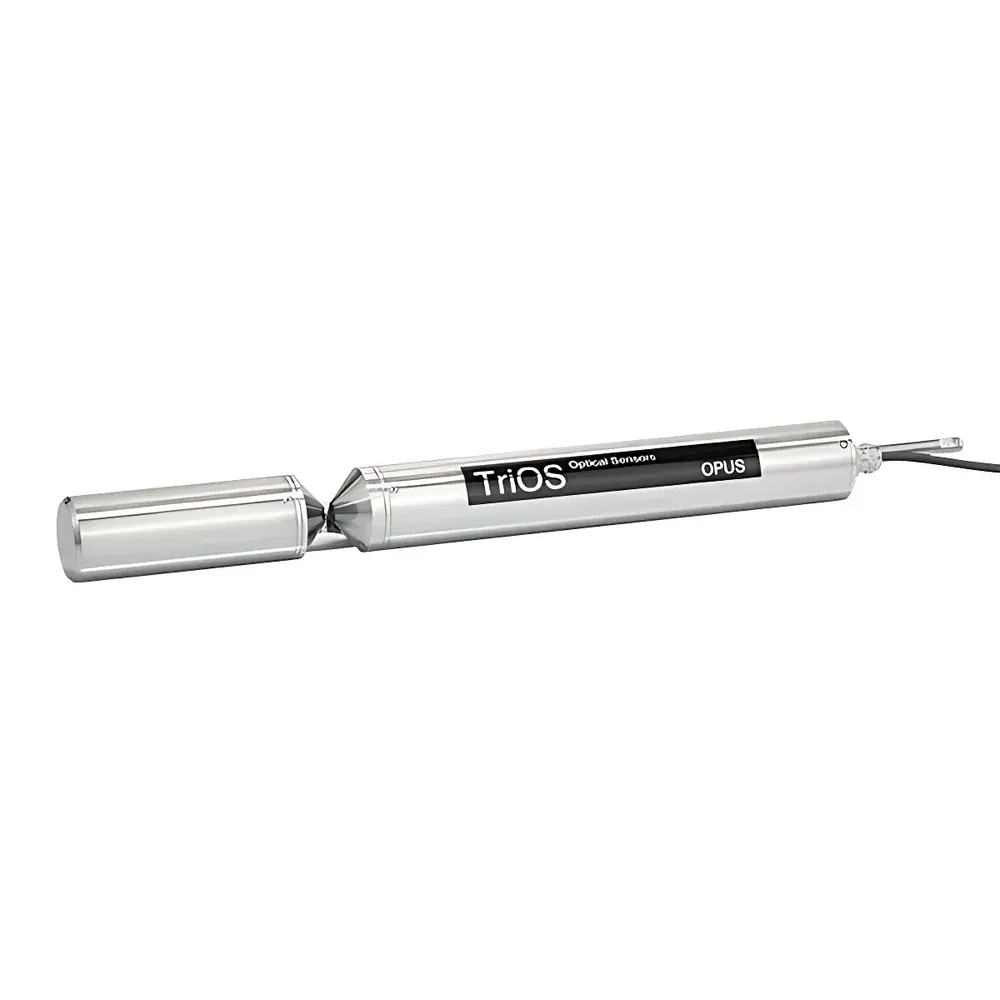
OPUS HS Sulfide Online Analyzer by TriOS
| Brand | TriOS |
|---|---|
| Origin | Germany |
| Model | OPUS HS |
| Type | Online Analyzer |
| Optical Principle | UV Absorption Spectrophotometry (200–360 nm) |
| Light Source | Pulsed Xenon Lamp |
| Detector | 256-channel Miniature Spectrometer |
| Spectral Resolution | 0.8 nm/pixel |
| Optical Path Lengths | 0.3, 1, 2, 5, 10, 50 mm |
| Turbidity Compensation | Yes |
| Data Storage | 2 GB internal |
| Measurement Interval | ≥1 min |
| Output Interfaces | RS232 / RS485 |
| Power Consumption | ≤8 W |
| Housing Material | Stainless Steel or Titanium Alloy |
| Dimensions | Ø48 × 470 mm |
| Weight | 3 kg (stainless steel, 10 mm path) / 2 kg (titanium, 10 mm path) |
| Pressure Rating | 30 bar (SubConn connector), 3 bar (fixed cable), 1 bar (flow cell, 2–4 L/min) |
| IP Rating | IP68 |
| Operating Temperature (Sample) | 2–40 °C |
| Ambient Temperature | 2–40 °C |
| Storage Temperature | −20–80 °C |
| Compliance | Designed for continuous operation in wastewater, drinking water, and industrial effluent monitoring per ISO 7027 (turbidity), ASTM D515-18 (sulfide), and GLP/GMP-aligned data integrity practices |
Overview
The OPUS HS Sulfide Online Analyzer is a high-performance, submersible UV absorption spectrophotometer engineered by TriOS (Germany) for continuous, reagent-free quantification of dissolved sulfide (H₂S, HS⁻, S²⁻) in aqueous matrices. Unlike conventional colorimetric or electrochemical methods, the OPUS HS employs full-spectrum UV absorbance analysis (200–360 nm) with multivariate calibration to resolve sulfide-specific spectral signatures amid complex background interferences—including organic matter, nitrate, and turbidity. Its optical architecture integrates a pulsed xenon light source and a 256-channel miniature spectrometer (0.8 nm/pixel resolution), enabling robust detection across six selectable optical path lengths (0.3–50 mm) to optimize sensitivity (sub-µg/L range) and dynamic range (up to mg/L levels) for diverse applications—from low-conductivity drinking water sources to high-turbidity municipal wastewater influent. The sensor operates directly in situ without sample extraction, filtration, or chemical dosing, eliminating analytical delay and reagent-related maintenance.
Key Features
- Reagent-free, maintenance-light operation: No consumables, no liquid handling systems, no membrane replacements.
- Nanocoated sapphire optical window: Resists biofouling, scaling, and abrasion in aggressive media (e.g., seawater, digestate, industrial effluents).
- Integrated turbidity compensation: Real-time correction using spectral baseline algorithms—compliant with ISO 7027 principles for reliable sulfide quantification under variable particulate load.
- G2 interface module: Embedded web server enables browser-based configuration (no proprietary software required); supports firmware updates, calibration management, and diagnostic logging via Ethernet or Wi-Fi.
- Flexible deployment options: Submersible housing (IP68, 30 bar rated with SubConn), flow-through cell integration (2–4 L/min), or portable operation with optional battery pack.
- Secure data governance: Local 2 GB non-volatile storage with timestamped spectra and processed results; configurable export intervals and protocols (Modbus RTU/TCP, ASCII over RS232/RS485).
Sample Compatibility & Compliance
The OPUS HS is validated for direct immersion or flow-cell installation in raw sewage, activated sludge streams, anaerobic digester supernatant, surface water, groundwater, potable water distribution networks, and industrial process waters (e.g., pulp & paper, food processing, chemical manufacturing). It meets mechanical and environmental requirements per IEC 60529 (IP68), EN 61000-6-2/-6-4 (EMC), and DIN EN 14181 (QAL1-ready when paired with certified calibration procedures). While not a certified reference method per ISO 10566 or US EPA Method 376.1, its performance aligns with ASTM D515-18 (total sulfide) validation criteria for field-deployable analyzers under GLP conditions. Full audit trails—including spectral raw data, calibration history, and user access logs—are retained for regulatory review.
Software & Data Management
Configuration and monitoring occur through an embedded HTML5 interface accessible via any modern browser on laptop, tablet, or smartphone (Wi-Fi or wired Ethernet). The G2 module supports TLS 1.2 encryption, role-based user accounts (admin/operator/viewer), and configurable alarm thresholds with email/SMS notification via external gateways. Processed data (sulfide concentration, absorbance spectra, temperature, turbidity index) are exportable in CSV or JSON format. For enterprise integration, the device natively supports Modbus TCP/RTU and ASCII serial protocols—enabling seamless ingestion into SCADA, DCS, or cloud-based IIoT platforms (e.g., Ignition, Siemens MindSphere, AWS IoT Core). All stored spectra include EXIF-style metadata (timestamp, path length, lamp status, detector gain) to support retrospective reprocessing.
Applications
- Municipal wastewater treatment: Real-time monitoring of sulfide buildup in gravity sewers, wet wells, and headworks to trigger odor control dosing (e.g., FeCl₃, nitrate) and prevent H₂S corrosion.
- Drinking water safety: Early detection of sulfide incursion in groundwater sources or distribution reservoirs—critical for compliance with WHO guidelines (<0.05 mg/L) and aesthetic threshold control.
- Biogas plant optimization: Continuous measurement in anaerobic digesters and dewatering streams to correlate sulfide levels with microbial activity and guide desulfurization system control.
- Industrial pretreatment compliance: Effluent monitoring for textile, tannery, and metal finishing facilities subject to local discharge limits (e.g., EU Industrial Emissions Directive Annex I).
- Environmental research: High-frequency profiling of sulfide dynamics in estuarine sediments, hypoxic zones, or constructed wetlands using battery-powered mobile deployments.
FAQ
Does the OPUS HS require daily calibration or zero-point adjustment?
No—factory-applied multivariate calibrations are stable for ≥6 months under typical operating conditions. Field verification with certified sulfide standards (e.g., methylene blue reference solutions) is recommended quarterly per ASTM D515-18 QA/QC protocols.
Can it distinguish between H₂S, HS⁻, and S²⁻ species?
No—the analyzer reports total dissolved sulfide (ΣS²⁻) as a sum parameter. Speciation requires coupled pH measurement and thermodynamic modeling, which can be integrated externally via Modbus.
Is the titanium housing necessary for freshwater applications?
Stainless steel (1.4404/316L) suffices for most freshwater and municipal wastewater environments. Titanium (Grade 2) is specified only for seawater, brackish effluents, or chloride-rich industrial streams where pitting corrosion risk exceeds 250 ppm Cl⁻.
How is spectral drift compensated over time?
The xenon lamp’s pulsed operation and internal reference channel continuously monitor intensity stability; wavelength calibration is maintained via onboard neon emission line tracking at 297.9 nm and 301.2 nm.
What cybersecurity measures are implemented in the G2 interface?
HTTPS with TLS 1.2, password complexity enforcement, session timeout (configurable 5–60 min), disabled default credentials, and firmware signature verification prevent unauthorized access or tampering—supporting NIST SP 800-82 and IEC 62443-3-3 alignment.
Related Products







