
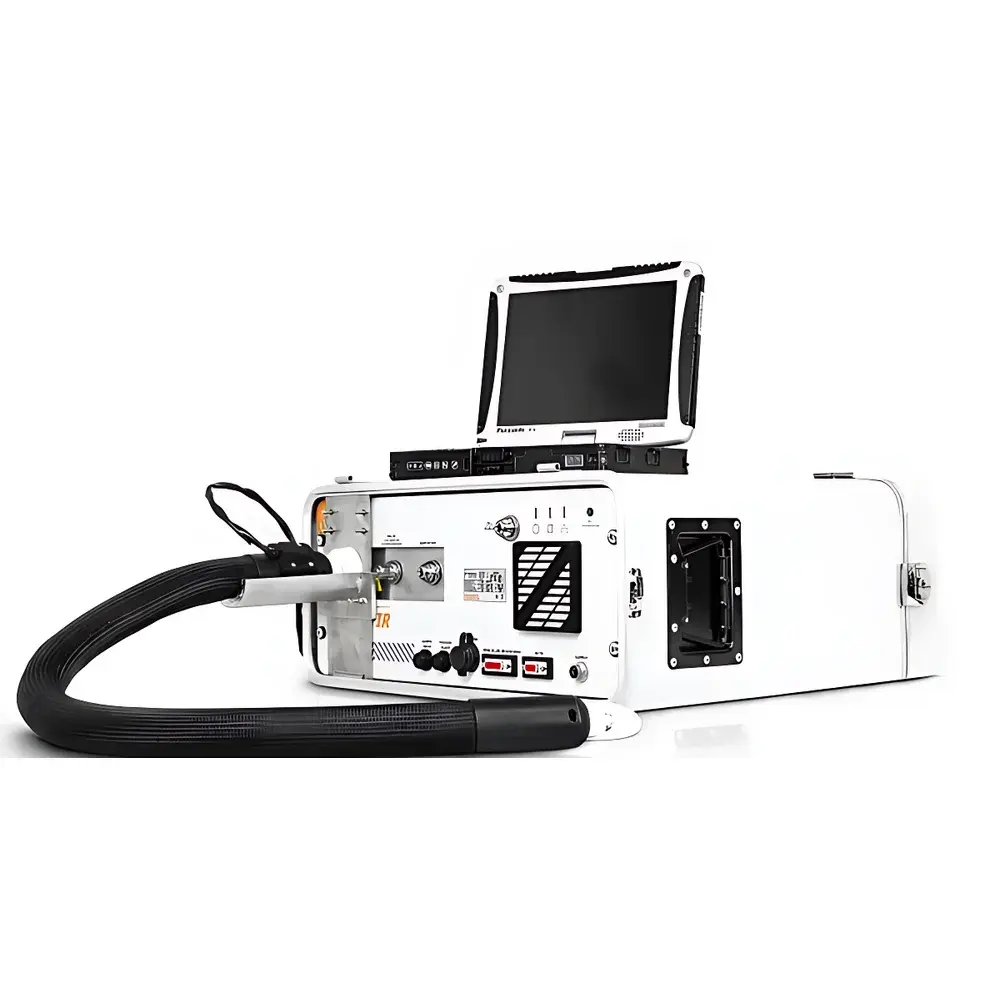
Protea AtmosFIRt Portable Fourier Transform Infrared (FTIR) Stack Emission Analyzer
| Brand | Protea |
|---|---|
| Origin | United Kingdom |
| Model | AtmosFIRt |
| Instrument Principle | Infrared Absorption Spectroscopy |
| Type | Portable Multicomponent Gas Analyzer |
| Response Time (T90) | 120 s (at 1 cm⁻¹ resolution) |
| Repeatability | <1% of full scale |
| Spectral Resolution | Adjustable from 0.5 cm⁻¹ to 8 cm⁻¹ (standard: 1, 2, 4, 8 cm⁻¹) |
| Spectral Range | 485–8500 cm⁻¹ |
| Detection Limits | <0.2 ppm (gas-dependent) |
| Operating Temperature | Up to 180 °C (sample cell) |
| Weight | 21 kg (configurable) |
| Power | 100–250 V AC, 50–60 Hz, 250 W typical |
Overview
The Protea AtmosFIRt is a field-deployable, high-performance Fourier Transform Infrared (FTIR) gas analyzer engineered for regulatory-compliant stack emission monitoring and industrial process gas analysis. Unlike conventional portable IR analyzers constrained by fixed resolution or limited spectral fidelity, the AtmosFIRt integrates a robust, double-pivot Michelson interferometer with permanently aligned optics—ensuring long-term measurement stability, high signal-to-noise ratio, and reproducible quantitative results without recalibration drift. Its core measurement principle relies on broadband mid-infrared absorption spectroscopy: incident light from a stabilized mid-IR source passes through a heated, 4.2-meter optical path sample cell, where molecular vibrational transitions generate unique absorbance signatures across 485–8500 cm⁻¹. These interferograms are digitized at 24-bit resolution by a DTGS detector and transformed via fast Fourier algorithm into calibrated spectra. The system’s variable spectral resolution—from 0.5 cm⁻¹ (for research-grade speciation) to 8 cm⁻¹ (for rapid screening)—is software-selectable, eliminating hardware modifications and enabling adaptive method deployment across diverse regulatory frameworks including EN 15267, EPA Methods 320 and 325, and ISO 12039.
Key Features
- Field-rugged 19-inch rack-mountable chassis housed in an IP-rated transport case, rated for continuous operation at ambient temperatures up to 50 °C and humidity ≤95% RH non-condensing
- Integrated heated sampling system: includes 180 °C heated probe, heated sample line controller, and in-line particulate filter upstream of the optical cell
- Onboard zirconia-based O2 sensor with simultaneous dry/wet basis correction capability
- Automatic N2 purge valve with flow regulation—enabling zero stabilization and optical path cleaning between measurements
- No external sample conditioning unit required: all critical conditioning (filtration, heating, pressure regulation) is embedded
- Dual analog (4–20 mA) and digital (RS232/RS485, Ethernet) I/O interfaces compliant with Modbus RTU/TCP and OPC UA protocols
- Optional mass flow controller for dynamic dilution calibration, span gas introduction, and linear range extension
- Self-diagnostics with real-time health monitoring: laser status, detector saturation, interferometer alignment, purge flow integrity
Sample Compatibility & Compliance
The AtmosFIRt quantifies over 50 infrared-active gases—including CO, NO, NO2, SO2, NH3, HCl, HF, CH4, C2H6, C3H8, C2H4, HCHO, N2O, TOC (as total hydrocarbon proxy), H2O, CO2, and O2—simultaneously and without cross-interference compensation tables. Its chemometric engine employs Partial Least Squares (PLS) regression trained on certified reference standards traceable to NIST and UKAS-accredited gas mixtures. All measurement algorithms adhere to QA/QC requirements under ISO/IEC 17025, EN 14181 (QAL2/QAL3), and US EPA 40 CFR Part 60 Appendix B performance specifications. Data audit trails—including raw interferograms, calibrated spectra, temperature/pressure/O2 metadata, and resolution settings—are automatically timestamped and stored with cryptographic integrity for GLP/GMP and 21 CFR Part 11 compliance when paired with validated PAS-Pro software configurations.
Software & Data Management
PAS-Pro is a CE-marked, Windows-based analytical platform developed exclusively for Protea FTIR systems. It operates in two modes: “Standard Mode” for routine emissions reporting (fully automated zero/span, drift correction, LDL calculation, pass/fail flagging per EN 15267-3), and “Expert Mode” for advanced spectral modeling. Expert Mode provides multivariate calibration tools (PLS, Classical Least Squares, MCR-ALS), spectral residual analysis, interference re-analysis, and library-free quantification—eliminating dependency on pre-loaded spectral databases. All spectra are saved in HDF5 format with embedded acquisition parameters (resolution, scan count, pathlength, cell T/P), ensuring full metrological traceability. Reports export to PDF, CSV, and XML formats compatible with environmental data management systems (EDMS) and regulatory portals such as UK EA’s EMAS, Germany’s IUTA, and US EPA’s CDX.
Applications
- Continuous emissions monitoring (CEM) and periodic stack testing per EN 14181, EPA PS-15, and MCERTS requirements
- Combustion efficiency assessment and pollutant formation studies in waste-to-energy plants, cement kilns, and biomass boilers
- Real-time total organic carbon (TOC) estimation in biogas upgrading and landfill gas treatment facilities
- Process gas verification during catalyst regeneration, flare stack commissioning, and solvent recovery unit optimization
- Odorant and siloxane (e.g., D4, D5) quantification in wastewater treatment off-gas streams
- Ambient air quality surveys at fence-line monitoring locations with detection limits down to sub-ppb levels for key toxics
- Mobile source emissions characterization (e.g., marine engine exhaust, locomotive testing) using trailer-mounted deployments
FAQ
Does the AtmosFIRt require external gas calibration standards for daily operation?
No—built-in automatic zeroing via N2 purge and optional span validation using integrated mass flow-controlled standard gas injection eliminate dependence on manual cylinder handling.
Can the AtmosFIRt operate unattended for extended periods?
Yes—designed for 7×24 field deployment, it supports scheduled auto-calibration, remote diagnostics via Ethernet, and watchdog-triggered fault logging.
Is spectral library development required for new target analytes?
Not for routine use—PAS-Pro’s PLS models are transferable across instruments; however, user-defined calibrations can be built from first principles using reference spectra and known concentration standards.
How is moisture interference managed in wet-stack applications?
The heated optical cell (180 °C) prevents condensation, while H2O spectral contribution is mathematically resolved via multivariate fitting—no physical scrubbers or permeation dryers needed.
What maintenance intervals are recommended?
Interferometer and laser carry lifetime warranties; DTGS detector and ZrO2 sensor have 24-month service life recommendations; particulate filters require replacement every 2–4 weeks depending on dust loading.
Related Products







