
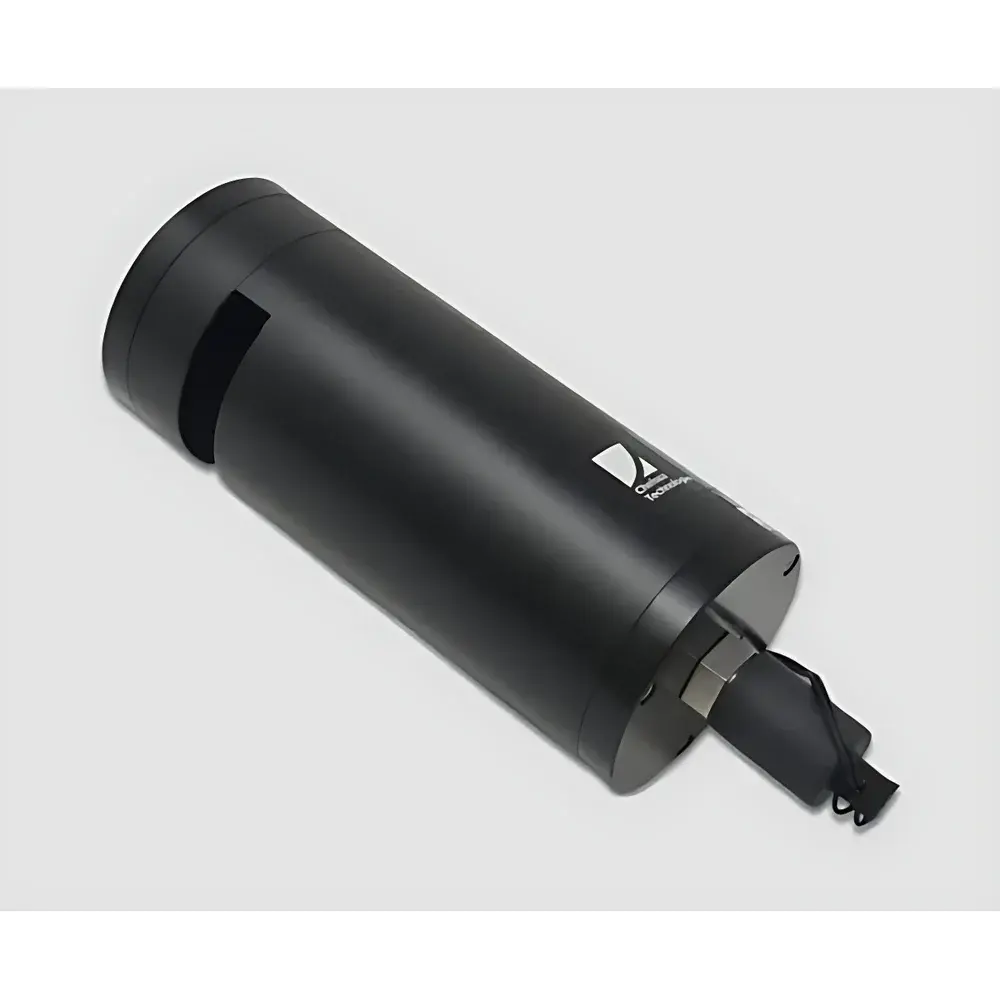
CTG UviLux FUEL-BTEX Fluorometer
| Brand | CTG |
|---|---|
| Origin | United Kingdom |
| Manufacturer Type | Authorized Distributor |
| Origin Category | Imported |
| Model | UviLux FUEL-BTEX |
| Instrument Type | Online |
| Measurement Principle | Fluorescence Spectrophotometry |
| Measurement Range | 3.0–50,000 ppb (as BTEX-equivalent) |
| Detection Limit | 20 ppb (LOD) |
| Accuracy | ±3% of reading |
| Resolution | 3 ppb |
| Measurement Frequency | 10 Hz |
| Sensitivity (QSU) | 0.06 QSU/ppb |
| Calibration Range | 0–600 QSU |
| Max Operating Depth | 1000 m |
| Operating Temperature | −2 °C to 40 °C |
| Storage Temperature | −40 °C to 70 °C |
| Dimensions | Ø70 mm × 149 mm |
| Weight | 800 g (air), 150 g (water) |
| Housing Material | Acetal C |
| Connector | MCBH6MP (wet-mateable) |
| Supply Voltage | 9–36 V DC |
| Power Consumption | <1 W @ 12 V |
Overview
The CTG UviLux FUEL-BTEX Fluorometer is a high-performance, submersible optical sensor engineered for continuous, in-situ quantification of benzene, toluene, ethylbenzene, and xylenes (BTEX) in aqueous environments. Leveraging selective ultraviolet-induced fluorescence (UV-IF) at excitation/emission wavelengths optimized for aromatic hydrocarbon ring structures, the instrument detects native fluorescence signatures emitted by BTEX compounds upon UV irradiation—without chemical reagents or sample extraction. This principle enables real-time, non-invasive monitoring with minimal maintenance, making it particularly suitable for long-term deployment in groundwater wells, riverine systems, industrial effluent streams, and marine near-shore zones where fuel hydrocarbon contamination poses ecological and regulatory risk. The sensor operates within a robust acetal housing rated to 1000 m depth, ensuring mechanical integrity and corrosion resistance in both freshwater and saline matrices under variable pressure and temperature conditions (−2 °C to 40 °C).
Key Features
- True in-situ detection: No sampling, filtration, or reagent addition required—measurements occur directly in the water column.
- High selectivity for BTEX: Optimized UV excitation (265 nm) and narrow-band emission detection (280–320 nm) minimize interference from humic substances and polycyclic aromatic hydrocarbons (PAHs).
- Integrated FDOM compensation: Optional co-deployment with CTG’s FDOM (fluorescent dissolved organic matter) sensor enables real-time correction for natural organic fluorescence background, improving quantitative accuracy in complex environmental waters.
- Low-power, wide-voltage operation: Draws less than 1 W at 12 V DC, compatible with solar-battery telemetry platforms and low-power data loggers.
- Wet-mateable connector (MCBH6MP): Enables rapid field deployment and retrieval without disassembly; supports hot-swapping in underwater housings.
- Turbidity and ambient light rejection: Advanced optical shielding and pulsed LED excitation suppress signal drift caused by suspended solids (>1000 NTU) and solar glare.
Sample Compatibility & Compliance
The UviLux FUEL-BTEX is validated for use in natural waters—including groundwater, surface freshwater, estuarine, and coastal seawater—with salinity up to 35 ppt. It complies with ISO 10523 (water quality — determination of pH), ASTM D7851-14 (standard test method for fluorescence-based hydrocarbon detection in water), and supports GLP/GMP-aligned monitoring workflows when paired with CTG’s Hawk handheld logger or wall-mounted data acquisition units. Data outputs are timestamped and support audit-trail functionality per FDA 21 CFR Part 11 requirements when integrated into validated SCADA or LIMS environments. Sensor calibration traceability is maintained through CTG’s UKAS-accredited reference standards (BTEX in certified aqueous matrix, NIST-traceable).
Software & Data Management
Raw fluorescence intensity (in Quenching-Suppressed Units, QSU) and processed BTEX-equivalent concentration (ppb) are output via RS-232/RS-485 serial interface or analog 4–20 mA (optional). CTG’s proprietary SeaBird-compatible SeaSuite software enables remote configuration, spectral diagnostics, zero/span verification, and multi-sensor synchronization. All data logs include metadata headers (temperature, pressure, battery voltage, sensor status flags) and support CSV, NetCDF, and MODBUS TCP export. Firmware updates are delivered over-the-air via Ethernet or cellular gateway, ensuring long-term compliance with evolving environmental reporting protocols (e.g., EU WFD, US EPA Method 418.1 addenda).
Applications
- Real-time early-warning monitoring at fuel spill sites, UST (underground storage tank) leak detection zones, and refinery outfalls.
- Long-term trend analysis of BTEX plume migration in aquifer systems using fixed-well deployments.
- Regulatory compliance monitoring for drinking water source protection areas and watershed management programs.
- Process water quality assurance in petrochemical facilities, offshore platforms, and marine vessel bilge systems.
- Scientific research on hydrocarbon biodegradation kinetics, where high-frequency (10 Hz) temporal resolution captures transient flux events.
FAQ
Does the UviLux FUEL-BTEX require periodic recalibration in the field?
Calibration stability exceeds 6 months under typical deployment conditions; however, CTG recommends annual verification against certified BTEX standards or quarterly if deployed in high-fouling environments.
Can it distinguish between individual BTEX compounds (e.g., benzene vs. xylene)?
No—it reports total BTEX-equivalent concentration based on a weighted average response calibrated to a mixture of all six isomers; compound-specific speciation requires GC-MS confirmation.
Is the sensor compatible with third-party data loggers beyond CTG hardware?
Yes—its ASCII protocol and Modbus RTU implementation are fully documented and interoperable with Campbell Scientific, Onset HOBO, and YSI EXO platforms.
How does turbidity affect measurement accuracy?
The optical design incorporates dual-beam referencing and pulse-width modulation to maintain ±3% accuracy up to 1000 NTU; beyond that, optional wiper integration is available.
What maintenance is required during extended submersion?
None beyond routine visual inspection; the acetal housing and sapphire window resist biofouling, and anti-fouling coatings can be applied per project specification.
Related Products







