
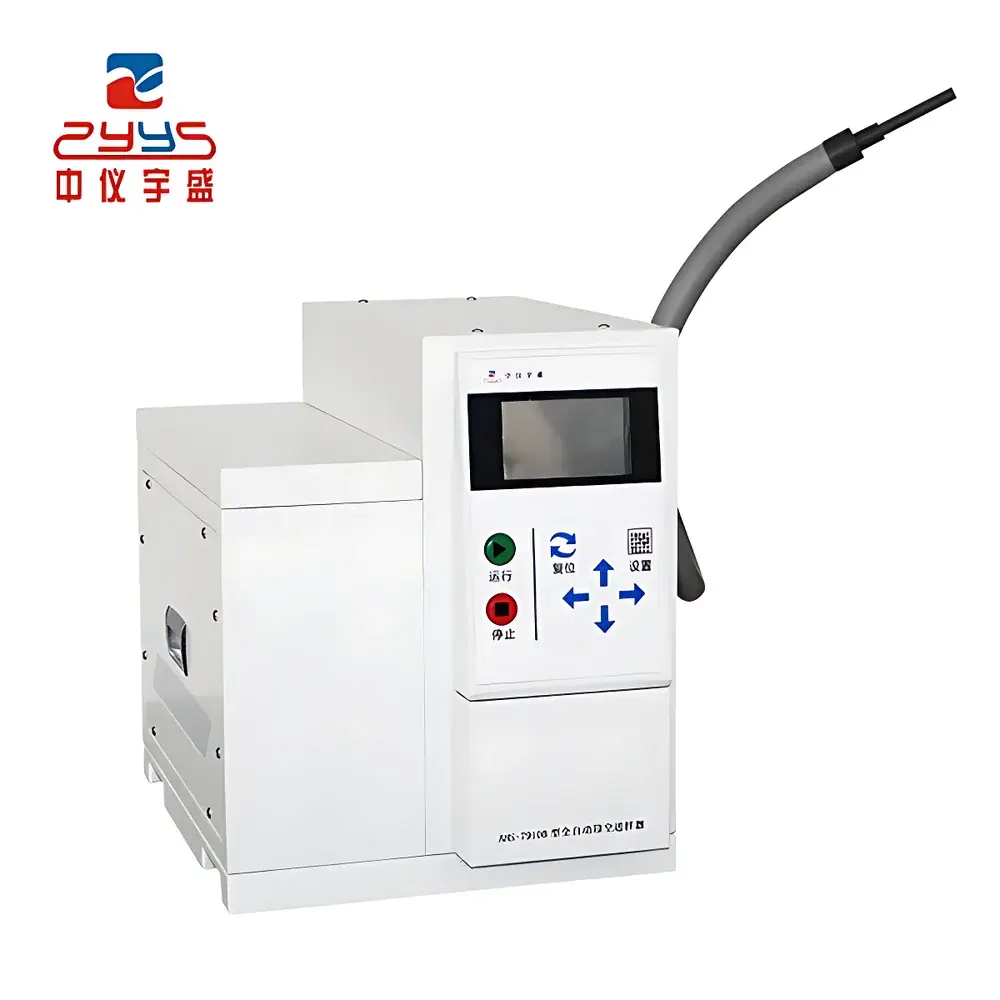
Zhongyi Yusheng AHS-7910B Fully Automated Static Headspace Sampler
| Brand | Zhongyi Yusheng |
|---|---|
| Origin | Beijing, China |
| Manufacturer Type | Original Equipment Manufacturer (OEM) |
| Instrument Type | Static Headspace Sampler |
| Automation Level | Fully Automated |
| Sample Tray Capacity | 10 positions |
| Vial Sizes Supported | 10 mL and 20 mL |
| Oven Temperature Range | Ambient to 240 °C (1 °C increments |
| Valve Temperature Range | Ambient to 220 °C (1 °C increments |
| Temperature Control Accuracy | < ±0.1 °C |
| Loop Volume | 10 mL |
Overview
The Zhongyi Yusheng AHS-7910B Fully Automated Static Headspace Sampler is a precision-engineered sample introduction system designed for quantitative volatile organic compound (VOC) analysis in environmental, clinical, pharmaceutical, and industrial laboratories. It operates on the principle of static headspace equilibrium—where analytes partition between the solid/liquid sample matrix and the gas phase above it at controlled temperature and time. Following equilibration, the vapor-phase sample is transferred via pressurized loop injection into a coupled gas chromatograph (GC) or GC–MS system. This method eliminates matrix interference, reduces column contamination, and enhances reproducibility for trace-level VOC determinations in complex matrices such as soil, water, blood, polymers, and pharmaceutical packaging. The AHS-7910B is optimized for compliance with internationally recognized static headspace methodologies—including ASTM D6866, ISO 15686-3, and USP , and serves as a validated platform for regulatory testing under EPA, HJ, GB/T, and GA/T standards referenced in its application portfolio.
Key Features
- Fully automated batch processing of up to 10 samples without manual intervention—enabling unattended overnight operation and improved laboratory throughput.
- Integrated self-diagnostic startup sequence with real-time fault detection, audible/visual alerts, and automatic carousel positioning and calibration to prevent vial misalignment or mechanical jamming.
- Independent, three-zone thermal control: sample oven, injection valve, and transfer line—each programmable in 1 °C increments with stability better than ±0.1 °C—ensuring consistent vapor-phase composition across all runs.
- Pressure-balanced loop injection mechanism delivering narrow peak widths, high sensitivity, and inter-run RSDs < 1.5% for target VOCs under standardized conditions.
- Programmable multi-step sequence: pressurization, equilibration, loop fill, injection, and post-injection purge—fully time-controlled and repeatable per ICH Q2(R2) validation requirements.
- Dual gas path support: compatible with external carrier gas supply or direct integration with the host GC’s existing pneumatic system—no hardware modification required.
- Modular interface design supporting seamless connection to major GC platforms (Agilent, Thermo Fisher, Shimadzu, PerkinElmer) via standardized septumless or split/splitless inlet adapters.
- Optional fused-silica transfer tubing for enhanced inertness during analysis of reactive compounds (e.g., aldehydes, epoxides, sulfur-containing species).
- User-adjustable loop fill volume and equilibration parameters—facilitating method optimization for both low-concentration environmental screening and high-concentration residual solvent assays.
Sample Compatibility & Compliance
The AHS-7910B supports standard 10 mL and 20 mL crimp-top headspace vials, accommodating liquid, slurry, solid, and semi-solid samples—including aqueous solutions, soils, sediments, biological fluids (e.g., whole blood for ethanol quantification), polymer films, and sterilized medical devices. Its thermal architecture meets the operational constraints defined in HJ 620–2011, HJ 642–2013, HJ 643–2013, HJ 741–2015, and GB/T 5750.8–2023 for VOC profiling in drinking water, wastewater, and potable media. It also satisfies the stringent thermal stability and carryover control criteria outlined in USP for residual solvent testing in active pharmaceutical ingredients (APIs) and excipients, and aligns with ISO 10993-7 for ethylene oxide residue verification in medical device sterilization validation. All temperature zones are traceably calibrated and documented per GLP-compliant instrument qualification protocols.
Software & Data Management
The embedded microprocessor-based controller provides intuitive method programming through an LCD touchscreen interface, supporting up to 20 user-defined methods with independent settings for oven ramp rates, valve timing, loop dwell, and purge cycles. Real-time status visualization includes animated workflow diagrams, elapsed run timers, and zone-specific temperature readouts. Method files are exportable via USB for audit trail retention. For enterprise integration, the system offers RS-232 and TTL-level trigger I/O ports—enabling bidirectional synchronization with third-party GC data systems (e.g., OpenLab CDS, Chromeleon, Empower) and LIMS environments. Audit-trail functionality records operator ID, method version, start/stop timestamps, and parameter modifications—supporting 21 CFR Part 11 compliance when deployed with electronic signature-enabled chromatography software.
Applications
- Environmental monitoring: quantification of BTEX, chlorinated solvents, ketones, ethers, and halocarbons in water, soil, and sediment per HJ 620, HJ 642, HJ 736, and HJ 810.
- Clinical toxicology: forensic ethanol and volatile substance screening in blood per GA/T 842–2019.
- Pharmaceutical quality control: residual solvent analysis (Class 1–3) in drug substances and products per USP and ICH Q3C(R8).
- Packaging safety: VOC migration testing from food-contact materials per SN/T 4148–2015.
- Medical device validation: ethylene oxide (EO) and chloroethanol residue assessment per GB/T 16886.7–2015 and ISO 10993-7.
- Industrial hygiene: workplace air contaminant screening using passive or active sampling followed by headspace reconstitution.
FAQ
Is the AHS-7910B compatible with GC–MS systems?
Yes—it supports direct coupling to all mainstream GC–MS platforms via standard transfer line interfaces and pressure-triggered injection synchronization.
Can the instrument perform dynamic headspace or purge-and-trap?
While primarily configured for static headspace, optional firmware and hardware modules enable limited dynamic headspace and purge-and-trap functionality per HJ 680–2013 methodology.
What maintenance is required for long-term reliability?
Routine tasks include quarterly valve seal inspection, annual oven sensor calibration, and periodic transfer line cleaning—documented in the included IQ/OQ/PQ protocol templates.
Does the system support 21 CFR Part 11 compliance?
The hardware supports electronic signatures and audit trails when integrated with validated chromatography data systems meeting Part 11 requirements.
How is carryover minimized between high-concentration samples?
Automated back-flush of the valve and transfer line with carrier gas occurs after each injection, and optional high-temperature bake-out cycles (up to 240 °C) further reduce memory effects.





