
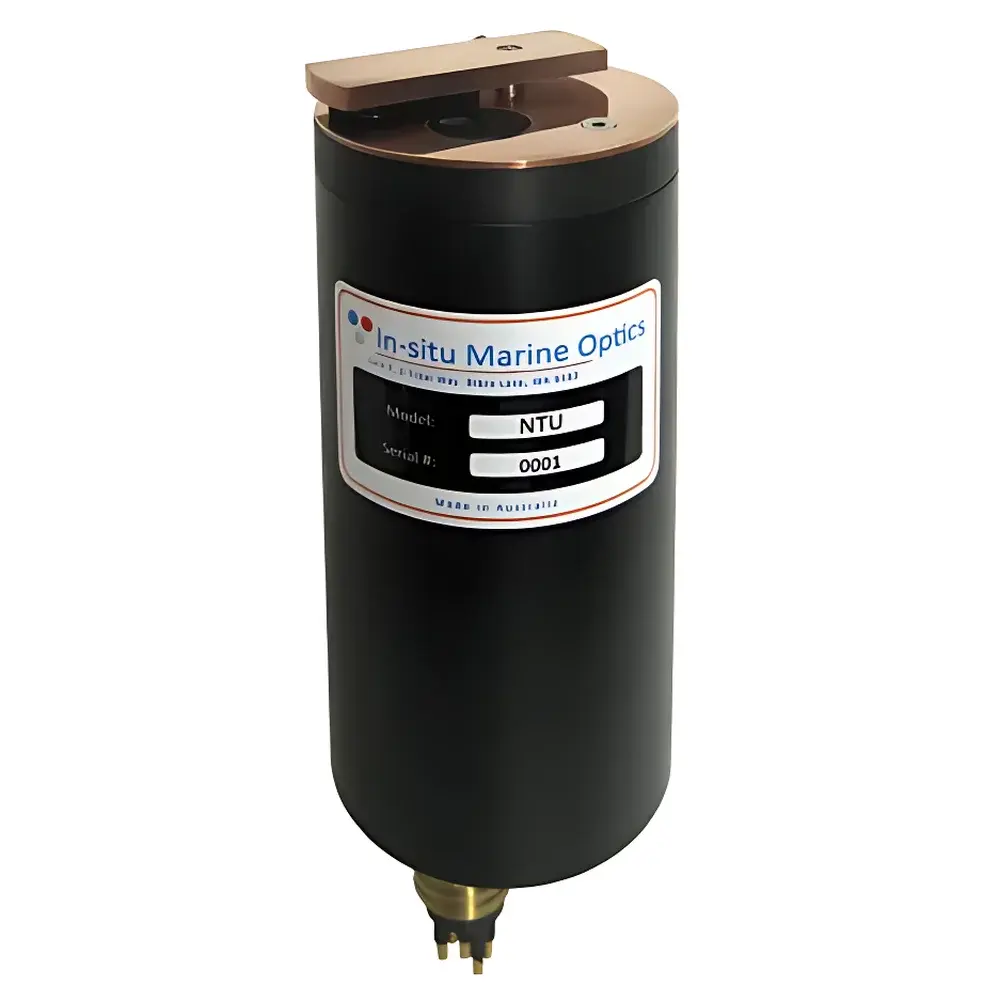
In-situ Marine IMO-NTU Submersible Turbidimeter
| Brand | In-situ Marine |
|---|---|
| Origin | Australia |
| Model | IMO-NTU |
| Product Type | Portable Submersible Turbidimeter |
| Measurement Range | 0–400 NTU (factory-customizable) |
| Resolution | 0.05 NTU |
| Operating Temperature | 0–40 °C |
| Accuracy | ±0.05 NTU |
| Scattering Angle | 120° |
| Detector | Silicon Photodiode |
| Light Source | 890 nm LED |
| Calibration Standard | Formazin (NTU) |
| ADC Resolution | 16-bit |
| Max Sampling Rate | 10 Hz |
| Ambient Light Rejection | Yes |
| Communication Protocol | RS-232 @ 19200 bps |
| NMEA-Style Output | Yes |
| Supply Voltage | 7–24 VDC |
| Current Draw | 15 mA (sampling), 150 mA (cleaning) |
| Analog Output | 0–5 VDC |
| Connector | MCBH6M |
| Length | 148 mm (plus 36 mm connector protrusion) |
| Diameter | 67 mm |
| Weight (air) | 650 g |
| Weight (water) | 150 g |
| Housing Material | Acetal |
| Brush & Panel Material | Copper |
| Maximum Depth Rating | 300 m |
Overview
The In-situ Marine IMO-NTU Submersible Turbidimeter is an engineered optical sensor designed for continuous, in-situ measurement of turbidity in aquatic environments—ranging from freshwater rivers and lakes to coastal marine systems and wastewater effluent streams. It operates on the principle of nephelometric turbidity measurement, detecting forward-scattered light at a fixed angle of 120° relative to the incident 890 nm LED beam. This wavelength minimizes interference from natural chromophores (e.g., dissolved organic matter) while maximizing sensitivity to suspended particulate matter—particularly silt, clay, phytoplankton, and biofouling debris. Unlike benchtop or grab-sample turbidimeters, the IMO-NTU is rated for permanent submersion up to 300 meters and integrates directly into oceanographic moorings, vertical profiling platforms (e.g., CTD rosettes), and autonomous water quality monitoring networks. Its design adheres to ISO 7027:2016 principles for instrumental turbidity measurement and is calibrated traceably to formazin standard suspensions, ensuring compliance with regulatory reporting frameworks used by environmental agencies and drinking water utilities.
Key Features
- Submersible architecture with acetal housing and copper brushing elements—resistant to biofouling, corrosion, and UV-induced yellowing
- Integrated self-cleaning mechanism using electro-mechanical brush actuation, programmable to reduce maintenance frequency in high-sediment environments
- Onboard real-time clock (RTC), digital compass, and tilt sensor—enabling spatially referenced, time-stamped data logging without external synchronization
- Embedded calibration coefficients stored in non-volatile memory—preserving instrument-specific response curves across firmware updates and field deployments
- NMEA-0183-compatible serial output (RS-232, 19200 bps) and analog 0–5 VDC signal—ensuring seamless integration with legacy oceanographic data loggers (e.g., Sea-Bird Electronics, RBR, Satlantic)
- High dynamic range 16-bit analog-to-digital conversion and ambient light rejection circuitry—maintaining measurement integrity under variable photic conditions including surface glare and diurnal cycles
Sample Compatibility & Compliance
The IMO-NTU is validated for use in natural waters with varying ionic strength, temperature gradients, and particulate composition—including estuarine brackish water (up to 35 ppt salinity), treated wastewater effluents, and low-conductivity alpine runoff. Its 120° scattering geometry conforms to the optical configuration specified in ASTM D7315–22 for field-deployable turbidimeters. While not certified to USP or EPA Method 180.1 for potable water compliance testing, it meets the performance criteria required for long-term environmental trend analysis under ISO 10703 and GLP-aligned monitoring programs. The sensor’s mechanical interface complies with standard oceanographic pinout configurations (e.g., WHOI-style 6-pin MCBH6M), facilitating plug-and-play installation on profiling winches and autonomous underwater vehicles (AUVs).
Software & Data Management
The IMO-NTU does not require proprietary software for basic operation; its ASCII-based NMEA-style output is natively parsed by most scientific data acquisition systems (e.g., MATLAB, Python pandas, LabVIEW, and Sea-Bird SBE Data Processing). Configuration—including sampling interval (100 ms–60 s), cleaning trigger logic, and output format—is performed via simple AT-command syntax over RS-232. Firmware updates are delivered as signed binary packages compatible with common terminal emulators (e.g., Tera Term, CoolTerm). All timestamps are synchronized to UTC via the internal RTC, supporting audit-ready data provenance in GMP- or ISO 17025-regulated laboratories when paired with timestamp-verified host loggers. No cloud dependency or vendor-hosted platform is required—data ownership remains fully with the user.
Applications
- Real-time sediment transport monitoring during dredging operations and flood events
- Early detection of algal bloom initiation and resuspension dynamics in stratified reservoirs
- Effluent quality assurance at municipal wastewater treatment plants (WWTPs) with discharge consent limits expressed in NTU
- Calibration and validation of satellite-derived water clarity products (e.g., Sentinel-3 OLCI, Landsat 9 OLI-2)
- Long-term trend analysis in GLP-compliant ecological monitoring programs mandated by EU WFD (Water Framework Directive) or US Clean Water Act Section 303(d)
- Integration into smart irrigation control systems for reclaimed water reuse in agriculture
FAQ
Is the IMO-NTU suitable for drinking water applications?
It is not certified for regulatory compliance testing per USP , EPA 180.1, or ISO 7027 Annex A for potable water. However, it is widely deployed for source water intake monitoring and distribution system integrity assessment where high-resolution temporal trends—not absolute certification-grade accuracy—are prioritized.
Can the measurement range be extended beyond 400 NTU?
Yes—In-situ Marine offers factory-configured variants with extended ranges (e.g., 0–1000 NTU) using optimized optical gain and detector saturation thresholds. Custom calibration certificates are provided with each unit.
How often does the self-cleaning system activate?
Cleaning frequency is fully user-definable via serial command—common configurations include time-based (e.g., every 15 minutes), event-triggered (e.g., after 5 consecutive readings >100 NTU), or manual activation during maintenance dives.
Does the sensor support Modbus or SDI-12 protocols?
No—only RS-232 (NMEA ASCII) and analog 0–5 VDC outputs are supported. Modbus or SDI-12 interfaces would require external protocol converters compliant with IEC 61158 or IEEE 1451.2.
What is the recommended recalibration interval?
For critical environmental monitoring, annual recalibration against formazin standards is recommended. Field verification using stable secondary standards (e.g., AMCO-AE particles) can be performed quarterly to assess drift before full recalibration.




