
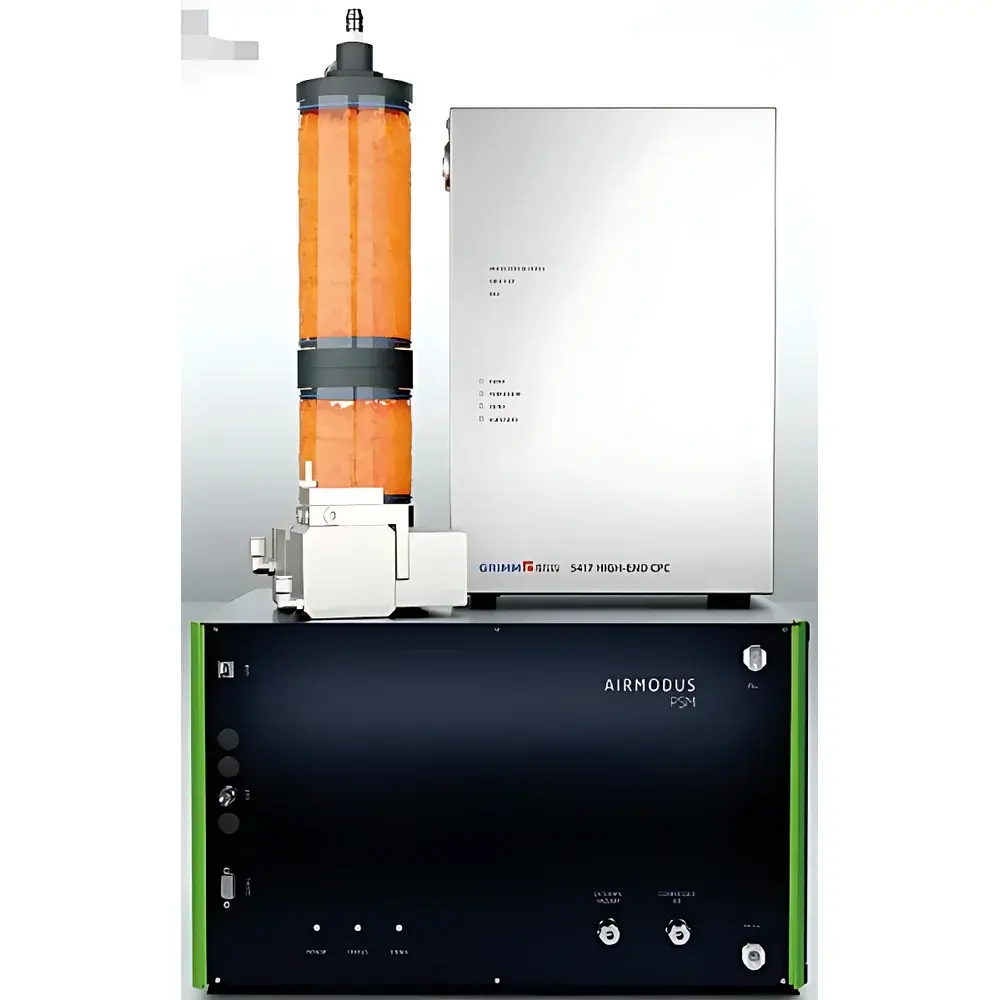
GRIMM PSMPS 1.1 nm Scanning Mobility Particle Sizer Spectrometer
| Brand | GRIMM |
|---|---|
| Origin | Germany |
| Model | PSMPS |
| Measurement Principle | Scanning Electrical Mobility Spectrometry (SEMS) |
| Sample Flow Rate | 2.5 L/min |
| Size Range | 1.1–155 nm |
| Counting Range | 10⁷ particles/cm³ |
| Size Channels | 45–255 channels (step mode) |
| DMA Types | S-DMA (1.1–55 nm), M-DMA (2.8–155 nm) |
| PSM Working Fluid | Diethylene Glycol |
| PSM d₅₀ Tunable | 1.3–3.5 nm |
| CPC Working Fluid | Isopropanol |
| CPC d₅₀ | 4 nm |
| CPC Flow Options | 0.3 or 0.6 L/min (aerosol), 3 or 10 L/min (sheath) |
| Operating Humidity | 0–95% RH (non-condensing) |
| Pressure Range | 600–1050 mbar |
| Power | 100–240 VAC, 50/60 Hz, max. 280 W (system) |
| Dimensions | DMA/PSM unit: 29 × 45 × 46.5 cm |
| CPC unit | 40 × 25 × 29 cm |
| Weight | DMA/PSM unit: 17 kg |
| CPC unit | 12.4 kg |
Overview
The GRIMM PSMPS 1.1 nm Scanning Mobility Particle Sizer Spectrometer is a high-sensitivity, research-grade nanoparticle sizing system engineered for quantitative analysis of ultrafine aerosols in the critical 1.1–155 nm mobility diameter range. It integrates three core components—Scanning Differential Mobility Analyzer (S-DMA or M-DMA), Particle Size Magnifier (PSM), and Condensation Particle Counter (CPC)—into a synchronized SEMS architecture. Unlike conventional mobility spectrometers limited by diffusion losses below 3 nm, the PSMPS employs an optimized DMA design with minimized residence time and enhanced laminar flow control to significantly reduce particle loss during classification—particularly for sub-2 nm ions and neutralized clusters. The PSM serves as a pre-CPC growth stage using diethylene glycol vapor to achieve controlled, homogeneous condensation on nanoscale nuclei, enabling reliable detection of particles as small as 1.1 nm. Subsequent amplification in the isopropanol-based CPC ensures robust optical counting across the full dynamic concentration range. This configuration supports fundamental atmospheric science applications including new particle formation (NPF) studies, nucleation kinetics, and early-stage growth rate quantification under ambient or controlled laboratory conditions.
Key Features
- Sub-2 nm detection capability: validated d₅₀ = 1.1 nm mobility diameter with high transmission efficiency for 1–3 nm particles
- Modular DMA selection: interchangeable S-DMA (1.1–55 nm) and M-DMA (2.8–155 nm) for application-specific resolution and dynamic range trade-offs
- Tunable PSM cutoff: d₅₀ adjustable from 1.3 to 3.5 nm via precise temperature and supersaturation control
- Multi-mode operation: scanning (64 logarithmically spaced channels), stepping (45–255 user-defined channels), and single-particle counting modes
- Integrated environmental monitoring: real-time input support for external temperature, relative humidity (0–95% RH, non-condensing), and barometric pressure (600–1050 mbar)
- Compact benchtop footprint: coordinated mechanical layout minimizing inter-unit transport losses and simplifying calibration traceability
- Flexible neutralization options: selectable radioactive (²¹⁰Po), soft X-ray, or corona discharge sources compatible with ISO 8503-1 and ASTM D6243 protocols
Sample Compatibility & Compliance
The PSMPS is designed for direct sampling of ambient air, chamber-generated aerosols, combustion effluents, and cleanroom exhaust streams without dilution or pre-conditioning—provided sample dew point remains below operating RH limits. Its electrical mobility-based classification conforms to ISO 15900:2020 (Determination of particle size distribution by electrical mobility analysis) and supports traceable calibration against NIST-traceable polystyrene latex (PSL) standards and certified reference nanoparticles. Data acquisition complies with GLP and GMP-aligned audit trail requirements when paired with GRIMM’s optional secure logging software. The system meets CE marking directives for electromagnetic compatibility (2014/30/EU) and low-voltage safety (2014/35/EU), and its operational parameters align with EPA Method IO-3.3 (for ultrafine particle characterization) and EU Air Quality Directive 2008/50/EC Annex XII technical guidance.
Software & Data Management
GRIMM’s proprietary PSMPS Control Software provides real-time visualization of differential mobility spectra, time-resolved size distribution evolution, and integrated number concentration metrics (e.g., total CN, N₁₋₂, N₂₋₃, N₃₋₁₀). Raw data are stored in HDF5 format with embedded metadata (DMA voltage ramp profile, PSM saturation ratio, CPC gain settings, environmental sensor timestamps). Export options include ASCII-compatible CSV for third-party analysis (e.g., MATLAB, Python Pandas, IGOR Pro) and direct integration with cloud-based environmental monitoring platforms via MQTT or RESTful API. All software modules support 21 CFR Part 11-compliant user access control, electronic signatures, and immutable audit logs for regulated environments.
Applications
- Atmospheric nucleation research: quantifying formation rates (J), growth rates (GR), and survival probabilities of sub-3 nm clusters in field campaigns and smog chambers
- Engine and industrial emission characterization: resolving primary nanoparticle emissions from diesel, aviation, and semiconductor fabrication processes
- Pharmaceutical aerosol development: evaluating dry powder inhaler (DPI) and nebulized drug formulations for respirable fraction and agglomeration dynamics
- Nanomaterial safety assessment: monitoring workplace exposure during synthesis, handling, and functionalization of carbon nanotubes, metal oxides, and quantum dots
- Filter and scrubber efficiency testing: measuring penetration curves for HEPA, ULPA, and electrostatic precipitators down to the most penetrating particle size (MPPS) region
FAQ
What is the smallest detectable particle size, and how is it verified?
The PSMPS achieves a verified d₅₀ detection limit of 1.1 nm using the S-DMA configuration, confirmed through tandem calibration with monodisperse tungsten oxide clusters and comparison to SMPS+ systems referenced to NIST SRM 1963.
Can the system operate unattended for long-term field measurements?
Yes—the PSMPS supports fully automated 7-day+ deployment with scheduled self-diagnostic routines, remote firmware updates, and watchdog-triggered restarts; external power conditioning and climate-controlled enclosures are recommended for extended outdoor use.
Is the PSMPS compliant with regulatory reporting standards for occupational exposure?
While not a certified personal sampler, its size-resolved output supports derivation of mass-based metrics (e.g., EC, BC) per ISO/TS 11037 and can be configured to report in alignment with ACGIH TLV® and OSHA PEL frameworks when coupled with validated conversion models.
How does the PSM differ from traditional butanol-based CPCs in ultrafine detection?
The PSM uses diethylene glycol at lower saturation ratios (S ≈ 1.5–3.0) to induce gentler, more uniform condensation on sub-2 nm nuclei—reducing stochastic activation variability and improving reproducibility compared to butanol or ethanol CPCs operating near their kinetic nucleation threshold.
What maintenance intervals are recommended for routine operation?
PSM working fluid replacement every 72 hours under continuous operation; CPC isopropanol refill every 48 hours; DMA electrode cleaning and flow verification quarterly; annual factory recalibration recommended for metrological traceability.
Related Products







