
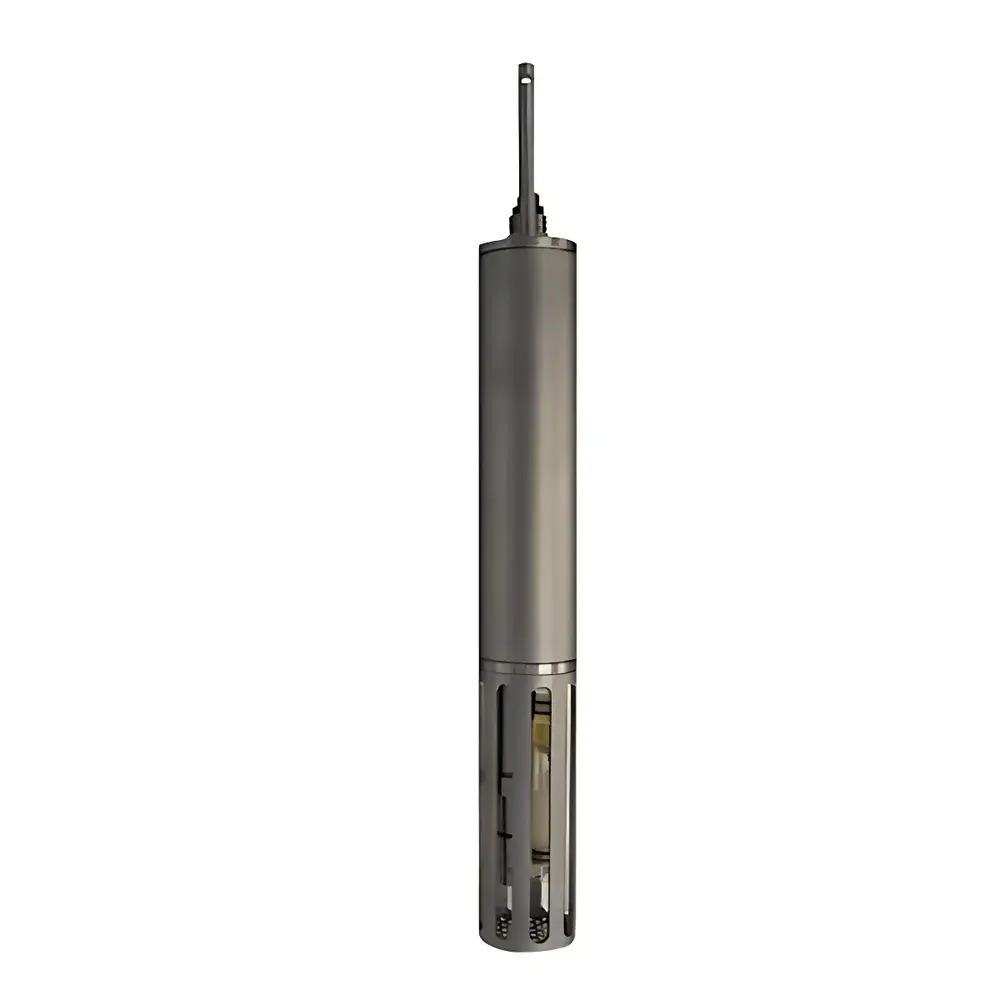
AMT Underwater H₂S / Sulfide Profiling Sensor System
| Brand | AMT (Germany) |
|---|---|
| Origin | Germany |
| Manufacturer Type | Authorized Distributor |
| Origin Category | Imported |
| Model | AMT-H2S/Sulfide |
| Price | Upon Request |
Overview
The AMT Underwater H₂S / Sulfide Profiling Sensor System is a purpose-built, in-situ electrochemical measurement platform engineered for high-fidelity, real-time profiling of dissolved sulfide species—including hydrogen sulfide (H₂S), hydrosulfide ion (HS⁻), and sulfide ion (S²⁻)—in aquatic environments. Operating on the principle of amperometric (polarographic) detection, the system employs a microelectrode-based sensor that selectively reduces H₂S at a controlled cathode potential, generating a current proportional to analyte concentration. This electrochemical architecture ensures minimal interference from co-existing redox-active species and eliminates reliance on chemical reagents or sample extraction—critical for preserving transient sulfide speciation in oxic/anoxic transition zones. Designed for deployment up to 100 m water depth, the instrument delivers true in-situ measurements without artifacts introduced by sample degassing, oxidation during retrieval, or storage-induced equilibration. Its compact titanium housing (Ø48 mm × 440 mm), pressure-rated to 10 bar, supports long-term mooring, ROV-mounted profiling, or CTD-integrated deployments in marine, lacustrine, estuarine, and wastewater treatment contexts.
Key Features
- Integrated multi-parameter sensing: Polarographic H₂S microsensor (detection range: 10 µg/L–3 mg/L; accuracy: ±2% of reading), Pt100 temperature sensor (–2 °C to 36 °C; ±0.05 °C), single-electrode pH sensor (0–14 pH; ±0.02 pH), and piezoresistive pressure/depth sensor (0–10 bar; ±0.1% FS)
- High-resolution temporal response: H₂S sensor response time <1 s; pressure sensor response time 150 ms; enabling dynamic profiling across sharp chemoclines
- Dual operational modes: Real-time telemetry (RS232 serial output via multi-conductor polyurethane cable) or autonomous logging (8 MB internal memory, storing up to 350,000 data sets)
- Robust power architecture: Supports external DC input (7–30 VDC), internal lithium battery (3.6 V, 20–35 mA draw), or alkaline battery packs (1.5 V, 50–90 mA); optimized for low-power field campaigns
- Marine-grade construction: Grade 5 titanium (Ti-6Al-4V) pressure housing with SubConn MCBH4M (online) or MCBH5M (standalone) wet-mateable connectors; corrosion-resistant and non-magnetic
- Embedded signal conditioning: Microprocessor-controlled 4-channel, 16-bit analog-to-digital conversion with hardware-level noise filtering and auto-zero compensation
Sample Compatibility & Compliance
The system is validated for direct immersion in natural waters (seawater, freshwater, sediment porewater), industrial effluents, anaerobic digester liquors, and geothermal discharge streams. It complies with ASTM D4129–18 (Standard Test Method for Total Sulfide in Water) for field-deployable sulfide quantification and aligns with ISO 10523:2022 (Water quality — Determination of pH) and ISO 7888:2019 (Water quality — Determination of electrical conductivity) for auxiliary parameter traceability. While not a certified reference method per se, its polarographic H₂S sensor meets performance benchmarks required under EU Water Framework Directive (WFD) monitoring programs for redox-sensitive ecosystems. Data integrity adheres to GLP principles: timestamped, sensor-specific calibration metadata embedded in each record; no post-acquisition interpolation applied during logging.
Software & Data Management
Data acquisition and visualization are managed via Windows-based AMT Profiler Suite, supporting real-time plotting, synchronous multi-sensor overlay, depth-synchronized profile generation, and export to CSV, MATLAB (.mat), or netCDF formats. The software implements configurable alarm thresholds, automatic gain switching across H₂S concentration ranges, and on-the-fly correction for temperature- and salinity-dependent diffusion coefficients. All logged datasets include embedded sensor health diagnostics (e.g., cathode polarization stability, membrane integrity flags). For regulatory reporting, the suite generates audit-ready PDF reports compliant with 21 CFR Part 11 requirements when used with validated electronic signatures and user-access controls.
Applications
- Marine biogeochemistry: Mapping sulfide gradients at hydrothermal vents, cold seeps, and oxygen minimum zones (OMZs)
- Lake and reservoir management: Monitoring seasonal hypolimnetic sulfide accumulation and forecasting euxinic events
- Wastewater infrastructure: In-line monitoring of sulfide buildup in sewers, digesters, and gravity mains to inform corrosion mitigation strategies
- Environmental impact assessment: Pre- and post-dredging sulfide flux quantification in contaminated sediments
- Vulcanology and geochemistry: Tracking subsurface fluid emissions in volcanic lakes and fumarolic zones
- Academic research: Mechanistic studies of sulfate-reducing bacteria (SRB) activity kinetics under controlled redox gradients
FAQ
What is the maximum operational depth rating?
The system is rated to 100 m water depth (10 bar absolute pressure) with full sensor functionality and housing integrity.
Can the H₂S sensor be calibrated in situ?
Yes—field calibration is supported using certified sulfide standard solutions injected via optional permeation tube modules or discrete NIST-traceable grab samples analyzed alongside concurrent sensor readings.
Is the system compatible with third-party CTD or AUV platforms?
Yes—RS232 output and standardized SubConn interfaces enable integration with Sea-Bird Electronics, Teledyne RDI, or Blue Robotics vehicle control systems using custom protocol mapping.
How is sensor fouling mitigated during long-term deployments?
The H₂S microsensor incorporates a gas-permeable silicone membrane with integrated anti-biofouling coating; optional mechanical wipers or low-voltage electrochemical cleaning pulses can be triggered via software command.
Does the system meet explosion-proof certification for hazardous area use?
While the titanium housing is intrinsically safe for underwater use, it does not carry ATEX or IECEx certification for above-water explosive atmospheres; operation is restricted to submerged or ventilated non-classified zones.
Related Products







