
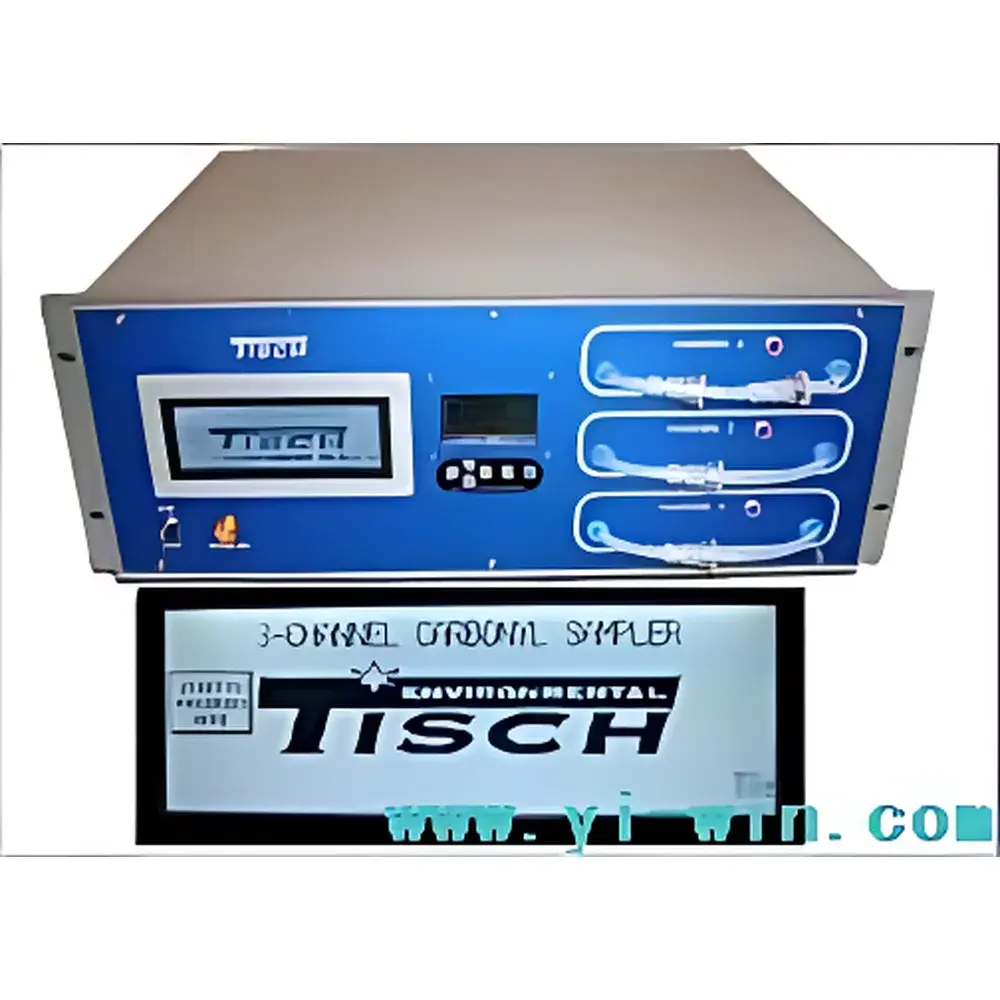
Tisch TE-323 Canister-Based VOC Sampling System
| Brand | Tisch |
|---|---|
| Origin | USA |
| Manufacturer Status | Authorized Distributor |
| Import Status | Imported |
| Model | TE-323 |
| Typical Configuration | Multi-Channel Integrated Air Sampler |
| Power Options | 240 V AC, 50/60 Hz |
| Flow Rate Range | 1–300 mL/min |
| Sample Container | 6-L Silonite®-coated Electropolished Stainless Steel Canister |
| Fill Time | ≤40 min to 10 psi |
| Channel Capacity | Standard 3 channels (expandable to 8) |
| Display | Backlit LCD (4 × 20 characters) |
| Control System | Siemens PLC-based Embedded Controller |
| Condensate Trap | Integrated |
| Pressure Monitoring | Individual Stainless Steel Vacuum Gauge per Channel |
| Flow Control | Three-Way Solenoid Valves with Precision Mass Flow Regulation |
| Data Logging | Timestamped Event Logs with Channel-Specific Start/Stop/Alarm Records |
| Rack Mounting | 19-inch EIA Compliant |
| Footprint | Desktop or Rack-Mountable with Rubber Isolation Feet |
| Compliance | EPA Method TO-14A and TO-15 Certified Sampling Platform |
Overview
The Tisch TE-323 Canister-Based VOC Sampling System is an engineered solution for regulatory-grade collection of volatile organic compounds (VOCs) from ambient, indoor, or fugitive emission sources. Designed in strict alignment with U.S. Environmental Protection Agency (EPA) Methods TO-14A and TO-15, the system enables quantitative, inert-phase sampling into electropolished, Silonite®-coated 6-liter stainless steel canisters—minimizing surface adsorption, catalytic degradation, and memory effects. Its core architecture employs a positive-displacement vacuum sampling principle: each channel independently evacuates and pressurizes the canister to a defined target (e.g., 10 psia), with real-time flow regulation ensuring stoichiometric sample integrity. Unlike passive diffusion or sorbent-tube methods, canister-based sampling preserves the full VOC speciation profile—including reactive, polar, and low-boiling compounds (e.g., formaldehyde, acetaldehyde, vinyl chloride)—for subsequent GC-MS or GC-FID analysis under laboratory conditions compliant with ASTM D5466 and ISO 16017-1.
Key Features
- Triple-channel independent sampling architecture with fully isolated pumps, flow paths, and pressure monitoring—eliminating cross-contamination risk between concurrent samples.
- Embedded Siemens PLC controller with programmable logic for time-weighted, event-triggered, or demand-initiated sampling sequences; supports custom duty cycles (e.g., 15-min on/45-min off over 7-day intervals).
- Integrated condensate trap upstream of each canister inlet, preventing water vapor ingress that could compromise analytical recovery or cause valve icing during low-temperature transport.
- Backlit 4×20-character LCD interface with intuitive menu navigation for setting sample duration, start delay, purge cycles, and alarm thresholds (e.g., low vacuum, flow deviation >±5% of setpoint).
- Redundant power architecture: compatible with 240 V AC mains, 12 V DC battery banks, photovoltaic arrays (via TE-232-1 mounting bracket), and uninterruptible power supply (UPS) systems—ensuring continuous operation in remote or grid-unstable locations.
- Real-time volumetric calculation using integrated thermal mass flow sensors calibrated per NIST-traceable standards; logged volume data includes temperature, pressure, and elapsed time for EPA-compliant reporting (40 CFR Part 51 Appendix P).
Sample Compatibility & Compliance
The TE-323 accommodates standard EPA-compliant 6-L canisters with electropolished interiors and Silonite® passivation—validated for stability of C2–C12 hydrocarbons, halogenated VOCs, oxygenates, and sulfur-containing compounds for up to 30 days at 25°C when stored inverted and chilled post-collection. Each channel features a dedicated stainless steel vacuum gauge with ±0.1 psi resolution, enabling verification of pre-sampling leak integrity per TO-15 Section 7.2. The system meets hardware requirements for GLP-compliant field operations, including audit-trail-capable event logging, password-protected configuration access, and timestamped metadata export (CSV/ASCII). It supports integration into EPA-approved Quality Assurance Project Plans (QAPPs) and satisfies documentation requirements for ISO/IEC 17025-accredited laboratories conducting ambient air monitoring under 40 CFR Part 58.
Software & Data Management
While the TE-323 operates autonomously via its embedded PLC, it exports ASCII-formatted log files via RS-232 or USB-C interface for ingestion into laboratory information management systems (LIMS) or custom QA/QC dashboards. Logged parameters include: channel ID, start/stop timestamps, final canister pressure, integrated flow volume, ambient temperature, pump runtime, and diagnostic flags (e.g., “valve timeout”, “flow error”). All data fields are immutable post-collection and include CRC-16 checksums for chain-of-custody validation. The system complies with FDA 21 CFR Part 11 requirements when paired with validated third-party LIMS software supporting electronic signatures and audit trails.
Applications
- Ambient air monitoring networks requiring multi-point, synchronized VOC profiling across urban, industrial, or background sites.
- Fenceline monitoring for refineries, chemical plants, and landfills under EPA’s Risk Management Program (RMP) and Community Right-to-Know Act (EPCRA) reporting mandates.
- Indoor air quality assessments in schools, hospitals, and office buildings—particularly for odor investigation and source identification studies.
- Emergency response deployments following chemical releases, where rapid, reproducible canister filling (<40 min to 10 psi) ensures timely lab submission.
- Method validation and inter-laboratory comparison studies requiring traceable, high-fidelity VOC reference samples.
FAQ
Does the TE-323 support automated calibration verification?
Yes—each channel can execute a zero-air purge cycle prior to sampling, and optional integrated permeation tube modules (e.g., for benzene or perchloroethylene) enable on-site span checks per TO-15 Section 8.3.
Can sample timing be synchronized across multiple TE-323 units?
Yes—via optional GPS-synchronized NTP server connectivity or hardwired pulse triggering, enabling coordinated multi-site sampling for atmospheric dispersion modeling.
What maintenance intervals are recommended for long-term unattended operation?
Pump diaphragms require replacement every 6,000 hours; solenoid valves and flow sensors should be verified annually using NIST-traceable test gases and certified flow calibrators.
Is the TE-323 compatible with non-6-L canisters (e.g., 1-L or 3-L)?
No—the system’s vacuum control algorithm and fill-time logic are optimized exclusively for 6-L canisters meeting EPA TO-14A/TO-15 dimensional and material specifications.
How is data integrity preserved during power loss?
Non-volatile FRAM memory retains all configuration settings and the last 1,000 event logs; internal supercapacitors sustain the real-time clock and PLC state for ≥72 hours during AC/DC outage.
Related Products







