
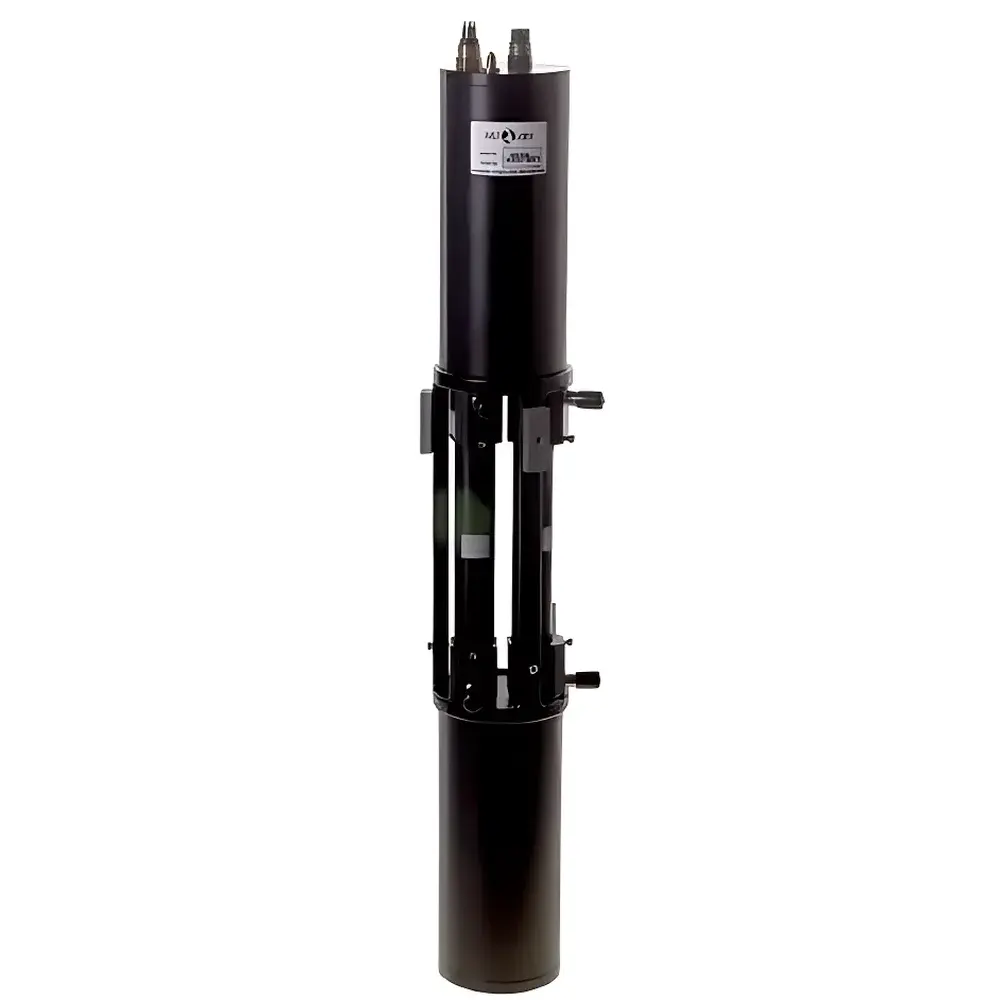
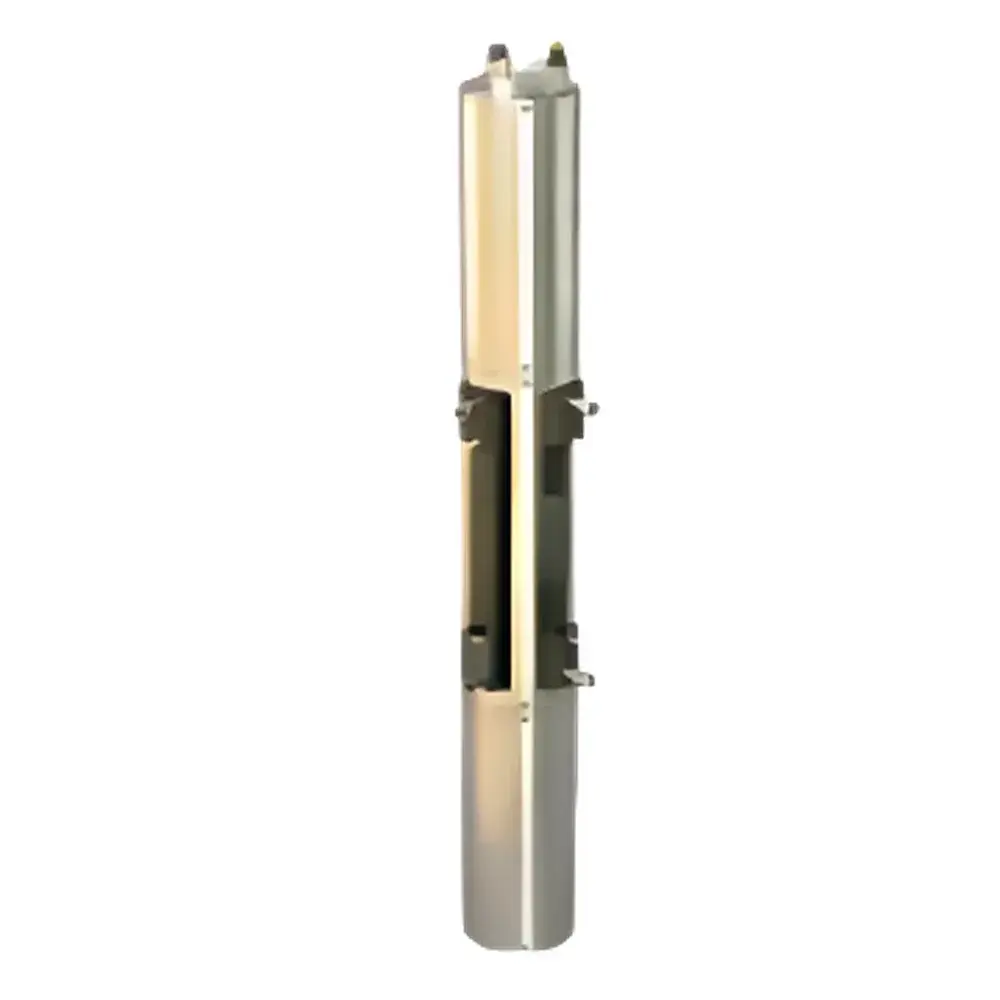
Wetlabs AC-S Absorption and Attenuation Spectrophotometer
| Brand | Wetlabs |
|---|---|
| Origin | USA |
| Model | AC-S |
| Spectral Range | 400–730 nm |
| Spectral Resolution | 4 nm |
| Bandpass | 15 nm per channel |
| Number of Output Bands | 80 ± 5 |
| Path Length | 10 cm or 25 cm |
| Beam Diameter | 8 mm |
| Linearity | ≥99% R² |
| Accuracy (400–449 nm) | ±0.005 m⁻¹ (typ.), ±0.012 m⁻¹ (max) @ 4 Hz |
| Accuracy (450–730 nm) | ±0.001 m⁻¹ (typ.), ±0.003 m⁻¹ (max) @ 4 Hz |
| Dynamic Range | 0.001–10 m⁻¹ |
| Sampling Rate | 4 Hz (standard) |
| Operating Temperature | 0–30 °C |
| Pressure Rating | 500 m or 5000 m (AC-S 5000 titanium variant) |
| Power Input | 10–35 VDC |
| Current Draw | 0.37 A @ 12 V |
| Communication Interfaces | RS-232, RS-422, RS-485 |
| Connector | MCBH6MP |
| Dimensions (standard) | Ø10.4 cm × 77 cm |
| Dimensions (5000) | Ø9.9 cm × 75.8 cm |
| Air Weight (standard) | 5.9 kg |
| Air Weight (5000) | 5.3 kg |
| In-Water Weight (standard) | 0.8 kg |
| In-Water Weight (5000) | 0.3 kg |
Overview
The Wetlabs AC-S Absorption and Attenuation Spectrophotometer is a high-spectral-resolution, dual-path optical instrument engineered for in situ quantification of spectral absorption (a(λ)) and beam attenuation (c(λ)) coefficients in natural aquatic environments. It operates on the principle of collimated transmittance measurement using two independent optical paths—one optimized for high-sensitivity absorption detection and the other for broadband attenuation—enabling simultaneous, co-located acquisition without temporal misalignment. The system employs a stabilized LED light source, a rotating linear variable filter (LVF) monochromator, and precision-engineered flow-through cuvettes with selectable 10 cm or 25 cm path lengths. Its 4 nm spectral resolution across 400–730 nm yields 80 ± 5 discrete wavelength bands, supporting rigorous bio-optical modeling, inherent optical property (IOP) inversion, and validation of satellite-derived ocean color products.
Key Features
- Dual-path optical architecture with independently calibrated absorption and attenuation channels, eliminating cross-talk and enabling direct comparison under identical hydrodynamic conditions
- Rotating linear variable filter (LVF) monochromator delivering stable 4 nm resolution and 15 nm full-width-at-half-maximum (FWHM) bandpass per channel
- Flow-through cell design validated for long-term deployment in moored, profiling, and towed platforms; beam acceptance angle = 0.93° for precise c(λ) definition per ASTM E275 and ISO 7027
- Titanium-housed AC-S 5000 variant rated to 5000 m depth, compliant with ISO 85042 pressure vessel standards for deep-ocean observatories
- High linearity (>99% R²) over full dynamic range (0.001–10 m⁻¹), traceable to NIST-traceable reference standards
- 4 Hz sampling rate supports high-resolution vertical profiling and turbulent microstructure studies; optional 1 Hz mode improves signal-to-noise ratio for low-scatter environments
- RS-232/RS-422/RS-485 serial interfaces enable integration into legacy and modern oceanographic data acquisition systems, including Sea-Bird Electronics, Teledyne RDI, and WHOI Moored Profiler architectures
Sample Compatibility & Compliance
The AC-S is designed for direct deployment in seawater, freshwater, estuarine, and hypersaline systems without sample extraction or filtration. Its flow-through cell accommodates particulate-laden waters up to ~100 NTU without clogging, supported by wet-mateable MCBH6MP connectors rated to IP68. The instrument meets IEC 60529 environmental protection requirements and conforms to GLP-compliant data integrity practices when used with timestamped, audit-trail-enabled acquisition software. Measurement protocols align with NASA Ocean Biology Processing Group (OBPG) IOP processing standards and support compliance with US EPA Method 418.1 (oil-in-water) and ISO 10264 (water quality—optical measurements) where applicable. Titanium housing (AC-S 5000) complies with ASTM B348 Grade 5 specifications for marine corrosion resistance.
Software & Data Management
Raw AC-S output consists of time-stamped, wavelength-indexed voltage counts for each channel, converted to absorption and attenuation coefficients via factory-applied calibration polynomials stored in non-volatile memory. Wetlabs’ open-format .cnv files are compatible with MATLAB, Python (via wetlabs_acs package), and Sea-Bird SBE Data Processing software. All calibrations include uncertainty propagation metadata per GUM (JCGM 100:2018). When integrated with compliant data loggers supporting FDA 21 CFR Part 11, the system supports electronic signatures, audit trails, and secure data archiving—essential for regulatory monitoring programs and GLP/GMP-aligned water quality assessments.
Applications
- Ocean color algorithm development and validation for VIIRS, Sentinel-3 OLCI, and PACE missions
- Quantification of phytoplankton pigment absorption (e.g., chlorophyll-a, phycocyanin, photoprotective carotenoids) and CDOM (colored dissolved organic matter) spectral slope
- Inherent optical property (IOP) derivation for radiative transfer modeling (e.g., Hydrolight, EcoLight)
- Long-term mooring-based monitoring of turbidity trends, sediment resuspension events, and harmful algal bloom (HAB) onset
- Profiling applications from CTD rosettes, autonomous gliders (e.g., Slocum, Seaglider), and AUVs (e.g., REMUS, Sentry)
- Calibration-transfer studies between laboratory spectrophotometers (e.g., Shimadzu UV-2600) and field-deployed sensors
FAQ
How does the AC-S distinguish absorption from total attenuation?
The AC-S uses two physically separate optical paths: one measures total beam attenuation (c(λ)) through a narrow-field detector aligned with the incident beam; the other measures absorption (a(λ)) using a large-area detector that excludes scattered photons beyond 0.93°, effectively isolating the non-scattering component per the definition in IOCCG Report No. 5.
Is post-deployment recalibration required?
No routine recalibration is needed within 12 months of factory calibration if operated within specified temperature and pressure limits; however, pre- and post-cruise dark/zero checks are recommended per NASA OBPG Protocol 2.1.
Can the AC-S be used in glacial meltwater or highly turbid rivers?
Yes—the 25 cm path length option extends lower detection limits for low-absorption environments, while the 10 cm configuration maintains dynamic range in high-turbidity settings (up to c(λ) ≈ 8 m⁻¹ at 440 nm).
What depth rating applies to standard versus titanium models?
The standard AC-S is rated to 500 m; the AC-S 5000 titanium variant is certified to 5000 m with full functionality, including pressure-compensated optics and hermetically sealed electronics per ISO 85042 Annex B.
Does the instrument comply with data integrity requirements for regulatory reporting?
When paired with compliant acquisition hardware and software supporting 21 CFR Part 11 controls (e.g., Sea-Bird SBE Data Processing v7.25+), the AC-S meets audit-trail, electronic signature, and data retention requirements for EPA, Environment Canada, and EU WFD reporting frameworks.
Related Products







