
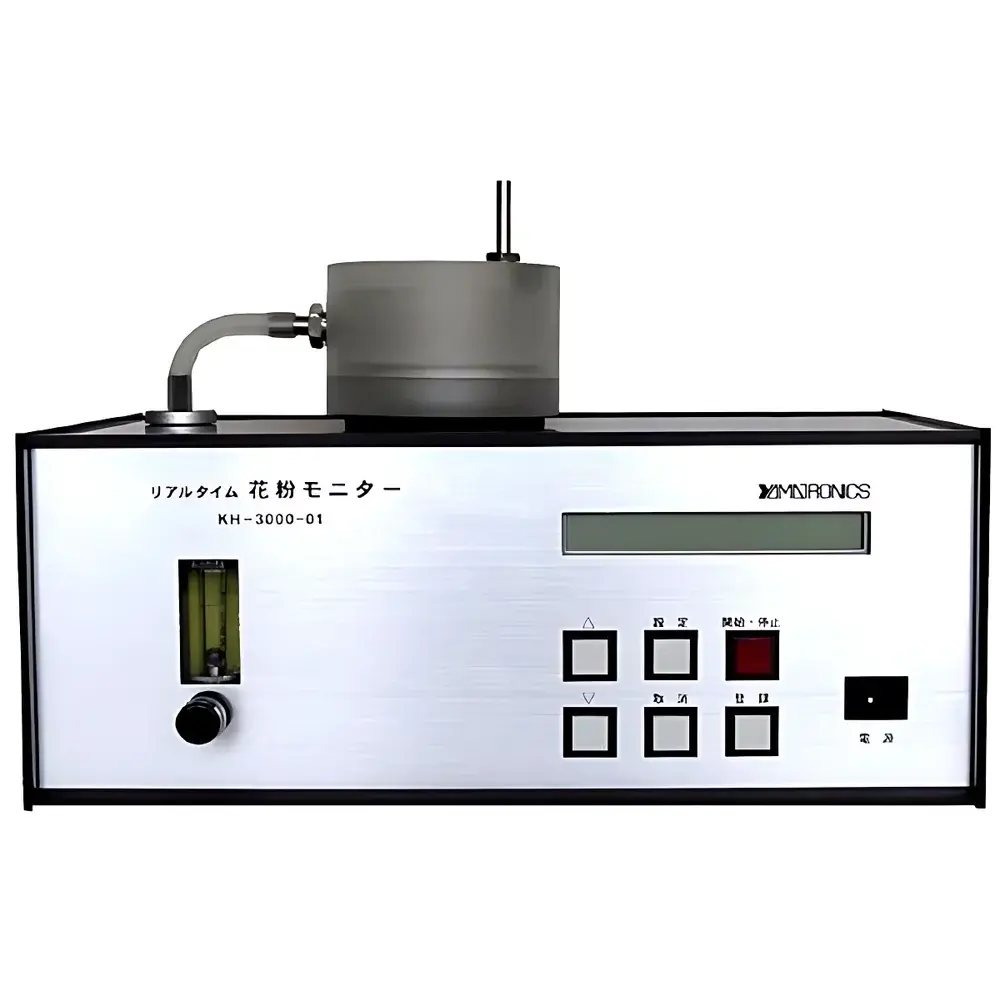
Yamatronics KH-3000-01A Pollen Monitoring System
| Brand | Yamatronics |
|---|---|
| Origin | Japan |
| Model | KH-3000-01A |
| Instrument Type | Aerosol Particle Counter for Pollen Detection |
| Measurement Principle | Forward + Sideways Semiconductor Laser Light Scattering |
| Particle Size Range | ~25–40 µm |
| Flow Rate | 4.1 LPM |
| Measurement Interval | 1–9999 min (adjustable) |
| Display | LCD |
| Interface | RS-232C |
| Data Storage Capacity | 180 records |
| Power Supply | AC 220 V, 50/60 Hz |
| Dimensions | 320(W) × 230(D) × 140(H) mm |
| Weight | ~5 kg |
| Compliance | Designed for ambient airborne pollen surveillance in accordance with ISO 21501-4 and JIS Z 8901 Annex B for optical particle counting |
Overview
The Yamatronics KH-3000-01A Pollen Monitoring System is a dedicated real-time aerosol particle counter engineered for the automated, continuous detection and quantification of airborne pollen grains in outdoor and semi-outdoor environmental monitoring stations. Unlike traditional volumetric spore traps that rely on adhesive-coated slides and manual microscopic enumeration, the KH-3000-01A employs dual-axis semiconductor laser light scattering—combining forward-scatter and sideways-scatter detection—to discriminate biogenic particles within the characteristic aerodynamic diameter range of common allergenic pollen (e.g., Cupressaceae, Pinus, Urticaceae, and Gramineae). This optical architecture enables rapid classification based on scattering intensity profiles and angular response signatures, delivering quantitative concentration data (particles/m³) without sample preparation or analyst intervention. The system operates at a calibrated volumetric flow rate of 4.1 LPM, ensuring representative air sampling under standard atmospheric conditions. Its compact benchtop form factor and low power consumption support long-term unattended deployment in meteorological observatories, public health surveillance networks, and botanical research facilities.
Key Features
- Dual-axis optical detection: Simultaneous forward- and sideways-scatter measurement enhances discrimination fidelity for pollen versus non-biological aerosols (e.g., textile fibers, mineral dust)
- Real-time interval programming: Adjustable measurement intervals from 1 minute to 9999 minutes, enabling flexible temporal resolution for diurnal or seasonal studies
- Integrated data logging: Onboard memory stores up to 180 timestamped concentration records, preserving continuity during transient communication outages
- RS-232C serial interface: Enables direct connection to PCs or thermal printers for local data export, remote command execution (e.g., start/stop, reset), and firmware diagnostics
- Robust industrial design: Sealed optical chamber with laminar-flow path minimizes particle loss and wall deposition; housed in an aluminum alloy chassis rated IP20 for indoor and sheltered outdoor use
- Low-maintenance operation: No consumables (e.g., tapes, oils, filters) required during routine operation; laser source lifetime exceeds 10,000 hours
Sample Compatibility & Compliance
The KH-3000-01A is optimized for ambient air samples containing pollen taxa with effective diameters between approximately 25 µm and 40 µm—covering >95% of clinically relevant wind-dispersed pollen species in temperate and subtropical zones. It does not detect submicron biological particles (e.g., fungal spores <10 µm, bacteria) or non-spherical hygroscopic aerosols whose scattering behavior deviates significantly from Mie theory assumptions. The instrument adheres to optical calibration protocols aligned with ISO 21501-4:2018 (Determination of particle size distribution — Single particle light interaction methods) and incorporates reference traceability to NIST-traceable polystyrene latex (PSL) standards. While not certified for regulatory compliance under EPA Method IO-3.3 or EN 12341, its output is routinely used as supplementary data in national pollen forecasting systems compliant with WHO/Eurosurveillance reporting frameworks.
Software & Data Management
Data acquisition and configuration are managed via ASCII-based command protocol over RS-232C. A vendor-supplied terminal emulator (Windows-compatible) allows users to initiate measurements, retrieve stored records, configure sampling intervals, and perform basic diagnostic checks (e.g., laser power verification, flow sensor validation). Raw outputs include UTC timestamps, particle counts per interval, and status flags (e.g., “flow error”, “low signal”). Exported CSV files are compatible with common statistical packages (R, Python pandas, MATLAB) for time-series analysis, correlation with meteorological variables (temperature, RH, wind speed), and integration into GIS-based pollen dispersion models. Audit trails are maintained locally but do not meet FDA 21 CFR Part 11 requirements for electronic records; for GLP/GMP environments, external timestamped logging via PC-based middleware is recommended.
Applications
- Public health early-warning systems for allergic rhinitis and asthma exacerbation risk assessment
- Long-term phenological studies correlating pollen season onset/peak/end with climate variables
- Validation of numerical atmospheric transport models (e.g., HYSPLIT, SILAM) for regional pollen dispersion forecasting
- Botanical garden and arboretum air quality management to inform visitor advisories
- Pharmaceutical clinical trial site selection where pollen exposure must be characterized and controlled
- Educational field laboratories demonstrating real-time bioaerosol dynamics and atmospheric particulate behavior
FAQ
Does the KH-3000-01A identify pollen to genus or species level?
No. It provides quantitative concentration data for particles within the 25–40 µm size band consistent with mature pollen grains. Taxonomic identification requires subsequent microscopic or molecular analysis of collected samples.
Can it operate continuously for weeks without maintenance?
Yes—provided ambient temperature remains between 5–40°C and relative humidity stays below 80% RH non-condensing. Periodic optical window inspection is advised every 30 days in high-dust environments.
Is calibration traceable to international standards?
Calibration uses PSL reference particles with NIST-traceable diameter certification; full calibration reports are issued with each unit shipment.
What is the minimum detectable concentration?
Under nominal 4.1 LPM flow and 1-minute interval, the lower limit of quantitation is ~1 particle/m³, assuming background noise remains below 0.1 counts per measurement cycle.
Does it comply with ISO 17025 for accredited testing labs?
The instrument itself is not ISO/IEC 17025-accredited, but its use within an accredited laboratory’s validated method—including documented uncertainty budgets and inter-laboratory comparison—supports conformity with clause 7.2.2.
Related Products







