
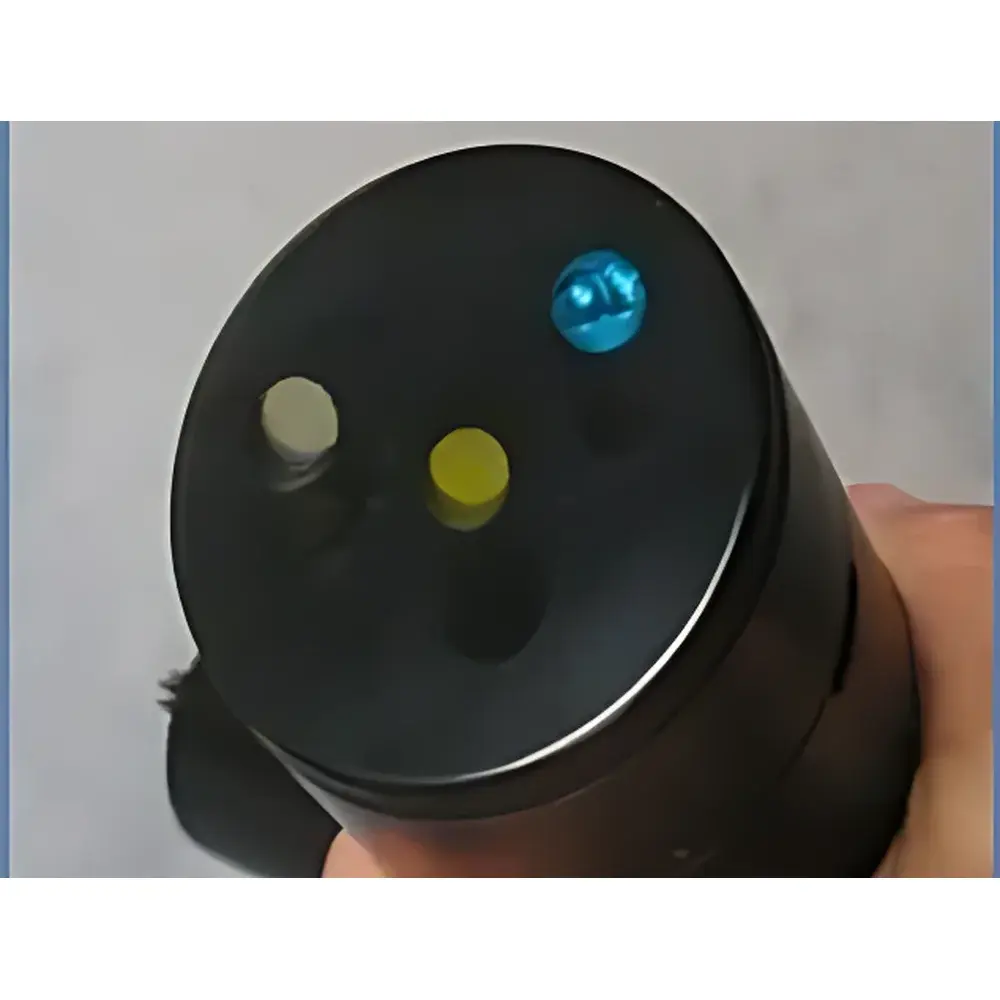
Wetlabs ECO-Triplet Tri-Parameter Water Optical Sensor
| Brand | Wetlabs |
|---|---|
| Origin | USA |
| Model | ECO-Triplet |
| Measurement Parameters | Turbidity, Chlorophyll-a Fluorescence, CDOM Fluorescence |
| Turbidity Range | 0–1000 NTU (Resolution: 0.01 NTU) |
| Chlorophyll-a Range | 0–250 µg/L (Detection Limit: 0.025 µg/L) |
| CDOM Range | 0–375 µg/L (Detection Limit: 0.28 µg/L) |
| Housing Material | Polyacetal (Acetal Copolymer), Seawater-Corrosion Resistant |
| Dimensions | Ø63 × 127 mm |
| Weight | 0.4 kg (air), 0.02 kg (buoyant in seawater) |
| Pressure Rating | 600 m (custom depths available) |
| Digital Output | RS-232, 19200 baud, 12-bit resolution |
| Analog Output | 0–5 V (user-configurable per channel) |
| Internal Data Logging | Optional, up to 77,000 samples |
| Power Supply | 7–15 VDC |
| Operating Current | 60 mA (active), 140 µA (sleep mode) |
| Sampling Rate | 4 Hz |
| Connector | SUBCONN Micro-5-pin male |
| Anti-fouling Option | Rotating copper brush (programmable cleaning interval) |
| Optional Features | Integrated battery pack, biofouling guard, CTD-mounting interface (compatible with SEA-BIRD CTD systems) |
Overview
The Wetlabs ECO-Triplet is a compact, submersible optical sensor engineered for simultaneous, high-fidelity measurement of three critical water optical properties: turbidity (via backscattering), chlorophyll-a fluorescence, and colored dissolved organic matter (CDOM) fluorescence. Based on calibrated, narrow-band excitation/emission photometry and temperature-compensated detection electronics, the ECO-Triplet operates on established principles of in situ fluorometry and nephelometry—enabling quantitative, real-time assessment of phytoplankton biomass, suspended particulate load, and terrestrial organic input in marine, estuarine, and freshwater environments. Its modular optical design supports interchangeable excitation/emission configurations, allowing users to select from multiple wavelength combinations—including 470 nm (blue backscatter), 532 nm (green scatter), 650 nm (red scatter), and fluorescence channels for phycocyanin, phycoerythrin, rhodamine, fluorescein sodium, or CDOM-specific bands—to match site-specific biogeochemical objectives.
Key Features
- Triple-parameter optical sensing in a single, pressure-rated housing (600 m standard; custom depth ratings available)
- Polyacetal (acetal copolymer) construction ensures long-term mechanical integrity and corrosion resistance in saline, brackish, and freshwater deployments
- Low-power architecture: 60 mA active draw, 140 µA sleep mode—optimized for autonomous platforms including moorings, gliders, AUVs, and profiling floats
- RS-232 digital interface (19200 baud, 12-bit resolution) with optional analog voltage output (0–5 V per parameter)
- Configurable internal data logging (up to 77,000 samples) and optional integrated lithium battery pack for stand-alone operation
- Optional rotating copper brush anti-fouling system with programmable cleaning intervals to maintain optical window clarity during extended deployments
- Subconn Micro-5-pin male connector enables direct integration with SEA-BIRD CTDs and other oceanographic telemetry systems
- Factory-calibrated with traceable NIST-traceable standards; calibration coefficients stored onboard for automatic signal conversion
Sample Compatibility & Compliance
The ECO-Triplet is validated for continuous in situ operation across a broad range of aquatic matrices—from oligotrophic open-ocean waters to highly turbid coastal and riverine systems. Its optical path geometry and spectral bandpass filters minimize cross-sensitivity between parameters (e.g., chlorophyll fluorescence interference from CDOM or turbidity). The sensor complies with ISO 7027 for turbidity measurement methodology and adheres to ASTM D6696 and EPA Method 445.0 for chlorophyll-a quantification via fluorescence. All firmware and data handling routines support GLP-compliant metadata tagging (timestamp, temperature, instrument ID, calibration status). When deployed with audit-trail-enabled data loggers or connected to FDA 21 CFR Part 11–compliant acquisition systems, the ECO-Triplet supports regulatory-grade water quality reporting for environmental monitoring programs and research requiring traceable, defensible datasets.
Software & Data Management
Data acquisition is supported through Wetlabs’ proprietary ECO Series software (ECOView), which provides real-time visualization, spectral diagnostics, and batch calibration management. Raw sensor outputs are delivered as ASCII-formatted serial streams or binary packets compatible with common oceanographic data handling frameworks—including Sea-Bird SBE Data Processing, MATLAB Oceanography Toolbox, Python-based PySeabird and IOOS compliance tools. All logged data include embedded temperature compensation values, gain settings, and user-defined deployment metadata. Firmware updates are performed via serial command protocol without hardware modification. Exported datasets conform to CF (Climate and Forecast) Metadata Conventions, facilitating ingestion into NOAA’s NCEI archives, EU Copernicus Marine Service repositories, and institutional data lakes aligned with FAIR (Findable, Accessible, Interoperable, Reusable) principles.
Applications
- Ocean color validation for satellite remote sensing missions (e.g., NASA PACE, ESA Sentinel-3 OLCI)
- Long-term ecological research on phytoplankton phenology and bloom dynamics in coastal shelf systems
- Real-time early warning for cyanobacterial harmful algal blooms (cHABs) in reservoirs and drinking water intakes
- Estuarine carbon cycling studies linking CDOM fluxes to watershed land-use change
- Autonomous platform integration (gliders, profilers, moored buoys) for high-resolution vertical and temporal profiling
- Regulatory compliance monitoring under EU WFD, US Clean Water Act Section 304(a), and national eutrophication assessment protocols
FAQ
Can the ECO-Triplet be deployed on a CTD rosette alongside other sensors?
Yes—the Micro-5-pin SUBCONN interface and low power requirements enable seamless integration with SEA-BIRD, RBR, and other industry-standard CTD systems without signal interference or voltage drop concerns.
Is factory recalibration required annually?
While not mandatory, Wetlabs recommends annual verification against secondary standards in controlled laboratory conditions to maintain metrological traceability; field drift is typically <±2% per year for chlorophyll-a and CDOM channels under normal fouling conditions.
Does the internal data logger retain data during power interruption?
Yes—non-volatile flash memory ensures full retention of logged samples even during complete power loss or battery replacement.
Can I configure different excitation wavelengths after purchase?
Optical modules are factory-assembled and not field-swappable; however, Wetlabs offers pre-configured variants (e.g., ECO-Triplet-BCF for backscatter/chlorophyll/CDOM) and can accommodate special-order combinations upon request.
What is the typical response time for turbidity measurement?
The sensor achieves 90% step response in <100 ms, supporting high-frequency profiling at descent rates up to 1 m/s without signal smearing.







