
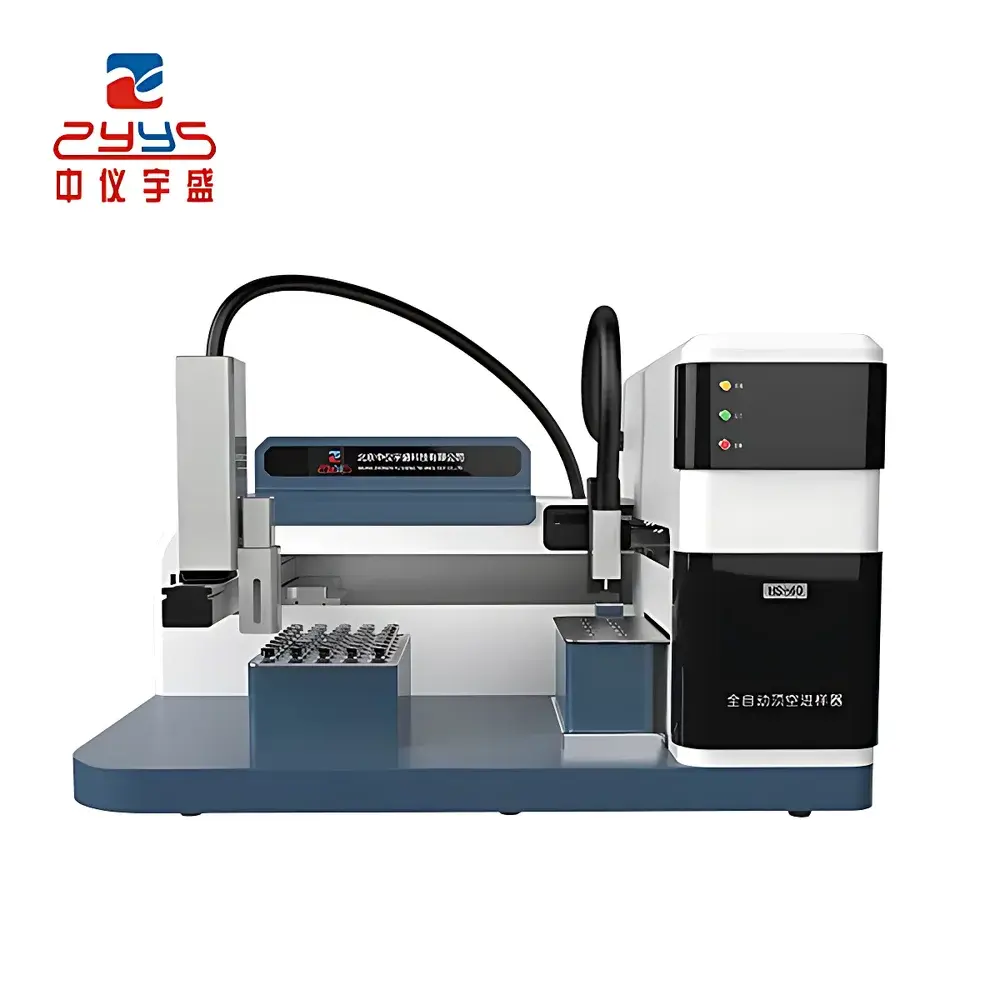
Zhongyi Yusheng HS-40 Fully Automated Static Headspace Sampler
| Brand | Zhongyi Yusheng |
|---|---|
| Origin | Beijing, China |
| Manufacturer Type | Original Equipment Manufacturer (OEM) |
| Instrument Type | Static Headspace Sampler |
| Automation Level | Fully Automated |
| Sample Position Capacity | 40 vials |
| Vial Sizes Supported | 10 mL and 20 mL |
| Heating Zone Count | 10 positions |
| Agitation Function | Yes |
| Needle Heating | Yes |
| PC-Controlled Interface | Yes |
| GC/GC-MS Synchronization Interface | Yes |
| Auto-Purge/Backflush | Yes |
| EPC Option | Available |
| Data Logging | Built-in audit trail |
Overview
The Zhongyi Yusheng HS-40 Fully Automated Static Headspace Sampler is an engineered solution for precise, high-throughput volatile organic compound (VOC) analysis in environmental, pharmaceutical, clinical, and industrial laboratories. Based on the static headspace principle—where equilibrated vapor-phase analytes above liquid or solid samples are extracted and transferred to a gas chromatograph (GC) or GC-mass spectrometer (GC-MS)—the HS-40 delivers reproducible sampling with minimal manual intervention. Its XYZ tri-axis robotic motion architecture decouples vial handling from needle insertion, enabling independent optimization of positioning accuracy and injection timing. Designed for compliance-critical workflows, the system supports method-defined equilibrium conditions—including temperature-controlled incubation, programmable agitation, and inert sample path materials—to ensure quantitative transfer of thermally labile and low-concentration volatiles without carryover or adsorption artifacts.
Key Features
- Fully automated 40-position sample carousel with dual independent XYZ motion platforms—separating vial transport and syringe actuation to enhance speed, positional repeatability, and future scalability.
- 10-zone heated incubation block allowing staggered or overlapping thermal equilibration across multiple samples, reducing overall cycle time without compromising equilibrium integrity.
- Programmable vial agitation during heating to accelerate phase partitioning and improve reproducibility for heterogeneous matrices (e.g., soils, sludges, biological tissues).
- Heated transfer lines and injection needle (up to 220 °C) prevent condensation of high-boiling-point analytes and maintain vapor-phase integrity throughout the sampling path.
- PC-based control software with real-time dynamic visualization: live status monitoring per vial position, queue progress bar, error diagnostics, and interactive priority reordering for urgent samples.
- Integrated auto-purge and backflush functionality between injections to minimize cross-contamination—critical for trace-level VOC analysis in complex sample sets.
- Comprehensive safety architecture: automatic system self-check at startup, overtemperature cutoff, leakage current protection, and hardware interlocks aligned with IEC 61010-1 requirements.
- Inert flow path construction using silanized stainless steel and PTFE-lined components to suppress analyte adsorption, degradation, or memory effects—especially relevant for aldehydes, nitriles, and sulfur-containing compounds.
Sample Compatibility & Compliance
The HS-40 accommodates standard 10 mL and 20 mL crimp-top or screw-cap headspace vials, compatible with widely adopted septa types (e.g., silicone/PFA, butyl rubber). It meets analytical requirements defined in multiple Chinese national and industry standards—including HJ 620–2011 through HJ 1072–2019 for water, soil, sediment, and solid waste; GB/T 42430–2023 for forensic toxicology (blood/urine ethanol and related alcohols); SN/T 4148–2015 for packaging VOC screening; and GB/T 16886.7–2015 for ethylene oxide residue testing in medical devices. While not certified to ISO/IEC 17025 or FDA 21 CFR Part 11 out-of-the-box, its built-in event logging, user-accessible audit trail, and deterministic sequence execution support GLP- and GMP-aligned validation protocols when deployed with qualified laboratory information management systems (LIMS).
Software & Data Management
Control and method development are performed via Windows-compatible desktop software featuring intuitive graphical workflow configuration. Users define individual vial parameters—including incubation temperature/time, agitation speed/duration, pressurization pressure, loop fill volume, and injection dwell time—with support for non-sequential batch composition (e.g., skipping defective vials or inserting calibration standards mid-run). All instrument events—including temperature logs, motion commands, error flags, and user login/logout timestamps—are recorded in a tamper-resistant local database compliant with ALCOA+ principles. Export options include CSV and XML formats for integration into third-party chromatography data systems (CDS), including Thermo Chromeleon, Agilent OpenLab CDS, and Shimadzu GC Solutions. Optional electronic pressure control (EPC) module enables closed-loop regulation of vial pressurization and carrier gas flow, improving retention time stability and peak area reproducibility across multi-day sequences.
Applications
The HS-40 serves as a robust front-end for regulatory and research-grade VOC analysis across diverse sectors: environmental monitoring (e.g., chlorinated solvents in groundwater per HJ 620–2011); food safety (residual solvents in packaging per SN/T 4148–2015); clinical toxicology (ethanol, methanol, acetone quantification in biological fluids per GB/T 42430–2023); pharmaceutical quality control (residual ethylene oxide in sterilized devices per GB/T 16886.7–2015); and industrial hygiene (benzene, toluene, xylene in workplace air simulants). Its ability to perform repeated injections from the same vial supports method development studies—such as equilibrium time profiling or matrix effect assessment—without re-preparation.
FAQ
Is the HS-40 compatible with third-party GC and GC-MS systems?
Yes—it provides TTL and RS-232 interfaces for synchronized start/stop triggering with major GC vendors, including Agilent, Thermo Fisher, Shimadzu, and PerkinElmer.
Does the system support method validation under GLP or GMP guidelines?
While the base configuration lacks pre-certified 21 CFR Part 11 compliance, its audit trail, user access controls, and deterministic operation enable full qualification per laboratory-specific SOPs and ISO/IEC 17025 requirements.
Can I use both 10 mL and 20 mL vials interchangeably within one run?
Yes—the adjustable vial holder accommodates both sizes without mechanical modification; software allows per-vial specification of volume-dependent parameters (e.g., headspace ratio, pressurization time).
What maintenance is required to ensure long-term performance?
Routine tasks include septum replacement every 100–200 injections, periodic cleaning of the needle and transfer line with appropriate solvents, and annual verification of temperature uniformity across all 10 heating zones using NIST-traceable probes.
Is remote monitoring or control supported?
The control software operates over local area networks (LAN); remote desktop access is permitted within secure institutional IT policies—but no native cloud interface or mobile app is provided.



