
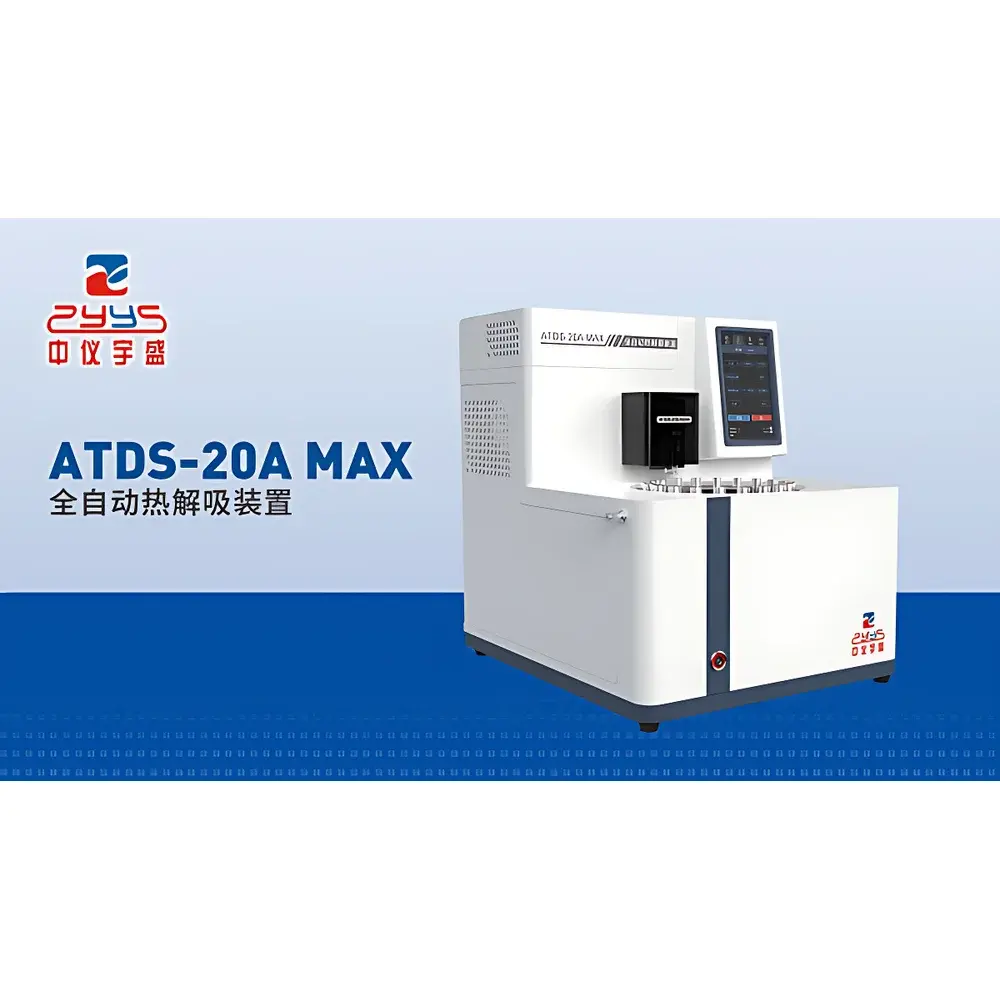
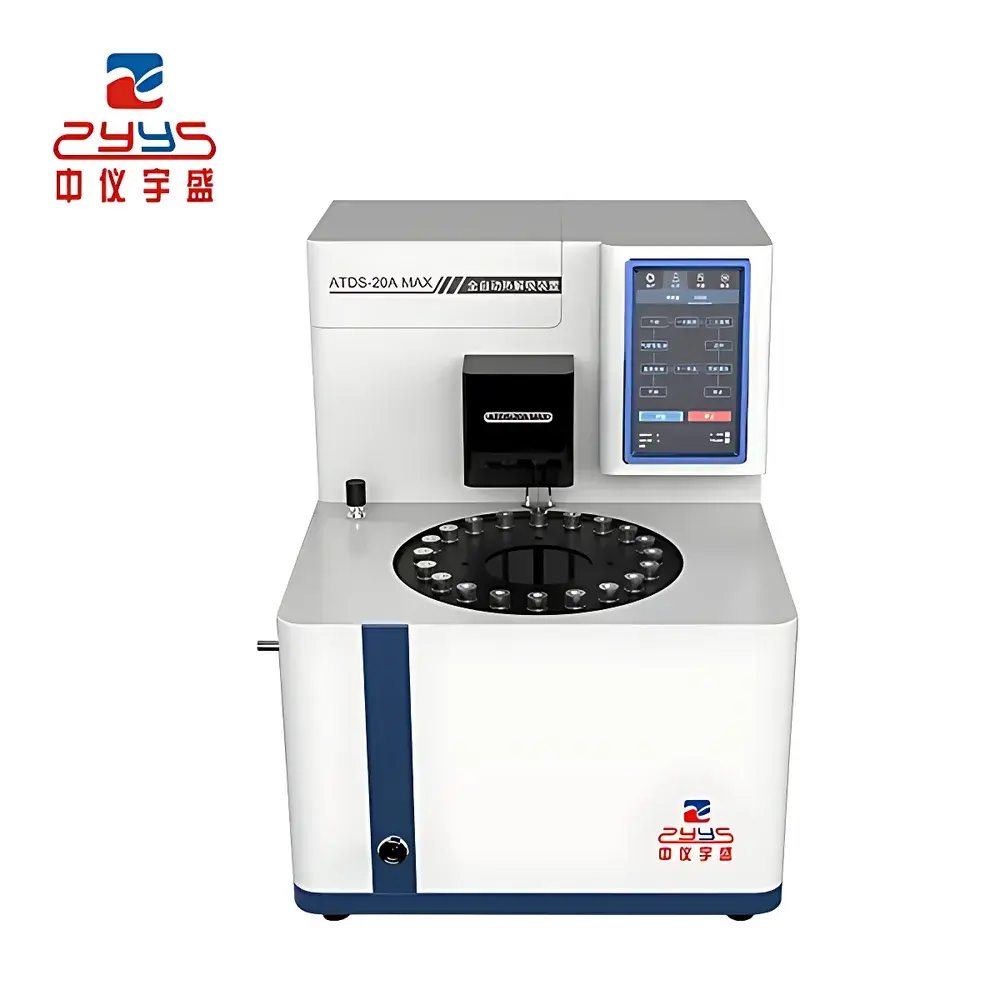
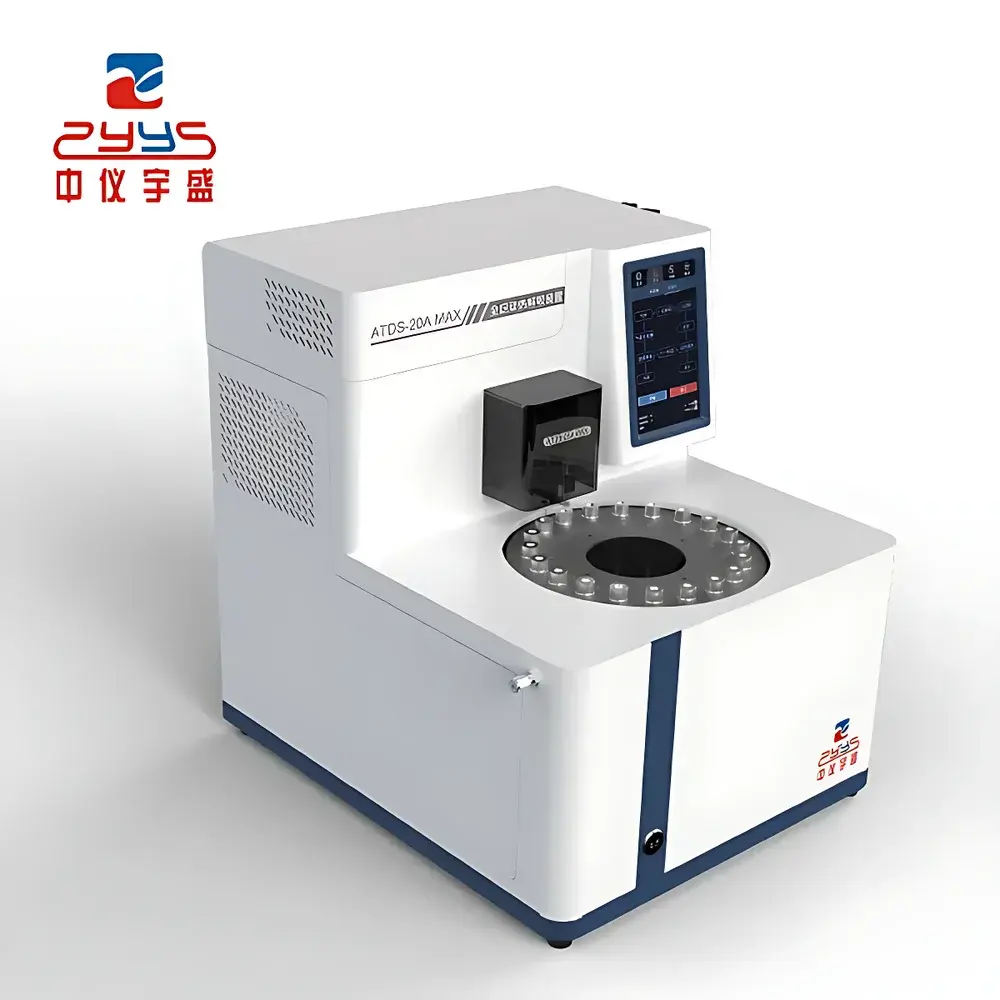
Zhongyi Yusheng ATDS-20A Max Fully Automated Thermal Desorber
| Brand | Zhongyi Yusheng |
|---|---|
| Origin | Beijing, China |
| Manufacturer Type | Direct Manufacturer |
| Product Category | Domestic |
| Model | ATDS-20A Max |
| Instrument Type | Dual-Stage Thermal Desorber |
| Automation Level | Fully Automated |
| Sample Capacity | 20 Positions |
| Compliance Standards | HJ 644–2013, HJ/T 400–2007, GB/T 18883–2002, HJ 583–2010, GB 50325–2020, HJ 734–2014 |
Overview
The Zhongyi Yusheng ATDS-20A Max is a fully automated dual-stage thermal desorber engineered for high-reproducibility quantitative analysis of volatile organic compounds (VOCs) and semi-volatile organic compounds (SVOCs) in environmental, indoor air, automotive cabin, and industrial emission samples. It operates on the principle of thermally driven analyte release from sorbent tubes—first by primary desorption at elevated temperature under controlled carrier gas flow, followed by cryo-focusing and secondary desorption directly into the GC or GC-MS inlet. This two-step process ensures sharp, symmetrical chromatographic peaks, enhanced sensitivity, and minimized breakthrough or carryover. The system integrates precision temperature control, real-time pressure monitoring, and inert sample pathways to meet the stringent requirements of regulatory methods including HJ 644–2013, HJ 734–2014, and GB 50325–2020.
Key Features
- Fully automated operation with 20-position sample carousel—enabling unattended batch processing of sorbent tubes without manual intervention;
- Dual-stage desorption architecture incorporating electronic Peltier cooling for cryo-focusing (−30 °C to −40 °C range) and rapid secondary desorption (up to 400 °C), optimized for narrow peak widths and improved resolution;
- Inert, passivated gas pathways throughout the entire flow path—including stainless steel tubing, valves, and transfer lines—to prevent adsorption, catalytic degradation, or memory effects;
- Integrated back-flush functionality for both the sample transfer line and injection valve, minimizing cross-contamination between sequential analyses;
- Self-diagnostic startup sequence with real-time fault detection, overtemperature protection, electrical leakage monitoring, and differential pressure alarms for gas supply integrity;
- 7-inch capacitive touchscreen interface with intuitive workflow navigation, real-time pressure visualization via digital pressure sensors, and configurable method storage;
- Modular mechanical design comprising five independent subsystems—desorption oven, cryo-focusing unit, pneumatic control module, sample carousel assembly, and electronics chassis—supporting targeted maintenance and future hardware upgrades;
- Built-in calibration mode enabling direct generation of calibration curves using certified standard gases or liquid standards via simulated sampling and thermal extraction;
- Dedicated airflow channel architecture enhancing thermal efficiency of the cold trap and reducing cycle time per sample;
- Energy-efficient semiconductor-based cooling system eliminating reliance on liquid nitrogen or external chillers.
Sample Compatibility & Compliance
The ATDS-20A Max supports standard 6-mm OD stainless steel or quartz sorbent tubes (e.g., Tenax TA, Carbopack B/C, Carboxen 1000, or multi-bed configurations) compliant with EPA TO-17, ISO 16017-1, and Chinese environmental standards. Its performance aligns with method validation criteria specified in HJ 644–2013 (VOCs in ambient air), HJ 734–2014 (stationary source emissions), and GB 50325–2020 (indoor air quality in civil construction). All thermal zones are calibrated traceably to NIST-traceable references. The system’s operational parameters—including desorption temperature ramp rates, hold times, trap cooling profiles, and purge flows—are fully programmable and auditable, supporting GLP/GMP-aligned data integrity practices.
Software & Data Management
Control software provides full method development, execution logging, and event-driven audit trails. Each run records timestamped metadata—including setpoints, actual temperatures, pressure readings, valve actuation events, and error flags—stored locally with optional export to LIMS via CSV or XML. The software architecture complies with ALCOA+ principles (Attributable, Legible, Contemporaneous, Original, Accurate, Complete, Consistent, Enduring, Available) and supports 21 CFR Part 11–compliant user authentication, electronic signatures, and change control when deployed in regulated QC environments. No cloud dependency; all data resides on-device or on user-defined network drives.
Applications
- Regulatory monitoring of VOCs in ambient, indoor, and workplace air per national and provincial environmental standards;
- Automotive interior air quality assessment (e.g., aldehydes, benzene, toluene, xylene) in accordance with HJ/T 400–2007;
- Quality control of building materials, adhesives, and coatings for VOC emissions compliance (GB/T 18883–2002);
- Source identification and quantification in industrial stack testing (HJ 734–2014);
- Method development and validation for emerging contaminants such as halogenated VOCs, oxygenates, and sulfur-containing compounds;
- Research-grade studies requiring high-throughput, low-background thermal desorption coupled to high-resolution GC×GC or GC-MS/MS platforms.
FAQ
Is the ATDS-20A Max compatible with all major GC and GC-MS systems?
Yes—it features universal GC interface compatibility via standard 1/16″ Swagelok fittings and adjustable transfer line temperature control (up to 400 °C), supporting integration with Agilent, Thermo Fisher, Shimadzu, and PerkinElmer instruments.
Does the system support method transfer from legacy thermal desorbers?
Yes—parameter mapping tables and conversion utilities are provided to translate methods from common single- or dual-stage desorbers, including retention time alignment and trap cooling profile replication.
Can the instrument be validated per ISO/IEC 17025 requirements?
Yes—the modular design, full parameter logging, traceable calibration certificates, and documented IQ/OQ protocols enable laboratory-specific validation in accordance with ISO/IEC 17025:2017 Annex A.2.
What maintenance intervals are recommended for long-term reliability?
Routine inspection every 6 months includes valve function verification, pressure sensor calibration, cold trap cleaning, and sorbent tube holder alignment check; full preventive maintenance is advised annually or after 2,000 cycles.
Is remote monitoring or control supported?
Local Ethernet connectivity enables secure remote access via SSH or VNC for diagnostics and method upload; however, no proprietary cloud service or subscription-based telemetry is implemented.






