
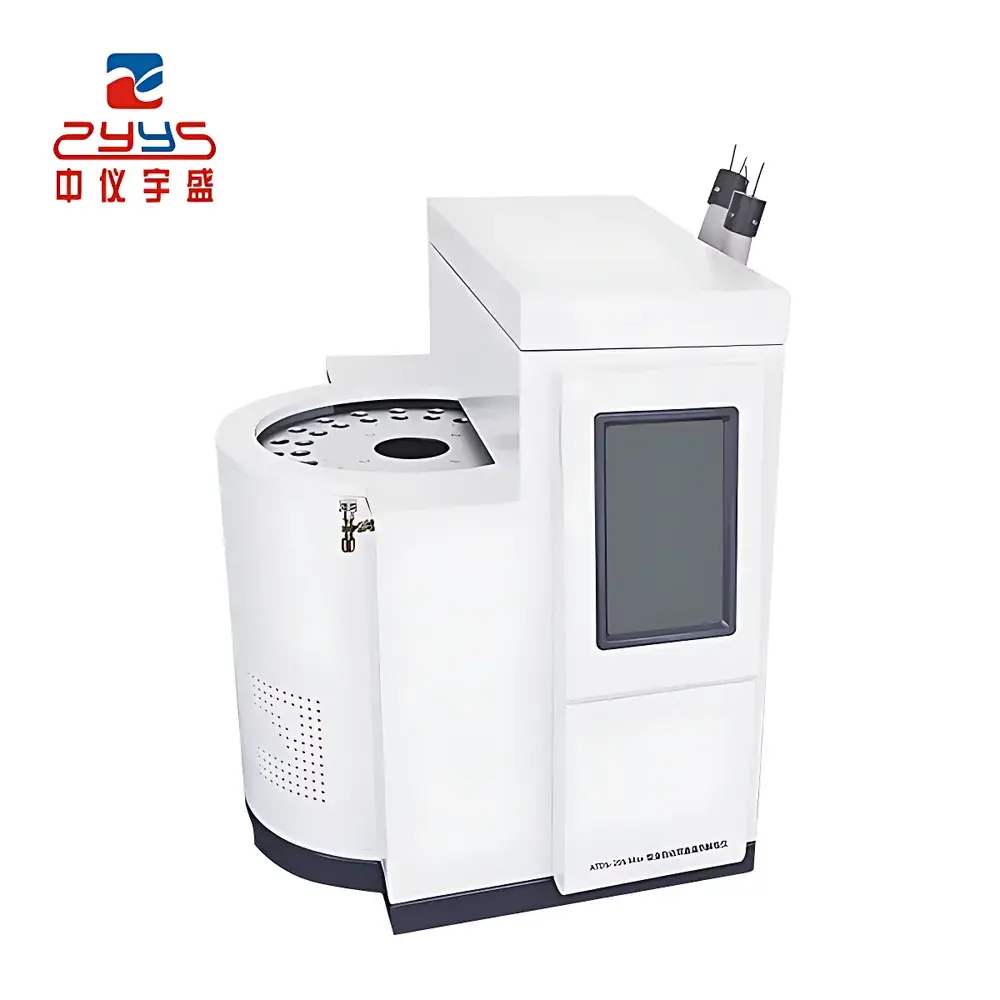
Zyuyou ATDS-20S Max Dual-Channel Automated Thermal Desorber
| Brand | Zyuyou |
|---|---|
| Origin | Beijing, China |
| Manufacturer Type | Direct Manufacturer |
| Product Category | Domestic |
| Model | ATDS-20S Max |
| Instrument Type | Dual-Channel Secondary Thermal Desorber |
| Automation Level | Fully Automatic |
| Sample Capacity | 40 positions (2 × 20) |
| Compliance | HJ 644–2013, HJ/T 400–2007, GB/T 18883–2002, HJ 583–2010, HJ 734–2014, GB 50325–2020 |
Overview
The Zyuyou ATDS-20S Max Dual-Channel Automated Thermal Desorber is a high-throughput, fully integrated sample introduction system engineered for quantitative volatile organic compound (VOC) and semi-volatile organic compound (SVOC) analysis by thermal desorption–gas chromatography (TD–GC) or thermal desorption–gas chromatography–mass spectrometry (TD–GC–MS). Based on dual-zone sequential thermal desorption architecture—comprising primary desorption, cryo-focused trapping, and secondary thermal desorption—the instrument enables precise, reproducible release of analytes from sorbent tubes under controlled inert gas flow and temperature ramping. Its dual-channel design supports parallel processing of two independent 20-sample sequences, delivering up to 40 samples per unattended run without manual intervention. The system is optimized for compliance with Chinese environmental monitoring standards including HJ 644–2013 and HJ 734–2014, and its thermal control architecture meets the fundamental requirements for GLP-aligned VOC analysis workflows in regulatory and research laboratories.
Key Features
- Fully automated dual-channel operation: Each channel independently processes 1–20 sorbent tubes per sequence; total capacity is 40 positions across two rotatable sample trays.
- Comprehensive thermal zoning: Four independently controlled heating zones—primary desorption oven, sampling valve, transfer line, and secondary desorption/focusing trap—ensure precise thermal management and minimize analyte degradation or breakthrough.
- Self-diagnostic startup routine: Automatic system check at power-on includes valve actuation verification, temperature sensor validation, and robotic arm position calibration with optical feedback.
- Time-programmable multi-step method execution: Integrated sequence control supports primary desorption, inert gas purge, cryo-trapping (optional low-temperature module), secondary desorption, GC injection, and post-run transfer-line/valve back-flush—all triggered via user-defined time events.
- Integrated sorbent tube conditioning: Built-in tube activation protocol applies programmable heating profiles under continuous helium or nitrogen flow to regenerate used tubes prior to reuse.
- Cross-contamination mitigation: Active back-flush of the transfer line and sampling valve between runs prevents carryover; optional fused silica or deactivated quartz transfer tubing available for reactive analytes (e.g., aldehydes, amines).
- GC synchronization interface: TTL-level trigger outputs support direct coordination with major GC and GC–MS platforms (Agilent, Thermo Fisher, Shimadzu, PerkinElmer); also accepts external start commands via RS-232 or Ethernet.
Sample Compatibility & Compliance
The ATDS-20S Max accommodates standard 6 mm OD × 89 mm length stainless steel or glass sorbent tubes packed with single- or multi-bed media (e.g., Tenax TA, Carbopack B/X, Carboxen 1000). It supports both ambient and active (pumped) sampling configurations and is validated for use with EPA TO-17–compatible methodologies. The instrument conforms to key national environmental testing standards: HJ 644–2013 (ambient air VOCs), HJ/T 400–2007 (in-vehicle VOCs), GB/T 18883–2002 (indoor air quality), HJ 583–2010 (benzene homologues), HJ 734–2014 (stationary source emissions), and GB 50325–2020 (civil building indoor pollution control). While not certified to ISO/IEC 17025 or FDA 21 CFR Part 11 out-of-the-box, its audit-ready method logging, electronic signature-capable software, and full parameter traceability support laboratory-developed validation protocols required for ISO 17025 accreditation.
Software & Data Management
Control and method development are performed via an embedded 10.1-inch capacitive touchscreen running a real-time Linux-based firmware environment. All method parameters—including temperature ramps, dwell times, carrier gas flows, and valve timing—are stored as encrypted binary files with timestamped revision history. The system logs operational events (e.g., error codes, door openings, temperature deviations) to internal flash memory with configurable retention policies. Export formats include CSV for raw event logs and XML for method definitions. Optional PC-based desktop software provides advanced scheduling, remote monitoring via HTTPS, and integration with LIMS through ASTM E1384-compliant interfaces. Audit trail functionality records user login/logout, method edits, and run initiation—supporting basic GLP documentation requirements.
Applications
The ATDS-20S Max is routinely deployed in environmental monitoring labs for ambient air, indoor air, and industrial emission testing; in automotive R&D centers for cabin air quality assessment per HJ/T 400–2007; and in construction materials certification labs verifying compliance with GB 50325–2020. It is also applied in forensic toxicology for headspace VOC profiling and in pharmaceutical stability studies for residual solvent quantification (ICH Q3C guidelines). Method adaptability allows extension to odorant profiling, polymer off-gassing analysis, and catalyst deactivation studies where thermally labile compounds require rapid, low-degradation transfer.
FAQ
What sorbent tube formats does the ATDS-20S Max support?
Standard 6 mm OD × 89 mm sorbent tubes; custom-length tubes may be accommodated with tray adapter kits.
Can the instrument perform cold trapping without an external cryogen?
Yes—integrated Peltier cooling achieves trap temperatures down to –30 °C; liquid nitrogen or CO₂ cryo-cooling modules are optional upgrades.
Is method transfer possible between different GC platforms?
Method parameters are platform-agnostic; GC synchronization signals are electrically isolated and configurable for voltage level and pulse width.
How is calibration traceability maintained?
The system supports external standard introduction via calibrated gas cylinders or dynamic vapor generators; all calibration events are logged with operator ID and reference material lot numbers.
Does the ATDS-20S Max meet cybersecurity requirements for networked deployment?
Firmware supports TLS 1.2 encryption for remote access; local operation requires no network connection, minimizing attack surface in regulated environments.
Related Products





