
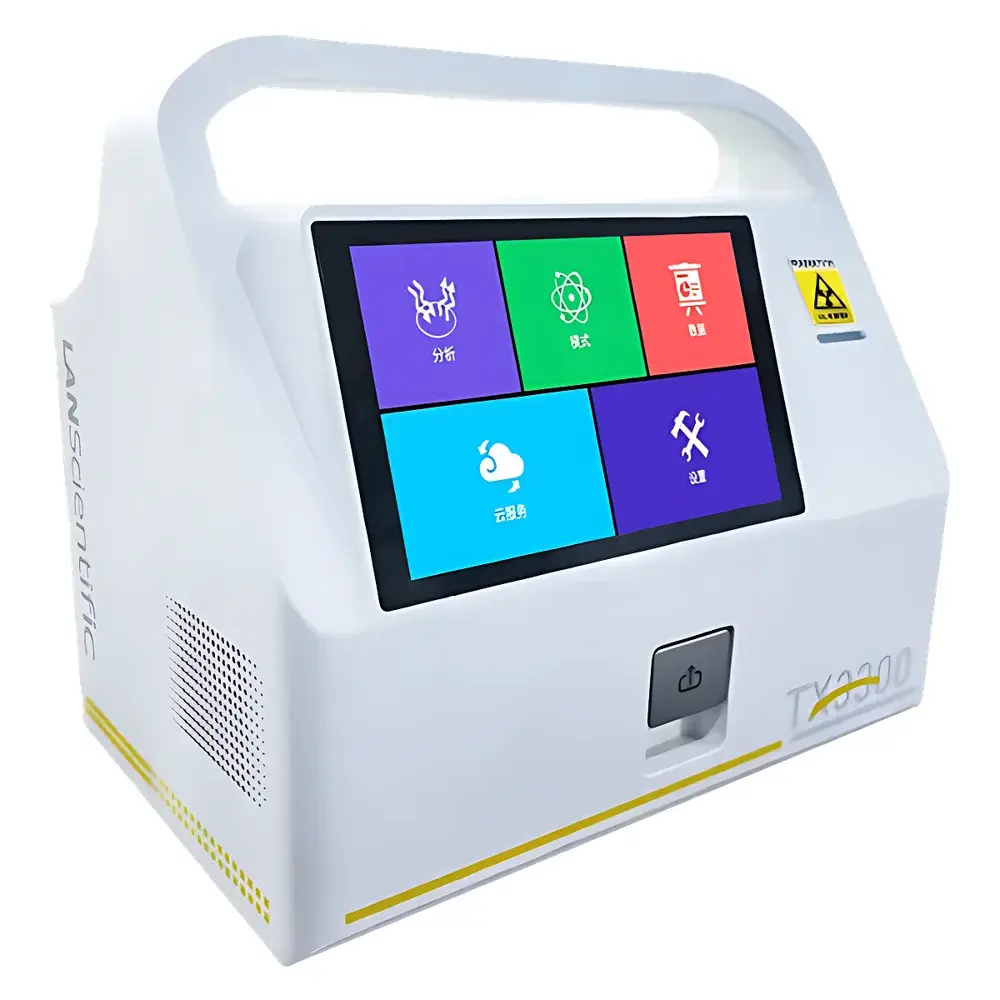
LANScientific TX3300Cl Portable Total-Reflection X-Ray Fluorescence (TXRF) Spectrometer for Inorganic Elemental Analysis in Methanol Fuel
| Brand | LANScientific |
|---|---|
| Origin | Jiangsu, China |
| Manufacturer Type | Manufacturer |
| Model | TX3300Cl |
| Application | Handheld/Portable |
| Instrument Type | Total-Reflection X-Ray Fluorescence (TXRF) |
| Industry-Specific Use | Energy & Chemical Engineering |
| Elemental Range | Mg (12) to U (92) |
| Detection Range | 0.3 ppm – 100 ppm |
| Detector | Silicon Drift Detector (SDD) |
Overview
The LANScientific TX3300Cl is a purpose-engineered, handheld total-reflection X-ray fluorescence (TXRF) spectrometer designed specifically for trace inorganic elemental analysis in methanol-based fuels and related energy feedstocks. Unlike conventional energy-dispersive X-ray fluorescence (ED-XRF) systems, TXRF employs a grazing-incidence geometry where the primary X-ray beam strikes the sample carrier—typically a quartz or silicon wafer—at an angle below the critical angle for total external reflection (<0.1°). This configuration suppresses background scattering from the substrate, dramatically enhancing signal-to-noise ratio and enabling sub-ppb detection limits for elements from magnesium (Mg, Z=12) through uranium (U, Z=92). The instrument leverages a high-brilliance microfocus X-ray tube and a Peltier-cooled silicon drift detector (SDD) with high count-rate capability and excellent energy resolution (~125 eV at Mn Kα), ensuring robust quantification of multi-element impurities—including sulfur (S), chlorine (Cl), calcium (Ca), iron (Fe), nickel (Ni), and vanadium (V)—without matrix-matched standards or acid digestion.
Key Features
- True portable TXRF architecture: Compact footprint (≤280 × 220 × 120 mm), weight <3.2 kg, battery-operated (optional), enabling on-site analysis at fuel blending facilities, storage terminals, or R&D labs.
- Ultra-low detection limits: Achieves detection limits down to 0.05–0.3 pg (≈0.1–0.6 ppb in 10 µL aqueous deposit), validated per ISO 18507 and ASTM D7042 protocols for fuel contaminants.
- Light-element optimization: Enhanced sensitivity for S and Cl due to minimized Bremsstrahlung background and optimized excitation/detection geometry—critical for assessing corrosion potential and catalyst poisoning in methanol fuel systems.
- No-sample-prep workflow: Direct analysis of ≤10 µL liquid deposits dried on ultra-clean quartz carriers; eliminates acid digestion, dilution, or calibration curve generation for routine screening.
- Radiation safety by design: Enclosed beam path with interlocked shutter and <1 µSv/h leakage at 5 cm (IEC 61010-1 compliant); no regulatory licensing required for field deployment in most jurisdictions.
- Thermal and mechanical stability: Integrated temperature-controlled stage and passive vibration damping ensure reproducible spot positioning and spectral stability over 8+ hour continuous operation.
Sample Compatibility & Compliance
The TX3300Cl accepts liquid samples—including neat methanol, methanol-water blends, bioderived methanol, and denatured fuel grades—with minimal preparation. Viscosity range: 0.3–2.5 cP; maximum suspended solids: <5 mg/L (to avoid carrier contamination). Solid residues (e.g., filter membranes post-fuel filtration) may be analyzed after solvent extraction and drop-casting. The system supports compliance workflows aligned with ASTM D7042 (determination of trace metals in diesel and biodiesel), ISO 8217 (marine fuel specifications), and EN 14214 (biodiesel purity requirements). All spectral acquisition, processing, and reporting logs are timestamped and user-auditable, supporting GLP/GMP documentation needs and 21 CFR Part 11–compatible electronic signatures when paired with optional LANScientific LabManager software.
Software & Data Management
Pre-installed TXRF Analyzer v4.2 firmware provides intuitive touch-screen operation, automated peak deconvolution (using fundamental parameter + empirical correction algorithms), and batch report generation in PDF/CSV/XLSX formats. Quantitative analysis employs internal standardization (e.g., Ga or Y spike) or standardless mode with certified reference materials (CRM) validation (e.g., NIST SRM 2781, ERM-EC680k). Data export supports LIMS integration via OPC UA or secure FTP. Audit trails record all method changes, calibration events, and user actions with immutable timestamps—fully traceable for internal QA audits or third-party certification reviews.
Applications
- Quality control of commercial methanol fuel: Monitoring Cl⁻ (corrosion), Na/K (catalyst deactivation), Fe/Ni/V (wear metal ingress), and S-species (emission precursor).
- R&D of next-generation fuel formulations: Rapid screening of additive-induced elemental leaching or cross-contamination during co-processing.
- Environmental compliance verification: Field assessment of fuel spill residues or groundwater contamination near storage sites.
- Supply chain traceability: On-the-spot verification of supplier-provided certificates of analysis (CoA) for elemental impurity profiles.
- Regulatory support for IMO 2020 and EU RED II reporting: Documenting compliance with sulfur content limits (<0.10 wt% for marine distillates; <10 mg/kg for advanced biofuels).
FAQ
Does the TX3300Cl require daily calibration?
No—its fundamental parameter-based quantification engine eliminates routine calibration. Daily performance verification is conducted using a built-in check source (Fe-55/Mn-54), with results logged automatically.
Can it analyze undiluted methanol without matrix effects?
Yes—TXRF’s inherent insensitivity to bulk matrix composition allows direct analysis of neat methanol. Volatility is mitigated by rapid drying under inert gas purge (integrated N₂ flow option).
Is method validation support available for ISO/ASTM compliance?
Yes—LANScientific provides application notes, validation templates (LOD/LOQ, precision, recovery), and IQ/OQ documentation packages aligned with ISO/IEC 17025 laboratory accreditation requirements.
What maintenance is required beyond detector cooling?
Annual optical alignment verification and X-ray tube output calibration (performed by certified field service engineers); no consumables other than quartz carriers and N₂ purge gas.
How does TX3300Cl compare to lab-based ICP-MS for fuel analysis?
While ICP-MS offers lower absolute LODs, TX3300Cl delivers comparable sensitivity for key fuel contaminants (S, Cl, Ca, Fe, Ni, V) with zero sample prep, no argon consumption, and full portability—making it optimal for high-throughput screening and field triage.







