
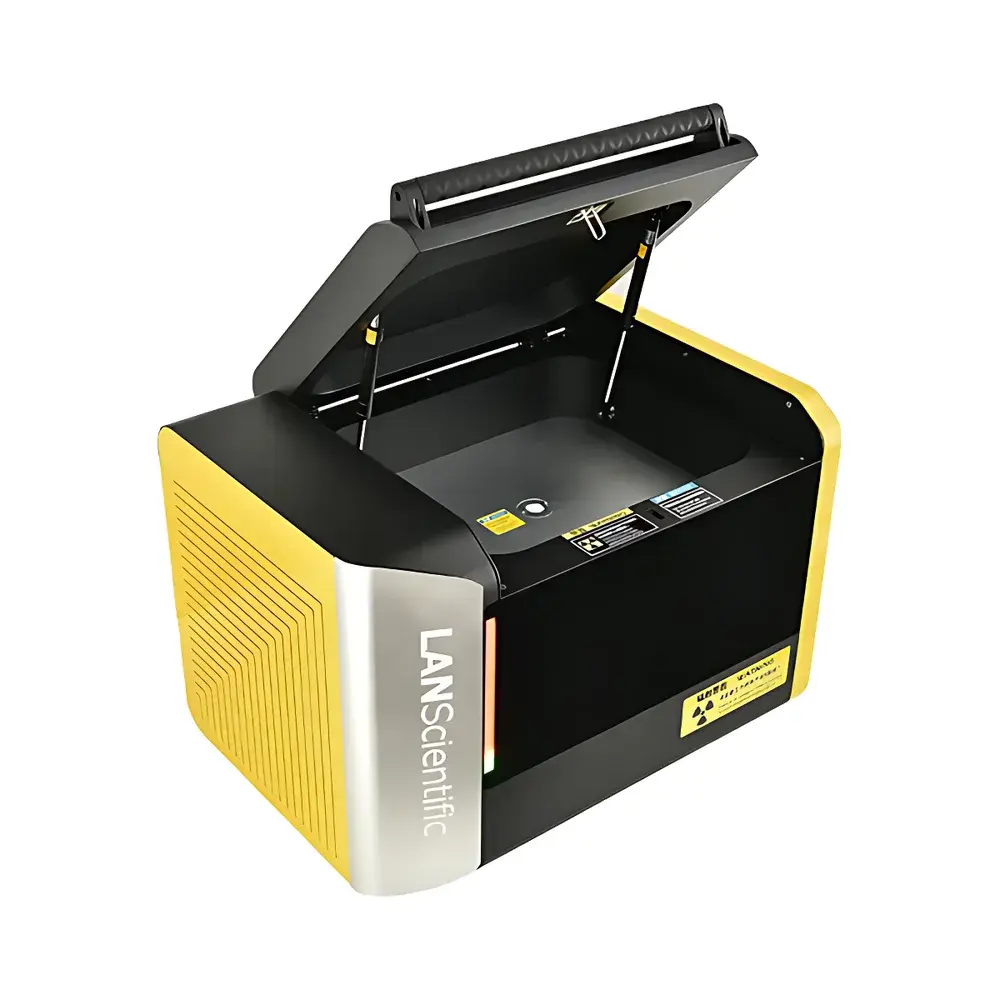
LANScientific ScopeX G59 High-Purity Gold X-Ray Fluorescence Spectrometer
| Brand | LANScientific |
|---|---|
| Origin | Jiangsu, China |
| Manufacturer Type | Manufacturer |
| Regional Classification | Domestic |
| Model | ScopeX G59 |
| Configuration | Benchtop/Floor-Standing |
| Instrument Type | Conventional ED-XRF |
| Industry-Specific Application | Non-Ferrous Metals (Precious Metals) |
| Elemental Range | Al (13) to U (92) |
Overview
The LANScientific ScopeX G59 is a benchtop/floor-standing Energy Dispersive X-Ray Fluorescence (ED-XRF) spectrometer engineered specifically for high-precision quantitative analysis of ultra-high-purity gold and its trace impurities. Operating on the fundamental principle of X-ray fluorescence—where primary X-rays excite inner-shell electrons in sample atoms, resulting in characteristic secondary (fluorescent) X-ray emission—the ScopeX G59 delivers non-destructive, rapid elemental quantification with exceptional sensitivity for light-to-heavy elements (Al to U). Its vertically oriented optical geometry minimizes geometric scatter and enhances signal-to-noise ratio, particularly critical for detecting sub-10 ppm Ag and Cu impurities in Au matrices. Designed to meet the metrological demands of certified gold trading environments—including 99.999% (AU99999) and higher purity grades—the instrument supports trace-level impurity profiling essential for compliance with national gold fineness standards (e.g., GB/T 4134–2021) and international assay practices.
Key Features
- Vertical beam path architecture optimized for high-count-rate detection and reduced background interference in dense metallic matrices.
- Large-area Silicon Drift Detector (SDD) with active area ≥ 50 mm² and energy resolution ≤ 125 eV at Mn Kα, enabling high spectral throughput and improved peak separation for overlapping Ag L-lines and Cu K-lines.
- Multi-aperture collimator set (Φ0.1 mm, Φ0.3 mm, Φ1.0 mm) for spatially resolved micro-analysis of small or irregularly shaped jewelry components, solder joints, or grain boundaries.
- Automated filter wheel with five selectable primary-beam filters (e.g., Al, Cu, Mo, Ti, open), dynamically selected per measurement to optimize excitation efficiency and minimize matrix absorption effects.
- Integrated thermal-stabilized X-ray tube (50 kV / 1 mA max) with dual-target anode (Rh/Ag) for flexible excitation across the full analytical range.
- Built-in thermal printer supporting immediate hard-copy generation of test reports compliant with ISO/IEC 17025 documentation requirements.
Sample Compatibility & Compliance
The ScopeX G59 accommodates samples up to 300 × 300 × 150 mm (W × D × H) within its motorized, vacuum-compatible sample chamber. It supports direct analysis of solid gold alloys, granules, foils, plated items, and sintered powders without digestion or coating. The system complies with IEC 61000-6-3 (EMC) and IEC 61000-6-4 (emission) standards. For regulated environments, data acquisition and reporting modules support audit-trail functionality aligned with GLP principles; optional software validation packages are available for laboratories operating under ISO 17025 or CNAS accreditation frameworks. While not FDA 21 CFR Part 11–certified out-of-the-box, the firmware architecture permits integration with validated LIMS platforms via ASTM E1382-compliant data export protocols.
Software & Data Management
The instrument is controlled by LANScientific’s proprietary QuantMaster XRF software, which implements hybrid quantification algorithms combining Fundamental Parameters (FP) modeling with empirical calibration curves. FP-based correction accounts for matrix absorption, enhancement, and inter-element effects—critical for accurate Ag/Cu quantification in near-pure Au. Software features include multi-point mapping mode, batch report generation (PDF/CSV/XLSX), user-defined pass/fail thresholds, and real-time spectral overlay comparison against reference libraries. All measurement parameters, spectra, and metadata are timestamped and stored locally with optional network backup. Raw spectral data adhere to the ASTM E1361 standard format for long-term archival and third-party reprocessing.
Applications
- Raw material verification at precious metal refineries and bullion suppliers.
- In-line purity monitoring during jewelry casting, rolling, and wire-drawing processes.
- Final product certification for AU9999 (99.99%) and AU99999 (99.999%) gold bars, coins, and investment-grade ingots.
- Impurity fingerprinting for forensic traceability—e.g., distinguishing recycled vs. newly mined gold based on characteristic Co/Ni/Pb/Sb signatures.
- Quality assurance in electroplating baths and sputtering target manufacturing.
- Research applications in metallurgical phase stability studies involving Au–Ag–Cu ternary systems.
FAQ
What is the detection limit for silver and copper in pure gold matrix?
The instrument achieves ≤10 ppm (w/w) detection limits for both Ag and Cu under optimized conditions (300 s live time, Φ0.3 mm collimator, Rh anode, vacuum atmosphere).
Can the ScopeX G59 analyze gold-plated substrates?
Yes—using multi-layer FP modeling, it quantifies Au layer thickness (10 nm–50 µm range) and underlying Ni/Cu substrate composition simultaneously.
Is vacuum or helium purge required for light element analysis?
Vacuum operation is recommended for reliable quantification of Al–Ca; helium flush is optional for enhanced Mg–Si sensitivity in air-mode measurements.
Does the system support regulatory reporting for assay laboratories?
Yes—software-generated reports include instrument ID, operator ID, date/time stamps, calibration history references, and uncertainty estimates per ISO/IEC 17025 Annex A.3.
What maintenance is required for long-term operational stability?
Annual detector resolution verification and X-ray tube output calibration are recommended; SDD cryocooler performance is monitored automatically via onboard diagnostics.





