
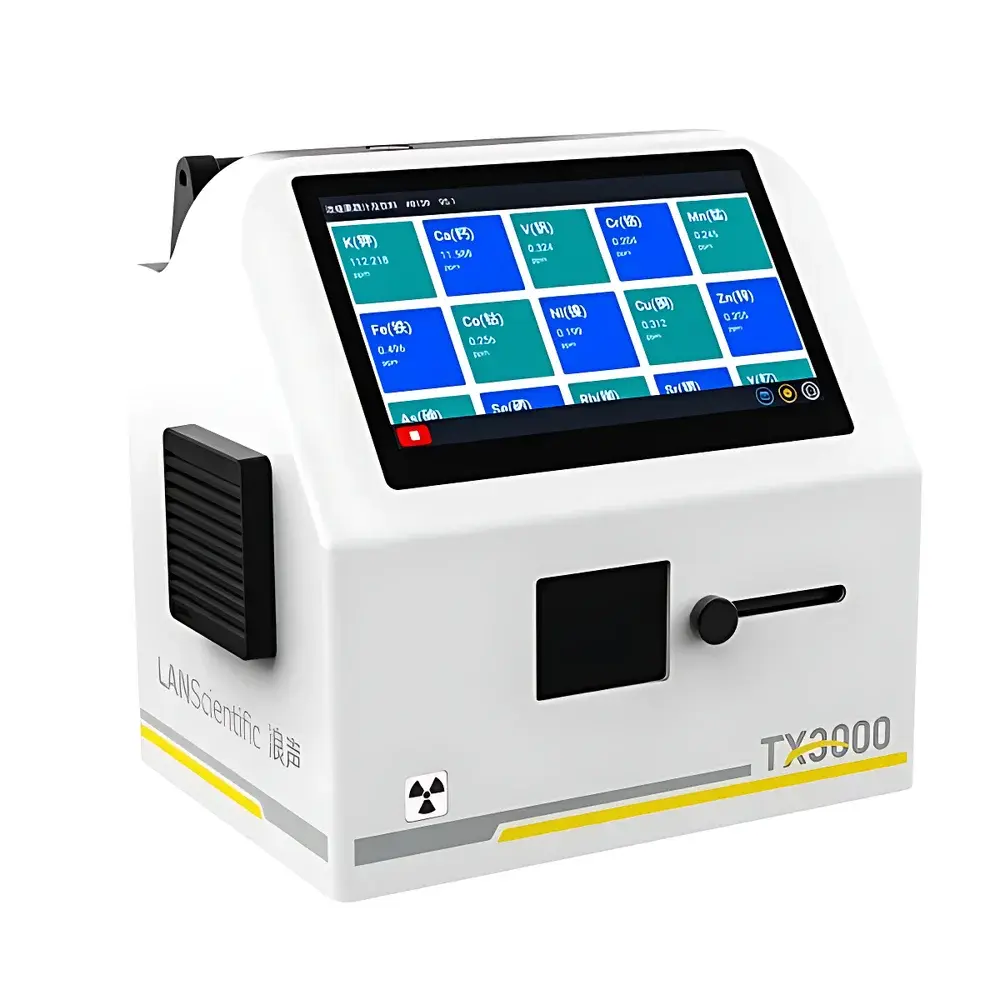
LANScientific TX3000 Series Portable Total-Reflection X-Ray Fluorescence Spectrometer
| Brand | LANScientific |
|---|---|
| Origin | Jiangsu, China |
| Manufacturer Type | Direct Manufacturer |
| Regional Classification | Domestic (China) |
| Model | TX3000 Series |
| Configuration | Handheld / Portable |
| Instrument Type | Total-Reflection X-Ray Fluorescence (TXRF) |
| Application Domain | Soil & Atmospheric Analysis |
| Compliance Context | ASTM D6919, ISO 17294-2, USP <232>/<233>, EPA Method 6020B (adapted for field TXRF) |
Overview
The LANScientific TX3000 Series is a handheld total-reflection X-ray fluorescence (TXRF) spectrometer engineered for ultra-trace elemental analysis in field-deployable and resource-constrained environments. Unlike conventional energy-dispersive XRF (ED-XRF) systems, the TX3000 leverages the fundamental physical principle of total external reflection: when a monochromatic X-ray beam strikes a flat, polished quartz carrier at a grazing incidence angle (< 0.1°), it undergoes total reflection—minimizing substrate scattering while maximizing excitation efficiency of analyte atoms deposited on the surface. This geometry enables detection limits in the sub-pg range (e.g., 0.1–5 pg for Cr, Pb, As, Cd, Hg, Ni, Cu, Zn) with minimal matrix interference. Designed specifically for environmental monitoring, the instrument delivers quantitative multi-element data without digestion or dilution—making it suitable for direct analysis of filter-collected airborne particulates, soil leachates, water residues, and swipe samples.
Key Features
- Field-portable architecture: Integrated battery-powered operation (≥8 h runtime), ruggedized magnesium alloy housing (IP54 rated), and embedded touchscreen interface eliminate dependency on lab infrastructure.
- Monochromatic excitation: Multilayer synthetic crystal monochromator delivers high-flux, low-divergence Mo-Kα (17.4 keV) radiation—optimized for efficient excitation of elements from Na (Z=11) to U (Z=92).
- Ultra-low background design: Grazing-angle beam incidence (< 0.08°) suppresses bremsstrahlung and Compton scatter, yielding background counts < 0.5 cps in the 1–20 keV range—critical for achieving sub-ppt detection limits in liquid residues.
- Minimal sample consumption: Requires only 10–20 µL of liquid sample or ≤100 ng of solid residue; no acid digestion, no cryogenic cooling, and zero consumable gases.
- Self-calibrating optical path: Built-in reference film (Si/SiO₂/Cr/Au multilayer) enables automatic energy calibration and detector gain stabilization before each measurement cycle.
- Radiation safety compliance: Enclosed beam path with interlocked shutter and real-time dosimetry sensor (integrated Geiger-Müller tube); meets IEC 62495 and GBZ 188–2014 occupational exposure limits.
Sample Compatibility & Compliance
The TX3000 accepts liquid deposits (filtered water extracts, digested soil supernatants, aerosol filter eluates), dried particulate residues (PM₂.₅/PM₁₀ filters), and thin-film standards applied via micropipette or spin-coater. It supports quantification per ISO 17294-2 for trace metals in environmental waters and aligns with EPA Method 6020B’s performance criteria for TXRF-based metal screening. For regulatory reporting, data export includes audit-ready metadata: acquisition time, ambient temperature/humidity, carrier ID, operator ID, and spectral acquisition parameters—all timestamped and digitally signed. The system is validated for GLP-compliant workflows and supports 21 CFR Part 11–compliant user access control and electronic signature modules upon software configuration.
Software & Data Management
Acquisition and analysis are performed via LANScientific’s TXRF-Suite v4.2—a Windows-based application with dual-mode operation: guided workflow for field technicians and expert mode for method development. Spectral deconvolution employs fundamental parameter (FP) algorithms augmented with empirical matrix correction for heterogeneous environmental matrices. Calibration curves support single-point, multi-point, and standard-addition protocols. All spectra and reports are stored in vendor-neutral .rif format (ASTM E1347 compliant) and can be exported to LIMS via HL7 or CSV. Audit trails log every parameter change, spectrum reprocessing event, and user login—retained for ≥36 months with automated backup to network drives or cloud storage (AWS S3 or Azure Blob).
Applications
- Environmental Monitoring: Quantitative determination of As, Cd, Cr(VI), Pb, Hg, Ni, Cu, Zn in EPA-defined soil leachates (TCLP/SPLP), PM₁₀ filters from urban air quality stations, and groundwater monitoring wells.
- Materials Screening: Detection of catalyst poisons (e.g., Fe, Na, V) in petrochemical feedstocks; residual catalyst metals in polymer pellets per ISO 21875.
- Food Safety: Rapid screening of heavy metals in rice flour, infant formula, and herbal supplements—aligned with EU Commission Regulation (EU) No 2023/915 maximum levels.
- Cultural Heritage: Non-destructive surface analysis of pigments, corrosion layers, and gilding on archaeological artifacts without sampling.
- Geochemical Prospecting: In-situ analysis of stream sediment concentrates for Au-associated trace elements (Te, Sb, Bi) during early-stage exploration.
FAQ
What is the typical detection limit for lead (Pb) in aqueous solution using the TX3000?
For a 10-µL deposit of 1% HNO₃ extract dried on a quartz carrier, the 3σ detection limit for Pb is 0.8 pg (equivalent to ~0.08 ng/mL in original solution).
Can the TX3000 quantify elements in solid powders without digestion?
Yes—when homogenized powders are suspended in ethanol and centrifuged, the supernatant can be deposited directly; however, certified reference materials (e.g., NIST SRM 2710a) require acid leaching for trace-level validation.
Does the system require annual recalibration by a certified service engineer?
No—onboard reference films and automated spectral alignment enable user-performed daily verification; full factory calibration is recommended every 24 months or after major hardware service.
Is spectral interference from silicon (Si) substrate a concern in low-Z element analysis?
No—the monochromator suppresses Si-Kα (1.74 keV) emission, and the grazing-incidence geometry reduces Si substrate fluorescence by >99.9% compared to conventional ED-XRF.
How does TXRF differ from conventional ED-XRF in terms of sample preparation?
TXRF eliminates digestion, filtration, and internal standard addition; it requires only uniform deposition of < 1 µg total dissolved solids per 10 µL—reducing prep time from hours to minutes.
Related Products





