
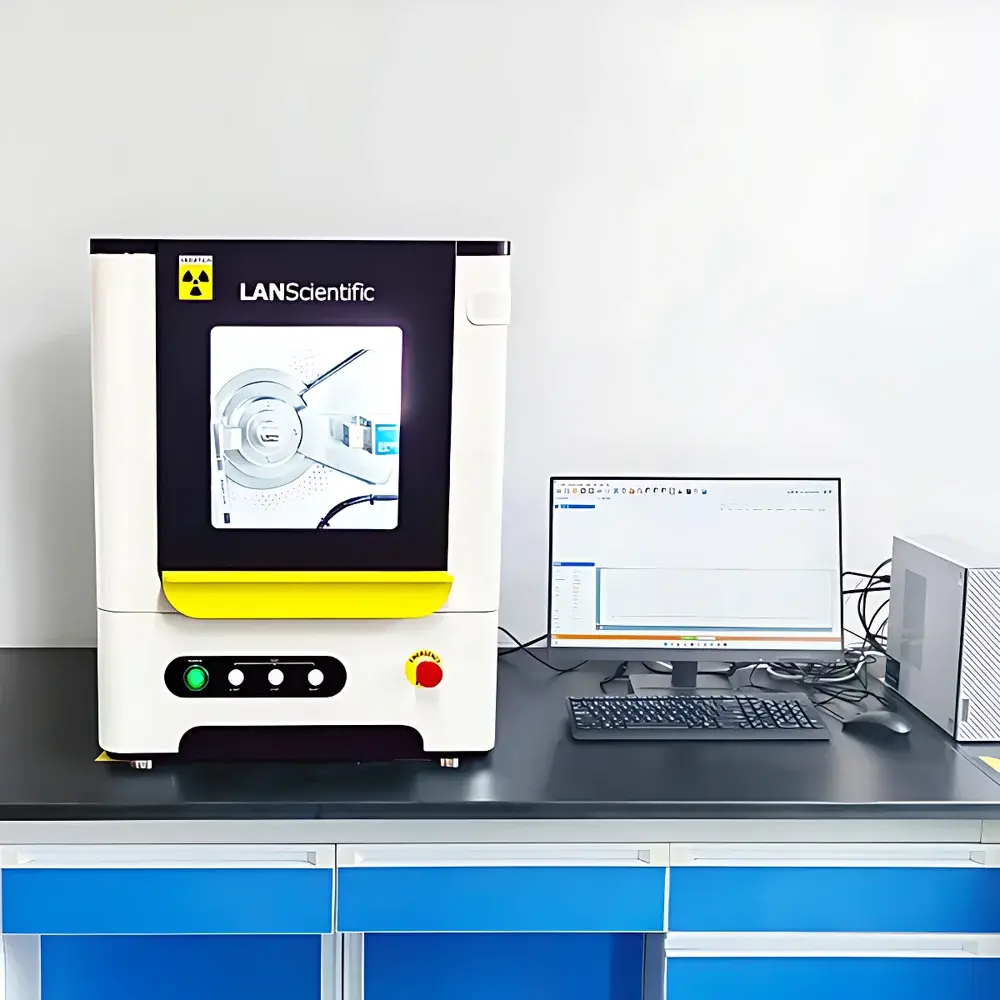
LANScientific FRINGE EV Desktop Powder X-ray Diffractometer
| Brand | LANScientific |
|---|---|
| Origin | Jiangsu, China |
| Manufacturer Type | Direct Manufacturer |
| Instrument Type | Powder X-ray Diffractometer |
| Geometry | Bragg-Brentano θ–2θ Reflection |
| Detector | Digital Pulse Processing Counter (DPPC) |
| Count Rate Capacity | ≥1 × 10⁷ counts per second (CPS) |
| Sample Stage | Fixed-center goniometer with integrated Soller slits |
| Power Supply | kW-class microfocus X-ray source (exact rating specified in technical documentation) |
| Compliance | CE-marked for laboratory use |
Overview
The LANScientific FRINGE EV is a benchtop powder X-ray diffractometer engineered for high-fidelity crystallographic analysis of pharmaceutical active pharmaceutical ingredients (APIs), excipients, and related solid-state materials. It operates on the Bragg–Brentano θ–2θ reflection geometry, where monochromatic or quasi-monochromatic X-rays—generated by a kW-class microfocus sealed-tube source—interact with crystalline samples mounted on a precision goniometer stage. When incident radiation satisfies Bragg’s law (nλ = 2d sinθ), constructive interference produces discrete diffraction peaks indexed to lattice plane spacings (d-values). These peaks are captured by a high-throughput Digital Pulse Processing Counter (DPPC) detector, enabling simultaneous acquisition of both diffraction intensity data and energy-dispersive spectral information—eliminating the need for secondary monochromators. The system’s compact footprint, air-spring assisted large-window hinged door, and rigid mechanical architecture support stable operation on standard laboratory desks or mobile platforms including vehicle-mounted analytical labs.
Key Features
- Integrated Soller slits—fixed-position, non-adjustable design—enhance angular resolution while eliminating mechanical drift and improving long-term goniometer reliability.
- DPPC detector with ≥1 × 10⁷ CPS count rate capacity ensures rapid data collection without pulse pile-up, supporting high-resolution phase identification even in low-intensity or highly attenuated samples.
- kW-class microfocus X-ray source delivers sufficient photon flux for robust signal-to-noise ratios across diverse sample types—including low-Z organics, hydrated salts, and metastable polymorphs—without requiring cryogenic cooling or external water chillers.
- Full interlock safety architecture: motorized chamber door triggers automatic beam shutdown upon opening; real-time status indicators confirm closed-door operational readiness in compliance with IEC 61010-1 Class I electrical safety standards.
- Benchtop form factor (W × D × H ≈ 650 × 580 × 420 mm) enables deployment in QC laboratories, formulation development suites, and academic teaching labs where floor space is constrained.
Sample Compatibility & Compliance
The FRINGE EV accepts powdered, pelletized, thin-film, and bulk solid specimens—ideal for routine polymorph screening, hydrate/anhydrate differentiation, and batch-to-batch crystallinity verification in pharmaceutical manufacturing. Its optical path and detector configuration comply with ASTM E975 (Standard Practice for X-ray Diffraction Analysis of Polycrystalline Materials) and ISO 17873 (X-ray diffraction—Qualitative and quantitative phase analysis). Data acquisition workflows support audit-trail generation required under FDA 21 CFR Part 11 when paired with validated CrystalX software configurations. All hardware components meet RoHS directives and carry CE marking for use within EU-regulated environments.
Software & Data Management
CrystalX software provides automated phase identification using the ICDD PDF-4+ database (licensed separately), quantitative Rietveld refinement (via embedded TOPAS engine), crystallinity index calculation (based on Segal method or full-pattern fitting), and unit-cell parameter optimization. Raw .raw and .xy files are exportable in CIF, ASCII, and Bruker RAW formats. Batch processing modules enable unattended multi-sample runs with metadata tagging (operator ID, timestamp, instrument serial number). Software validation packages—including IQ/OQ documentation templates—are available for GMP-compliant installations subject to internal SOPs and third-party qualification.
Applications
- Pharmaceutical solid-state characterization: polymorph mapping, amorphous content quantification, salt/co-crystal confirmation, and stability-indicating assay development.
- Regulatory submission support: generation of XRD patterns compliant with ICH Q5A(R2), Q6A, and Q7 guidelines for drug substance specifications.
- Academic research: teaching crystallography fundamentals, lattice parameter determination, and structure solution via direct methods (when coupled with single-crystal data).
- Materials science: phase evolution studies during thermal cycling, stress-induced texture analysis, and nanocrystallite size estimation via Scherrer equation implementation.
- Quality control: incoming raw material verification, blend uniformity assessment, and post-compression tablet integrity evaluation.
FAQ
Is the FRINGE EV suitable for GMP-regulated pharmaceutical laboratories?
Yes—when deployed with validated CrystalX software, documented IQ/OQ protocols, and configured for electronic signature and audit trail functionality, it meets foundational requirements for 21 CFR Part 11 compliance.
Does the system require external cooling or vacuum pumping?
No—the kW-class sealed X-ray tube operates air-cooled; no water chiller or vacuum pump is needed for standard operation.
Can the DPPC detector perform elemental analysis concurrently with XRD?
It acquires energy-dispersive spectral data alongside diffraction intensities, enabling qualitative elemental screening—but not quantitative EDXRF-grade analysis. For full elemental quantification, dedicated EDXRF instrumentation is recommended.
What sample preparation methods are supported?
Standard protocols include back-loading into zero-background silicon holders, side-loading into aluminum stubs, and capillary mounting for air-sensitive or volatile compounds.
Is remote monitoring or network integration possible?
CrystalX supports TCP/IP-based instrument control and data transfer; integration with LIMS via HL7 or CSV export is achievable through optional middleware modules.
Related Products






