
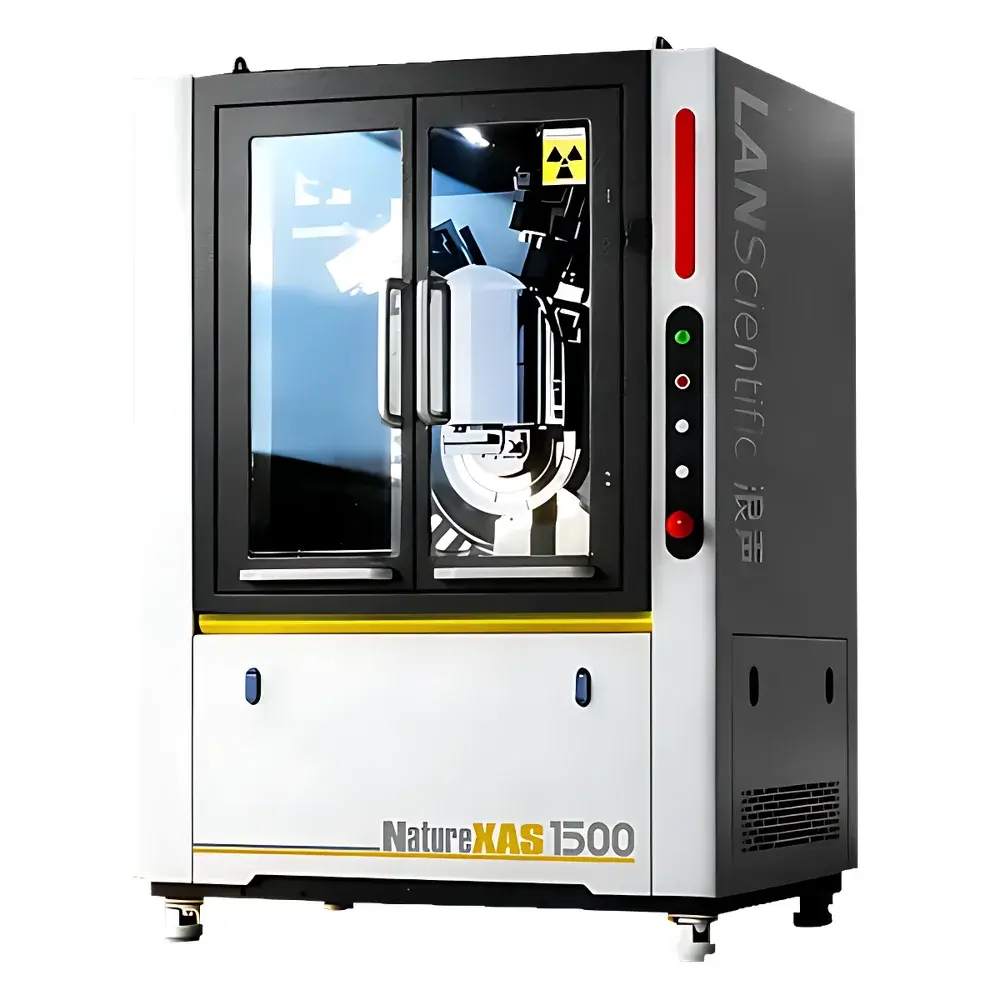
NatureXAS 1500 X-ray Absorption Fine Structure Spectrometer
| Brand | LANScientific |
|---|---|
| Origin | Jiangsu, China |
| Manufacturer Type | Original Equipment Manufacturer (OEM) |
| Product Category | Domestic Laboratory X-ray Spectrometer |
| Model | NatureXAS 1500 |
| Pricing | Upon Request |
Overview
The NatureXAS 1500 is a laboratory-scale, benchtop X-ray Absorption Fine Structure (XAFS) spectrometer engineered for high-fidelity elemental speciation and local structural analysis without reliance on synchrotron radiation. It employs a Rowland-circle optical geometry with a large-aperture bent crystal monochromator, enabling high signal-to-noise ratio (SNR) and long-term spectral stability under ambient laboratory conditions. The system simultaneously supports both X-ray Absorption Spectroscopy (XAS) — including XANES and EXAFS regions — and X-ray Emission Spectroscopy (XES) modes, with seamless in-situ switching via motorized optical components. Its core measurement principle is based on energy-dispersive detection of absorption edges and fine-structure oscillations induced by core-level excitation, allowing quantitative determination of oxidation state, coordination number, bond distance, Debye–Waller factor, and electronic configuration around target atoms. Designed for routine use in academic and industrial R&D laboratories, the NatureXAS 1500 delivers synchrotron-comparable spectral fidelity — particularly in XANES edge features, pre-edge peak intensities, and white-line ratios — while maintaining full compatibility with GLP-compliant workflows.
Key Features
- Rowland-circle monochromator with dynamically adaptive servo-controlled bent-crystal alignment — eliminates manual recalibration upon crystal exchange
- Dual-mode operation: integrated XAS and XES acquisition with software-triggered mode switching
- Patented dual-feedback optical stabilization: real-time position monitoring via optical encoders coupled with closed-loop piezoelectric actuation
- Helium-purged, quick-release beamline enclosure ensuring atmospheric exclusion without optical realignment
- Modular, all-in-one cabinet design integrating microfocus X-ray source (≤50 µm focal spot), multi-axis motorized sample stage, and silicon-drift detector (SDD) array
- Automated in-situ data collection: full high-resolution XAFS scan completed within minutes under controlled reaction environments (electrochemical, gas/liquid flow, thermal)
- Standardized mechanical and electrical interfaces for third-party in-situ cells (e.g., electrochemical flow cells, high-pressure gas reactors, cryostats, furnace stages)
Sample Compatibility & Compliance
The NatureXAS 1500 accommodates solid powders, thin films, foils, frozen solutions, and encapsulated liquid-phase samples across a broad elemental range (Ti K-edge to I L3-edge). Sample mounting follows ASTM E2714-20 guidelines for X-ray spectroscopic reference materials. The instrument architecture complies with IEC 61000-6-3 (EMC emissions) and IEC 61000-6-2 (immunity) standards. Data acquisition and processing modules support audit-trail logging per FDA 21 CFR Part 11 requirements when deployed in regulated environments. All spectral metadata — including monochromator angle, detector gain, incident flux, and environmental parameters — are embedded in HDF5-formatted output files, ensuring traceability and reproducibility per ISO/IEC 17025:2017 Annex A.2.
Software & Data Management
The proprietary XAS-Studio software provides a unified interface for instrument control, real-time diagnostics, and spectral processing. Key modules include: (1) Auto-alignment wizard with live beam profile visualization; (2) In-situ experiment scheduler supporting time-resolved XAFS/XES series; (3) Integrated Athena-compatible preprocessing pipeline (energy calibration, background subtraction, normalization, k-space conversion); (4) Export to standard formats (DXAS, SPEC, CSV) for downstream analysis in Artemis, FEFF, or LARCH. All user actions, parameter changes, and error logs are timestamped and stored locally with SHA-256 hash integrity verification. Remote access is supported via TLS-encrypted VNC session, enabling off-site monitoring without compromising data sovereignty.
Applications
- Catalysis: Operando tracking of Pt, Pd, Fe, or Co single-atom sites during CO oxidation or HER, resolving dynamic changes in coordination symmetry and d-band occupancy
- Battery Materials: In-cell XAFS of Ni/Mn/Co K-edges during galvanostatic cycling, quantifying cation mixing, lattice oxygen redox, and interfacial side-reaction kinetics
- Nanomaterials: Structural fingerprinting of dopant atoms in quantum dots or MOF linkers, distinguishing substitutional vs. interstitial incorporation
- Geochemistry: Speciation of As(III)/As(V) and Cr(III)/Cr(VI) in soil extracts, correlating coordination geometry with bioavailability and leaching potential
- Biological Systems: Metalloprotein active-site mapping of Fe-S clusters in nitrogenase or Mn-Ca-O motifs in PSII, preserving native conformation under cryogenic or anaerobic conditions
- Environmental Interfaces: Time-resolved adsorption studies of Pb(II) on ferrihydrite surfaces, resolving inner-sphere complex formation versus surface precipitation
FAQ
Does the NatureXAS 1500 require synchrotron beamtime?
No — it operates independently using a high-brightness microfocus X-ray tube and optimized Rowland-circle optics, delivering lab-based XAFS data comparable in resolution and SNR to third-generation synchrotron beamlines.
Can it perform true time-resolved measurements?
Yes — with sub-minute scan capability and programmable trigger synchronization, it supports millisecond-to-minute temporal resolution depending on signal intensity and desired k-range coverage.
Is helium purging mandatory for all measurements?
Helium atmosphere is required for measurements below the Cu K-edge (≤8.98 keV) to minimize air absorption; above this energy, air-path operation is fully supported.
What sample forms are compatible with in-situ cells?
Electrode-coated foils, slurry-cast membranes, gas-diffusion layers, and sealed capillary cells are routinely used; custom cell integration follows ISO 17025 mechanical interface specifications.
How is energy calibration verified?
Calibration uses certified reference foils (e.g., Fe, Cu, Zn) traceable to NIST SRM 1979, with automated edge alignment routines cross-validated against internal monochromator encoder feedback.





