
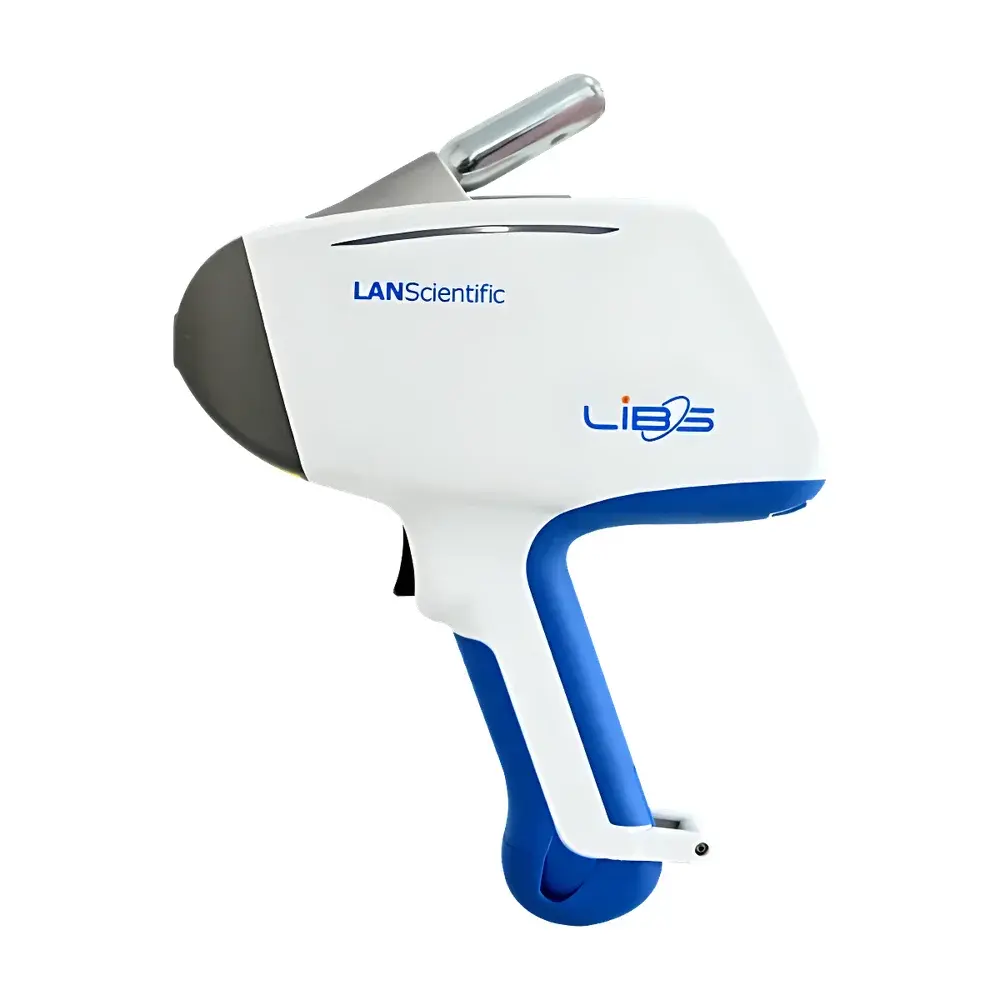
LANScientific LIBS 820C Handheld Laser-Induced Breakdown Spectroscopy Analyzer
| Brand | LANScientific |
|---|---|
| Origin | Jiangsu, China |
| Manufacturer Type | Direct Manufacturer |
| Instrument Type | Handheld |
| Model | LIBS 820C |
| Compliance | CE, RoHS, FDA 21 CFR Part 11 (Software Audit Trail Enabled) |
| Laser Class | 3B Pulsed Nd:YAG (1064 nm, <10 ns pulse width, ≤50 mJ/pulse) |
| Weight | 1.7 kg |
| Detection Elements | C, Si, Mn, Cr, Ni, Mo, V, Nb, Ti, Al, Cu, Co, W, B, Be, Li, P, S, N, Fe (matrix) |
| Typical Carbon LOD | 25–50 ppm (steel matrix, Ar purge) |
| Spectral Resolution | ≤0.1 nm (FWHM @ 247.8 nm C I line) |
| Analysis Time | ≤3 s per measurement |
| Sample Interface | Non-contact, micro-ablation spot size: 50–100 µm |
| Power Supply | Rechargeable Li-ion battery (≥8 h continuous operation) |
| Environmental Rating | IP54 |
| Operating Temperature | −10 °C to 50 °C |
Overview
The LANScientific LIBS 820C is a handheld laser-induced breakdown spectroscopy (LIBS) analyzer engineered for rapid, in-situ elemental analysis of metallic alloys—with particular emphasis on quantitative carbon determination in ferrous and non-ferrous materials. Unlike X-ray fluorescence (XRF), which lacks sensitivity for light elements, the LIBS 820C leverages high-energy pulsed laser ablation to generate transient micro-plasma on the sample surface. Emitted atomic and ionic emission spectra—spanning the UV–VIS range (190–850 nm)—are captured by a high-throughput, thermoelectrically cooled CCD spectrometer with optimized optical path design. The system employs time-gated detection synchronized to plasma decay dynamics, enabling suppression of continuum background and enhancement of signal-to-noise ratio for critical lines such as C I at 247.86 nm. This physical principle underpins its capability for direct, calibration-free semi-quantitative screening and factory-calibrated quantitative analysis—without requiring sample dissolution, grinding, or vacuum environments.
Key Features
- Real-time carbon quantification in steels and alloys with typical detection limits of 25–50 ppm under argon-purged conditions
- Integrated argon purge module minimizing atmospheric interference (O₂/N₂-induced CN/NO molecular bands), thereby improving spectral clarity and reproducibility of C, N, and O lines
- Light-element specificity: Reliable detection of C, B, Be, Li, and other low-Z elements inaccessible to conventional XRF systems
- Micro-destructive analysis: Laser spot diameter adjustable to 50–100 µm; ablation depth <1 µm per shot—leaving no visible damage to polished or coated surfaces
- Ergonomic handheld form factor (1.7 kg total mass) with balanced center-of-gravity design, tactile trigger interface, and glove-compatible touchscreen
- Laser safety architecture compliant with IEC 60825-1:2014: Class 3B pulsed Nd:YAG source with hardware-enforced interlock circuitry, beam shutter, and proximity sensor-based auto-shutdown
- Onboard battery supports ≥8 hours of continuous field operation; hot-swappable dual-battery option available for extended shift use
Sample Compatibility & Compliance
The LIBS 820C is validated for direct analysis of solid metallic samples including stainless steels (AISI 304/316/410), Cr-Mo steels (ASTM A335 P11/P22), low-alloy steels (ASTM A105/A106), cast irons (ASTM A48/A536), and nickel-based superalloys (Inconel 600/718). Surface condition requirements are minimal: flatness deviation <50 µm over 5 mm² and absence of thick oxide layers or heavy grease contamination. The instrument conforms to ISO 11583:2012 (LIBS performance testing), ASTM E2926-22 (Standard Guide for LIBS Analysis of Metals), and EU Directive 2014/30/EU (EMC). Software firmware includes full audit trail logging per FDA 21 CFR Part 11 requirements, supporting GLP/GMP-regulated environments in metallurgical QA/QC labs and production floors.
Software & Data Management
Embedded Linux-based operating system runs LANScientific’s proprietary LIBS AnalyzeSuite™ v4.2 software. Key modules include: (i) Auto-calibration wizard using certified reference materials (CRMs) traceable to NIST SRMs; (ii) Multivariate curve resolution–alternating least squares (MCR-ALS) spectral deconvolution for overlapping peaks; (iii) Matrix-matched calibration libraries for >120 alloy grades (UNS, EN, GB/T, JIS standards); (iv) Real-time statistical process control (SPC) dashboard with Cp/Cpk calculation and out-of-spec alerting; (v) Export formats: CSV, PDF reports (with digital signature), and direct integration via OPC UA or RESTful API into MES/ERP systems (e.g., SAP QM, Siemens Opcenter).
Applications
- Scrap sorting and recycling: Rapid grade verification of mixed ferrous/non-ferrous streams at shredder facilities
- Aerospace component certification: In-field verification of carbon content in turbine disk forgings prior to heat treatment
- Automotive powertrain QA: On-line carbon check of crankshaft and camshaft steels during machining
- Oil & gas pipeline integrity: Field assessment of carbon migration in weld HAZ zones of X65/X70 line pipe
- Power generation maintenance: Spot-checking carbon depletion in boiler tube superheater sections exposed to high-temperature oxidation
- R&D metallurgy labs: High-throughput screening of novel alloy compositions during development cycles
FAQ
Does the LIBS 820C require external gas supply for routine operation?
Yes—argon purging is recommended for optimal carbon sensitivity and precision. An integrated 120 mL disposable argon cartridge provides ≥200 measurements per charge; optional external cylinder interface supports continuous flow for high-volume applications.
Can the instrument analyze painted or galvanized surfaces?
Surface coatings must be removed mechanically or ablated through via multi-shot mode. Single-shot analysis is only valid on bare metal; automated coating-thickness compensation is not supported.
Is spectral library customization possible for proprietary alloys?
Yes—users may import custom CRM datasets and generate application-specific calibrations using the Calibration Builder module, subject to internal validation protocols.
What is the recalibration interval under normal field use?
Factory calibration remains stable for ≥6 months under controlled storage; field recalibration using certified steel CRMs (e.g., NIST SRM 1251 series) is advised every 200 measurements or after mechanical shock exposure.
How does the LIBS 820C handle heterogeneous microstructures such as welds or cast dendrites?
The instrument supports raster mapping mode (5×5 grid, 25 points) with automatic spatial averaging; reported values represent median intensity-weighted composition across the mapped area.
Related Products






