
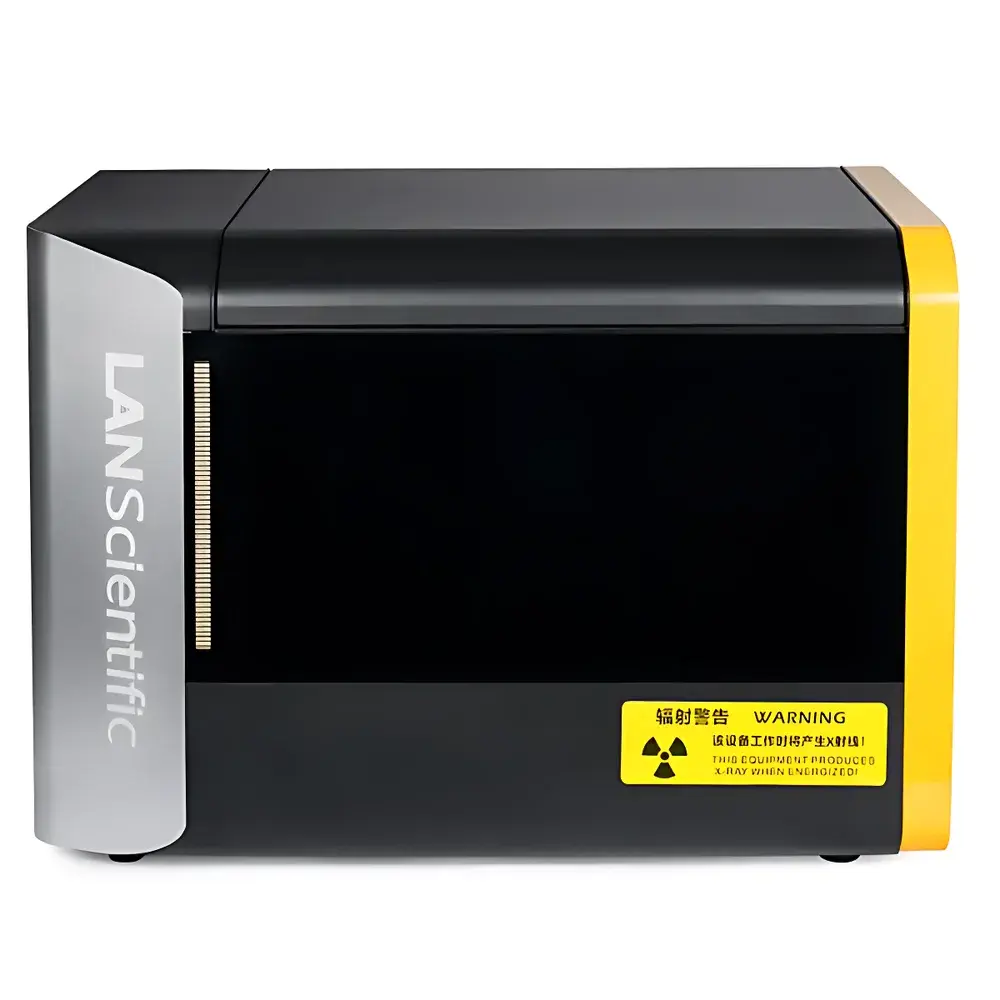
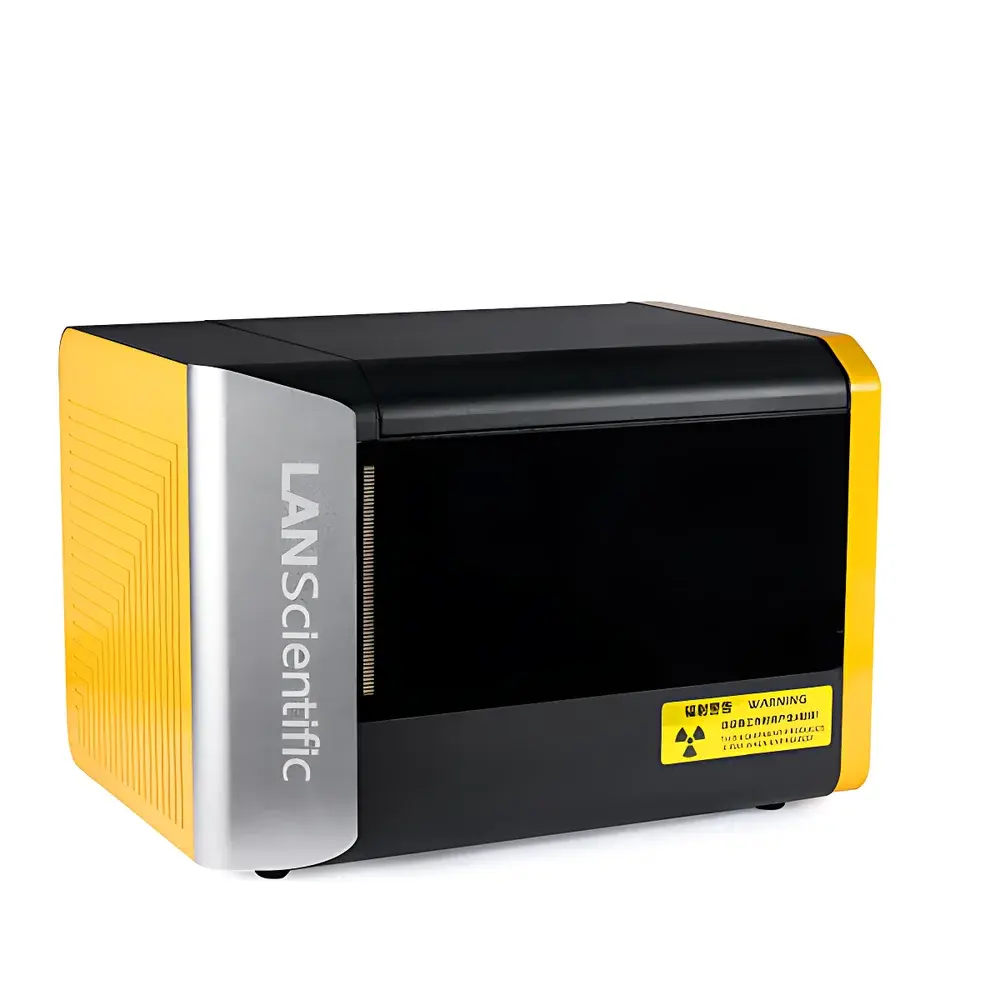
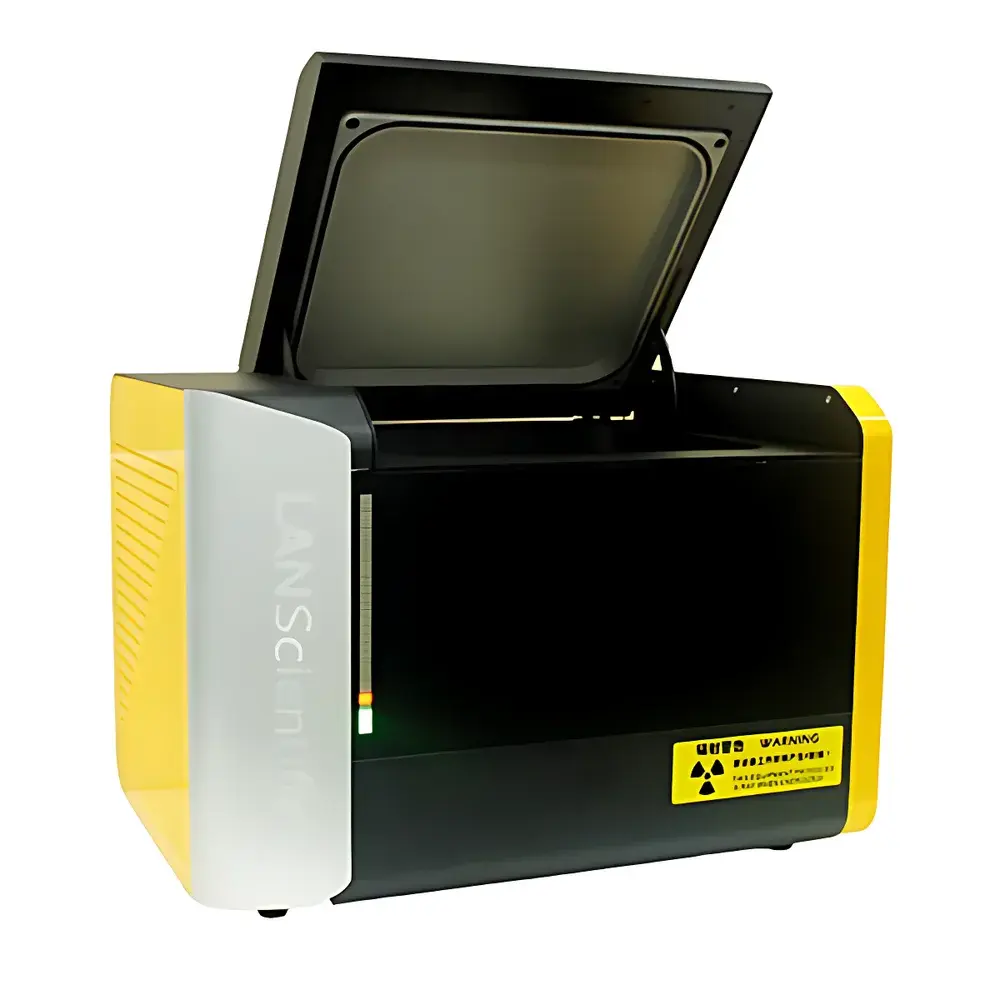
LANScientific ScopeX Desktop Energy Dispersive X-Ray Fluorescence Spectrometer for Ceramic and Silicate Analysis
| Brand | LANScientific |
|---|---|
| Origin | Jiangsu, China |
| Manufacturer Type | Direct Manufacturer |
| Origin Category | Domestic (China) |
| Model | ScopeX Ceramic & Silicate Analyzer |
| Form Factor | Benchtop |
| Instrument Type | Conventional ED-XRF |
| Industry-Specific Application | Non-Ferrous Metals & Inorganic Materials |
| Elemental Range | Na (11) – U (92) |
| Detection Limit | down to sub-ppm level for selected elements |
| Sample Compatibility | Solid, Powder, Liquid, Thin Film, Coating |
| Excitation Source | Low-Energy X-ray Tube with Intelligent Vacuum System |
| Detector | Peltier-Cooled Silicon Drift Detector (SDD) |
| Collimators | 5 mm, 3 mm, 1 mm, 0.5 mm (motorized auto-switching) |
| Filters | Multiple programmable primary beam filters |
| Data Interfaces | USB 3.0, Wi-Fi 5 (802.11ac), Bluetooth 5.0 |
| Software Output Formats | Customizable Excel, PDF, CSV, Spectral Image (PNG/SVG) |
| Regulatory Compliance | GB18871-2002, GBZ115-2002, IEC 61000-6-3 EMC |
Overview
The LANScientific ScopeX Desktop Energy Dispersive X-Ray Fluorescence (ED-XRF) Spectrometer is an engineered solution for rapid, non-destructive elemental quantification in ceramic, silicate, geological, and metallurgical matrices. Based on fundamental XRF physics, the instrument irradiates samples with a focused, low-energy X-ray beam, inducing characteristic secondary fluorescence emission from atoms across the periodic table (Na–U). Emitted photons are energy-resolved by a high-resolution silicon drift detector (SDD), enabling simultaneous multi-element detection without chemical digestion or sample destruction. Unlike wavelength-dispersive systems, the ScopeX leverages optimized excitation geometry, vacuum-assisted light-element sensitivity, and real-time spectral deconvolution to deliver reproducible quantitative results for major, minor, and trace constituents — particularly critical for Si, Al, Mg, Ca, Fe, Ti, K, Na, P, S, and transition metals such as Cr, Ni, and Mo in refractory ceramics, clays, feldspars, glazes, and industrial slags.
Key Features
- Integrated intelligent vacuum system enabling reliable detection of light elements (Na, Mg, Al, Si, P, S) without liquid nitrogen or complex purge gas infrastructure
- Motorized collimator turret with four apertures (0.5 mm, 1 mm, 3 mm, 5 mm) and programmable filter wheel for adaptive excitation optimization per sample type and target element
- Peltier-cooled SDD detector offering stable energy resolution (<145 eV at Mn Kα) and long-term spectral fidelity without cryogenic maintenance
- Benchtop architecture with enlarged sample chamber (Ø 100 mm × H 60 mm), accommodating irregular solids, pressed pellets, loose powders, liquids in sealed cups, and coated substrates up to 30 mm thick
- Multi-modal connectivity: native support for USB 3.0 high-speed acquisition, enterprise-grade Wi-Fi (WPA3-secured), and Bluetooth 5.0 for peripheral integration and remote diagnostics
- Full hardware interlock system including shielded metal enclosure, radiation door sensor, and electromagnetic safety cutoff compliant with national radiation protection standards (GB18871-2002, GBZ115-2002)
Sample Compatibility & Compliance
The ScopeX is validated for heterogeneous inorganic materials common in ISO 12885, ASTM C114 (cement analysis), ASTM D7359 (petroleum catalysts), and ISO 21047 (silicate rock geochemistry). It accepts unprepared or minimally prepared samples — no fusion required for routine ceramic batch control. Certified reference materials (CRMs) including NIST SRM 278, GBW(E) 070082 (clay), and USGS GSP-2 (granite) demonstrate repeatability ≤1.5% RSD for major oxides and ≤5% RSD for trace elements below 100 ppm. The system supports GLP-compliant operation through audit-trail-enabled software logging, user access levels, and electronic signature capability aligned with FDA 21 CFR Part 11 readiness.
Software & Data Management
The proprietary QuantMaster™ analysis suite provides full spectral acquisition, peak deconvolution using fundamental parameter (FP) and empirical calibration models, matrix correction (e.g., alpha correction for absorption/enhancement effects), and automated oxide conversion. Users define custom report templates in Excel or PDF formats — embedding company logos, measurement metadata, spectral overlays, and statistical summaries (mean, SD, CV%, detection limits). All raw spectra (.spe), processed results (.csv), and configuration files (.qcf) are timestamped, version-controlled, and exportable via network share or encrypted USB drive. Optional cloud sync enables centralized instrument fleet monitoring and method library synchronization across QC labs.
Applications
- Quality assurance of raw materials (kaolin, quartz, feldspar) and fired ceramic bodies for Al₂O₃, SiO₂, Fe₂O₃, TiO₂, and alkali content
- Routine analysis of glaze compositions and heavy metal leachables (Pb, Cd, As) per EN 13821 and ASTM C738
- Process control of cement clinker and supplementary cementitious materials (SCMs) per ISO 29581-2
- Elemental mapping of mineral phases in geological thin sections and slag microstructures
- Coating thickness and composition verification for electroplated Ni/Cr layers and anodized aluminum
- Recycled material screening in WEEE and ELV streams for regulated substances (RoHS, REACH)
FAQ
Does the ScopeX require liquid nitrogen cooling?
No. It employs solid-state Peltier cooling for the SDD detector, eliminating cryogen handling, refills, and associated downtime.
Can it analyze powdered samples without pressing into pellets?
Yes — loose powders may be analyzed directly in specialized sample cups with Mylar film windows; however, pressed pellets are recommended for highest precision in quantitative oxide analysis.
Is method transfer possible between different ScopeX units?
Yes. Calibration models, spectral libraries, and instrument configurations are fully portable via encrypted .qcf files and supported by cross-unit validation protocols.
What regulatory documentation is provided for installation qualification (IQ) and operational qualification (OQ)?
LANScientific supplies IQ/OQ test scripts, factory calibration certificates traceable to NIST standards, and radiation safety compliance reports per GB18871-2002.
How is data integrity ensured during long-term deployment in regulated environments?
The software enforces role-based access control, immutable audit trails for all analytical actions, electronic signatures, and automatic backup to network-attached storage — satisfying core requirements of GLP, ISO/IEC 17025, and pharmaceutical QA frameworks.
Related Products






