
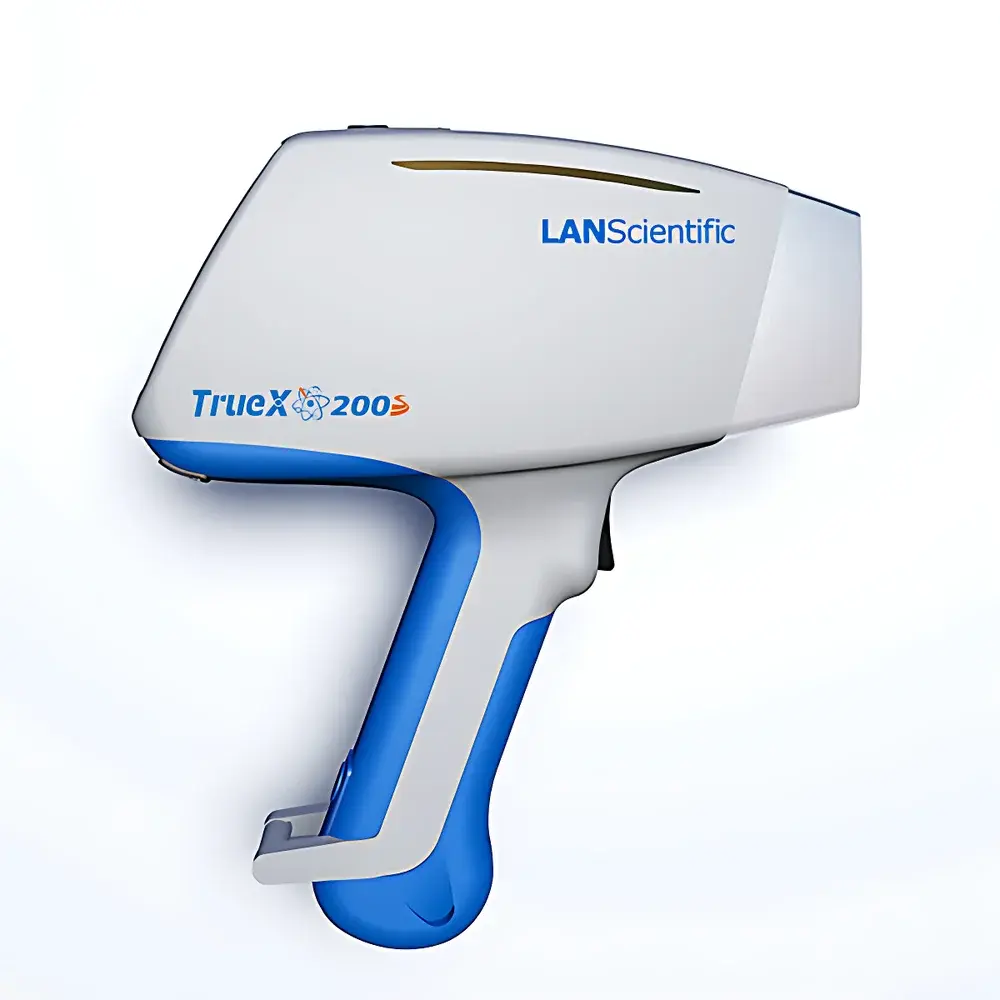
LANScientific TrueX 200S Portable Energy Dispersive X-Ray Fluorescence (EDXRF) Spectrometer for Soil Heavy Metal Analysis
| Brand | LANScientific |
|---|---|
| Origin | Jiangsu, China |
| Manufacturer Type | Manufacturer |
| Regional Category | Domestic |
| Model | TrueX 200S |
| Application | Handheld/Portable |
| Instrument Type | Conventional |
| Industry-Specific Type | General-Purpose |
| Elemental Range | Mg–U |
| Quantification Range | 1 ppm – 99.99% |
| Energy Resolution | <140 eV |
| Repeatability | 0.1% |
| Detector | High-Performance Silicon Drift Detector (SDD) |
Overview
The LANScientific TrueX 200S is a field-deployable, handheld energy dispersive X-ray fluorescence (EDXRF) spectrometer engineered for rapid, non-destructive elemental quantification in soil, sediment, sludge, dust, and other heterogeneous environmental matrices. Operating on the fundamental principle of X-ray fluorescence—where primary X-rays excite atoms in the sample, causing emission of characteristic secondary X-rays—the instrument delivers laboratory-grade analytical performance under real-world field conditions. Its optimized excitation geometry, high-efficiency SDD detector, and integrated vacuum/purge capability ensure reliable detection of light elements from magnesium (Mg) through uranium (U), with quantification sensitivity down to 1 ppm for key heavy metals including Pb, As, Cd, Cr, Hg, Ni, Cu, Zn, and Mn. Designed for regulatory compliance workflows, the TrueX 200S supports immediate decision-making during site characterization, remediation verification, and RCRA-related screening without requiring sample digestion or off-site lab submission.
Key Features
- True handheld form factor (<1.5 kg) with ergonomic grip, IP54-rated enclosure, and 8-hour battery life for extended field deployment.
- One-touch analysis workflow: automatic spectrum acquisition, peak deconvolution, matrix correction, and quantification completed in ≤3 seconds per measurement.
- High-resolution silicon drift detector (SDD) with <140 eV Mn Kα energy resolution at 0°C, enabling precise separation of overlapping spectral lines (e.g., As Kα/Pb Lα, Cr Kα/V Kα).
- Repeatability of ≤0.1% RSD (relative standard deviation) for major element concentrations across repeated measurements on homogeneous reference materials.
- Non-destructive testing (NDT) protocol: no sample preparation required—direct analysis of moist soils, powders, filter membranes, or solid fragments without grinding, drying, or acid digestion.
- Real-time dual-unit display: simultaneous readout of elemental mass fraction (%) to three decimal places and concentration in ppm, with configurable significant figures and unit switching.
Sample Compatibility & Compliance
The TrueX 200S accommodates a broad range of physical sample types encountered in environmental field work: bulk soils (clay, silt, sand), wet/dry sediments, air particulate filters (e.g., TSP, PM10), industrial sludges, landfill cover materials, and corrosion residues. Its collimated X-ray beam (3 mm diameter) and adaptive beam filtration minimize matrix effects across variable grain size and moisture content. The instrument complies with IEC 61000-6-3 (EMC emissions), IEC 61000-6-2 (immunity), and meets radiation safety requirements per IEC 62495 (handheld XRF devices). Method validation aligns with EPA Method 6200 (Field Portable XRF for Elemental Analysis) and supports data defensibility under ASTM D7212 (Standard Test Method for Low-Z Element Analysis in Plastics by EDXRF) and ISO 12847 (Soil Quality — Determination of Elements by XRF). Data integrity adheres to ALCOA+ principles (Attributable, Legible, Contemporaneous, Original, Accurate, Complete, Consistent, Enduring, Available) for GLP/GMP-aligned reporting.
Software & Data Management
LANScientific’s proprietary TrueX Manager software provides secure, audit-ready data handling. It supports role-based user authentication with encrypted password protection, customizable report templates (including corporate logo, address, and footer metadata), and export to PDF, CSV, and Excel formats. All spectral data—including raw counts, processed spectra, calibration coefficients, and instrument diagnostic logs—are stored with timestamped metadata. Software features include remote firmware updates via HTTPS, automated energy calibration using built-in reference sources, real-time system health monitoring (detector temperature, vacuum status, tube current/voltage), and configurable alarm thresholds for rapid pass/fail screening. Full traceability is maintained through electronic audit trails compliant with FDA 21 CFR Part 11 requirements for electronic records and signatures.
Applications
- On-site RCRA metal screening (As, Ba, Cd, Cr, Pb, Hg, Se, Ag) in soils and waste streams prior to disposal classification.
- Remediation progress monitoring: pre-/post-excavation analysis of contaminated sites (e.g., brownfields, mining tailings, industrial spill zones).
- Regulatory compliance verification for TCLP-extractable metals and total recoverable concentrations per EPA SW-846.
- Baseline geochemical mapping and anthropogenic metal enrichment assessment in agricultural or urban soils.
- QA/QC of dredged sediments, construction fill materials, and recycled aggregates used in civil engineering projects.
- Emergency response triage during chemical spills or hazardous material releases involving heavy metal contamination.
FAQ
Does the TrueX 200S require sample homogenization or drying before analysis?
No. The instrument is validated for direct analysis of as-received soil samples, including those with high moisture content or organic matter, provided surface debris is removed and the measurement window is in full contact.
Can the instrument quantify light elements such as sulfur or phosphorus in soils?
Yes—Mg through U coverage includes S, P, Cl, and K, critical for soil fertility and contaminant co-occurrence studies; optimal detection requires helium purge or vacuum mode for elements below Ca.
Is method validation documentation available for regulatory submissions?
Yes. LANScientific provides comprehensive validation reports including limit of detection (LOD), limit of quantification (LOQ), linearity (R² >0.999), and inter-laboratory comparison data per ISO/IEC 17025 guidelines.
How is calibration maintained during long-term field use?
Users may perform daily energy calibration using internal radioactive check sources; factory calibrations are traceable to NIST SRM 2711a and 2710a certified reference materials.
What safety certifications does the device hold for international shipment and operation?
CE marking (EMC & LVD directives), RoHS compliance, and UN 3481 Class 9 hazardous goods classification for air transport of lithium batteries.



