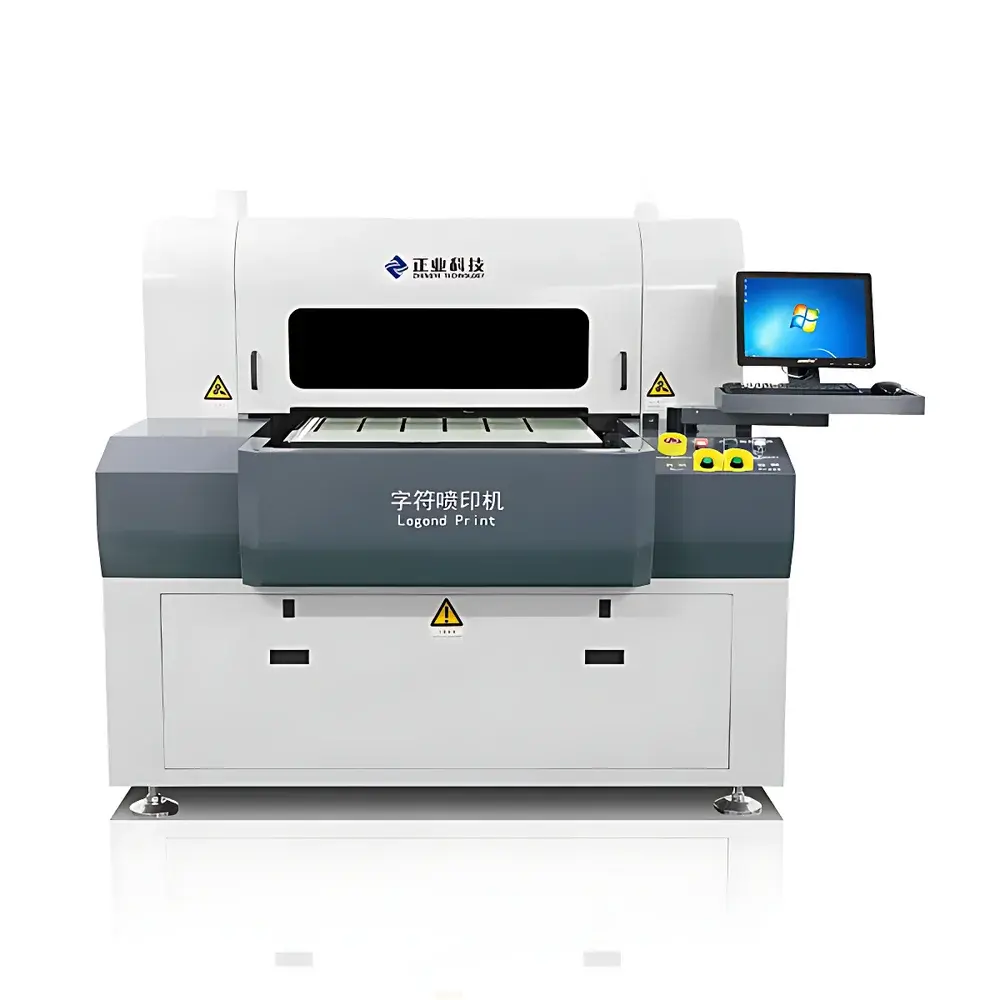
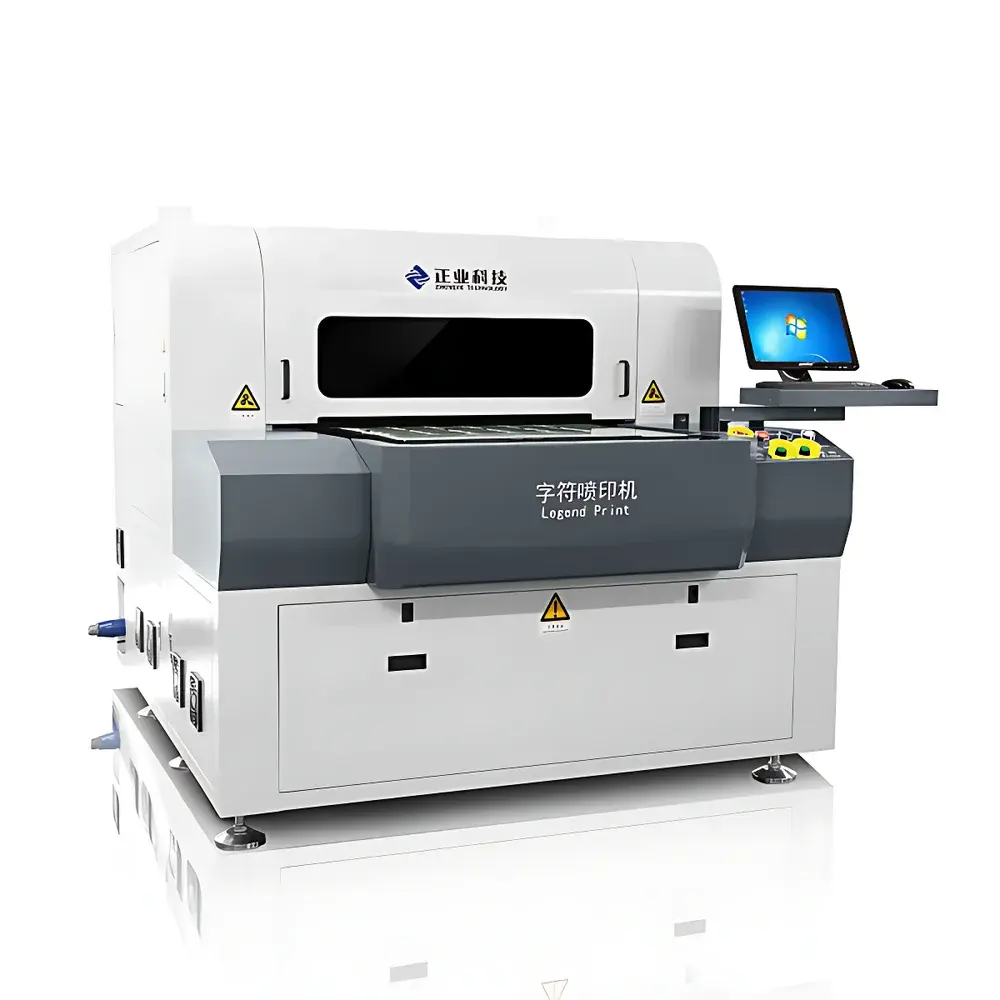
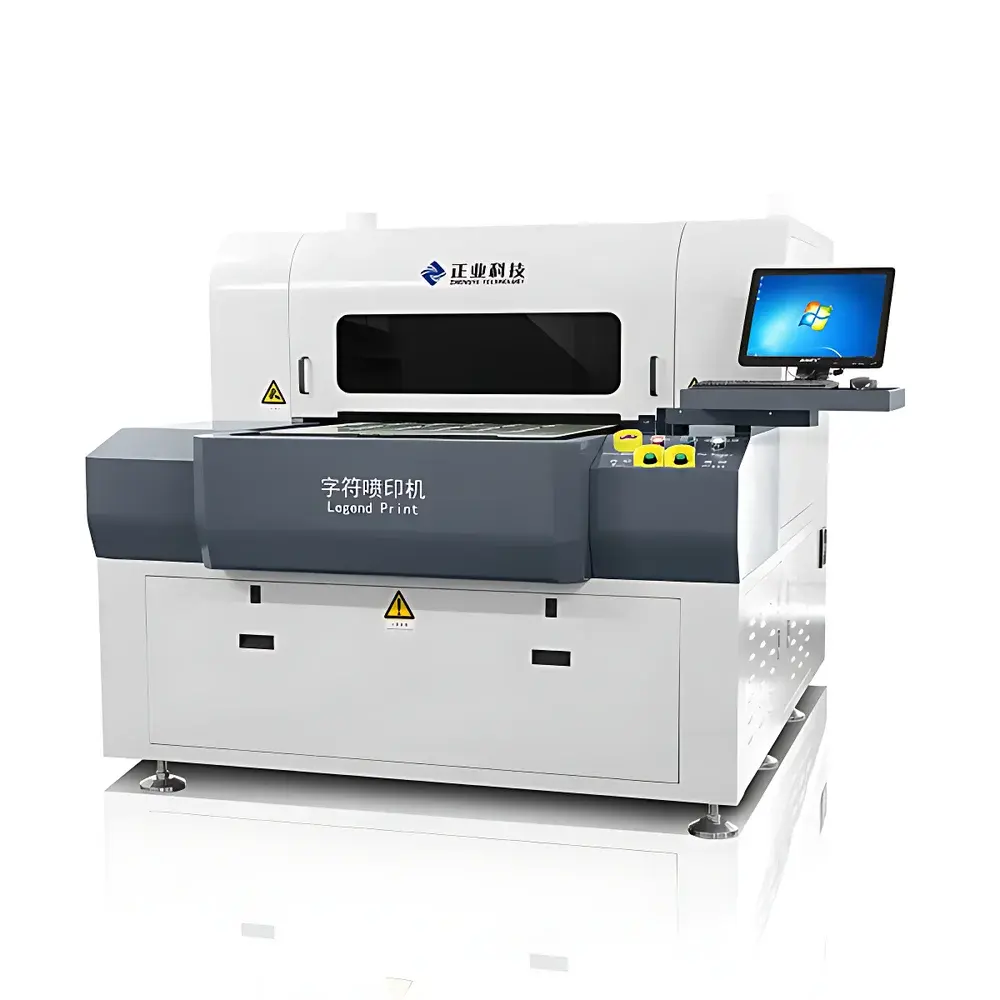
Zhengye PY300D High-Precision UV Inkjet Marking System for PCB, FPC, IC Substrates & LED Backlight Panels
| Brand | Zhengye |
|---|---|
| Origin | Guangdong, China |
| Manufacturer Type | Direct Manufacturer |
| Country of Origin | China |
| Model | PY300D |
| Pricing | Upon Request |
| Positioning Accuracy | ±38 µm |
| Repeatability | ±5 µm |
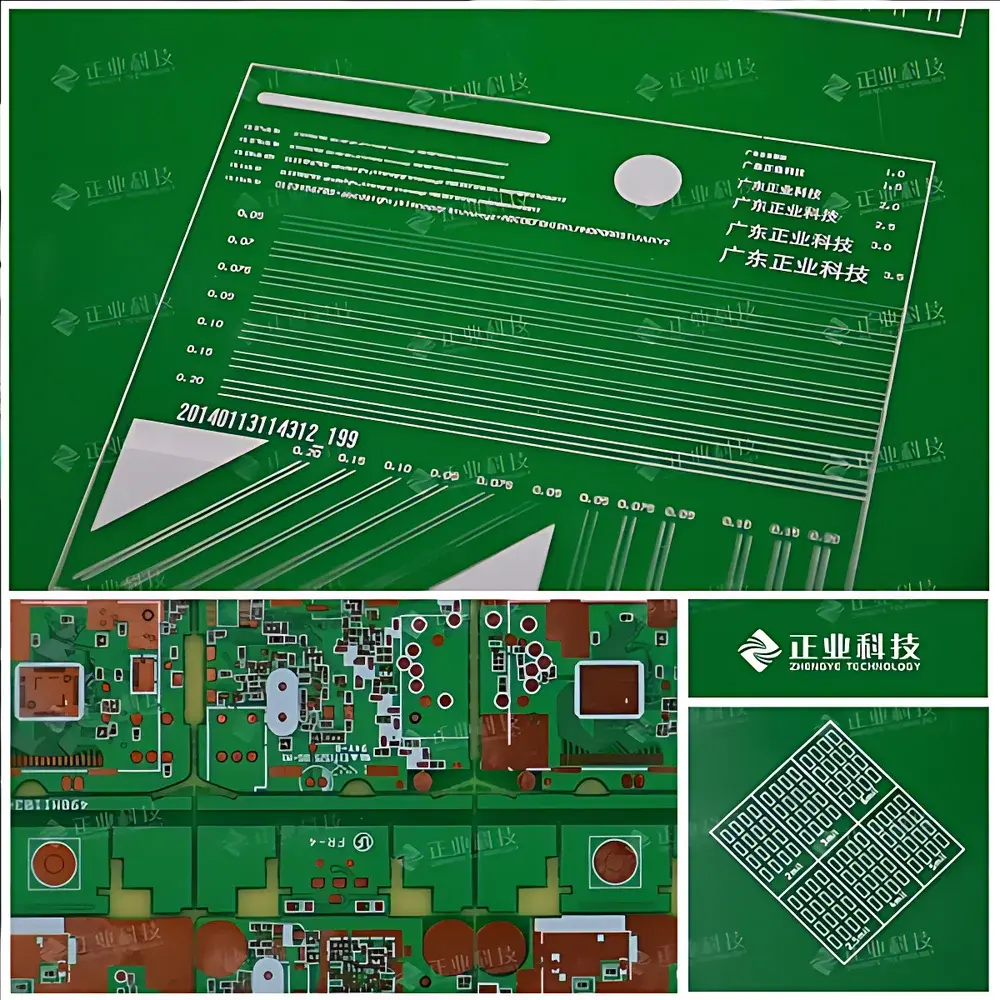
| Print Resolution | 720 × 360 dpi to 1440 × 1440 dpi |
| Minimum Line Width | 75–100 µm |
| Minimum Character Height | 0.5 mm |
| Max Board Size | 730 mm × 621 mm (28″ × 24″) |
| Board Thickness Range | 0.1–6 mm (4–236 mil) |
| Footprint (L×W×H) | 2050 mm × 1650 mm × 1650 mm |
| Weight | 1450 kg |
| Nozzle Configuration | 1024i × 4 |
| Throughput (Mass Production Mode, 2-pass) | 150 panels/hour |
| Throughput (High-Accuracy Mode, 3-pass) | 120 panels/hour |
| UV Pre-Curing System | Integrated |
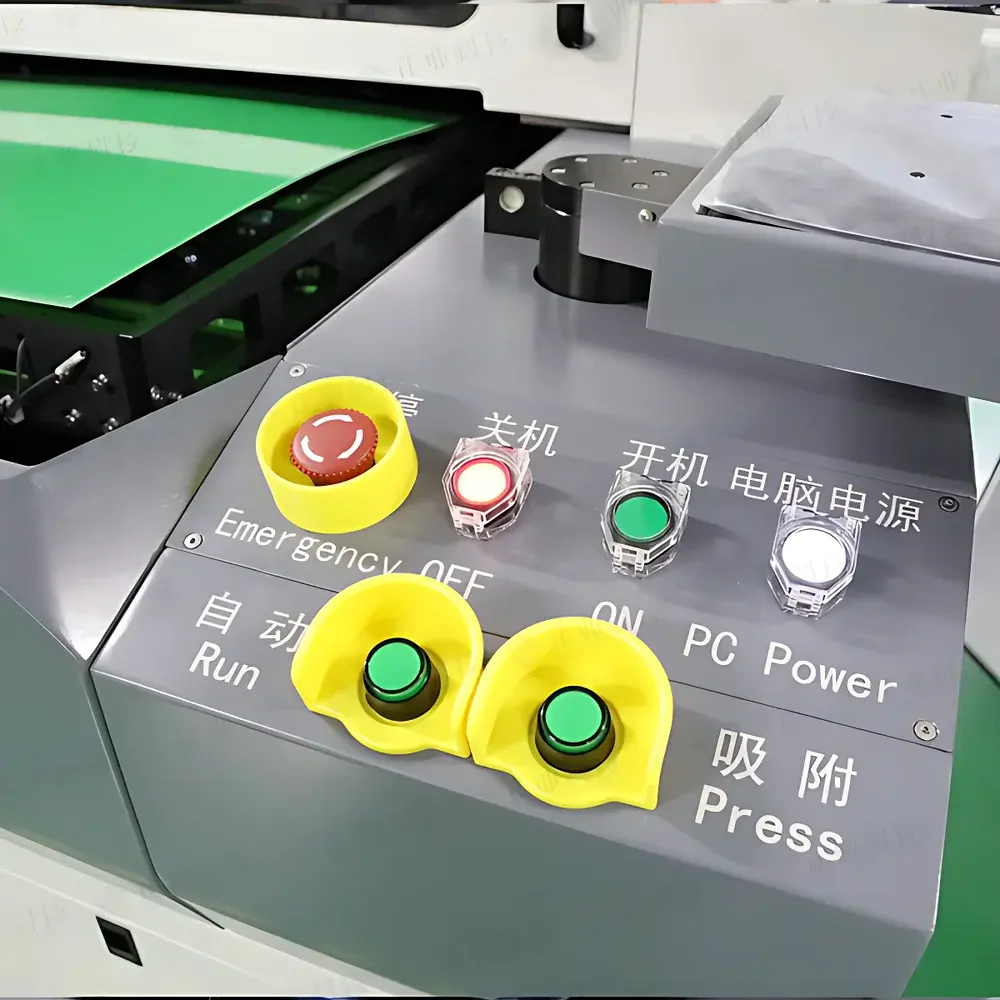
| Automation Options | Robotic Arm Loading/Unloading (with flip capability) or Vacuum Suction-Based Handling (no flip) |
Overview
The Zhengye PY300D is a purpose-built, industrial-grade UV inkjet marking system engineered specifically for high-precision alphanumeric and barcode printing on rigid and flexible printed circuit boards (PCBs), flexible printed circuits (FPCs), IC substrates, and LED backlight panels. Unlike conventional screen printing—limited by stencil wear, alignment drift, and low resolution—the PY300D employs non-contact piezoelectric inkjet technology with real-time positional feedback and dynamic board distortion compensation. Its core architecture integrates a high-rigidity granite base, precision linear motor-driven gantry with dual-axis servo synchronization, and closed-loop optical encoder positioning—enabling stable, repeatable deposition of UV-curable ink onto solder mask (green, black, white), coverlay, and bare copper surfaces. Designed for integration into semiconductor packaging and advanced electronics manufacturing lines, the PY300D meets stringent requirements for traceability, process control, and first-pass yield in IPC Class 3 and automotive-grade production environments.
Key Features
- Precision motion control: Dual-stage servo-driven XY gantry with granite base and air-bearing linear guides ensures ±38 µm absolute positioning accuracy and ±5 µm repeatability across full working envelope.
- Adaptive registration: Multi-point fiducial recognition (up to 8 points per panel) combined with real-time image-based scaling and rotation compensation corrects for thermal expansion, mechanical stretch, and substrate warpage during printing.
- High-fidelity ink deposition: Four independently controlled 1024-nozzle industrial printheads deliver variable-drop grayscale printing at resolutions up to 1440 × 1440 dpi; minimum line width maintained at 75–100 µm depending on surface topography and ink rheology.
- UV pre-cure integration: In-line 365 nm LED UV curing module stabilizes ink adhesion immediately after deposition—reducing smearing, improving edge definition, and enabling rapid stacking or downstream handling.
- Modular automation interface: Supports two factory-integrated material handling configurations—robotic arm loading/unloading with 180° panel flipping capability, or vacuum-based shuttle table with dual-station buffering for continuous flow operation.
Sample Compatibility & Compliance
The PY300D accommodates standard and custom panel formats up to 730 mm × 621 mm (28″ × 24″) and board thicknesses from 0.1 mm (flexible polyimide) to 6 mm (rigid multilayer substrates). It supports industry-standard solder masks—including LPI green, black, white, and matte finishes—as well as coverlay films and bare copper surfaces. All firmware and motion control logic comply with IEC 61508 functional safety principles for industrial machinery. The system’s ink delivery subsystem conforms to ISO 8502-3 for surface cleanliness assessment prior to marking, and its calibration protocol aligns with ISO/IEC 17025 traceability requirements when operated under GLP/GMP conditions. Optional audit trail logging and user access controls support FDA 21 CFR Part 11 readiness for regulated medical device PCB manufacturing.
Software & Data Management
The proprietary Zhengye MarkSoft™ v4.2 platform provides offline job preparation, real-time print monitoring, and integrated data logging. Operators define marking fields using vector-based font libraries (TrueType/OpenType), barcode symbologies (Code 128, QR, DataMatrix), and custom graphics—all subject to geometric constraint validation and DFM rule checking (e.g., minimum spacing, clearance from edges/cutouts). All print jobs are timestamped, version-controlled, and stored with full metadata—including panel ID, camera-calibrated fiducial offsets, nozzle health status, and UV irradiance log. Data export supports CSV, XML, and OPC UA protocols for MES/SCADA integration. Role-based authentication (admin/operator/maintenance) enforces separation of duties, while encrypted local storage ensures intellectual property protection.
Applications
- Permanent serial number, lot code, and date-code marking on HDI PCBs and ABF-based IC substrates for semiconductor backend assembly traceability.
- UL-certified labeling on power supply PCBs and automotive ECU modules requiring IPC-A-610 Class 3 compliance.
- High-density barcode marking on FPCs used in foldable smartphone displays—where traditional silk screening fails due to substrate flexibility and micro-feature density.
- LED backlight panel identification—including polarity indicators, binning codes, and thermal management labels—printed directly onto diffusion films or aluminum frames.
- Prototype and NPI support: Rapid job setup (<5 min) enables fast iteration across design revisions without tooling changeover.
FAQ
What types of UV-curable inks are compatible with the PY300D?
The system is validated for use with Zhengye ZY-UV series inks (green, white, black, yellow) formulated for adhesion to solder mask and polyimide. Third-party inks may be qualified upon submission of material safety data sheets (MSDS) and compatibility test reports.
Does the PY300D support JESD22-A114 (ESD-safe marking) requirements?
Yes—optional conductive ink variants and grounded printhead modules are available for electrostatic discharge–sensitive applications; full qualification requires joint testing with end-customer ESD protocols.
Can the system integrate with existing factory automation via SECS/GEM?
Standard Ethernet/IP and Modbus TCP interfaces are provided; SECS/GEM implementation requires optional communication gateway license and host-side configuration support.
Is remote diagnostics and firmware update supported?
Yes—via secure TLS-encrypted VPN connection using Zhengye RemoteCare™ service; all updates undergo SHA-256 signature verification prior to installation.
What maintenance intervals are recommended for printhead cleaning and calibration?
Daily automated nozzle check and weekly wet-cleaning cycle are advised; full optical calibration and mechanical alignment verification are scheduled every 500 operational hours or quarterly—whichever occurs first.