
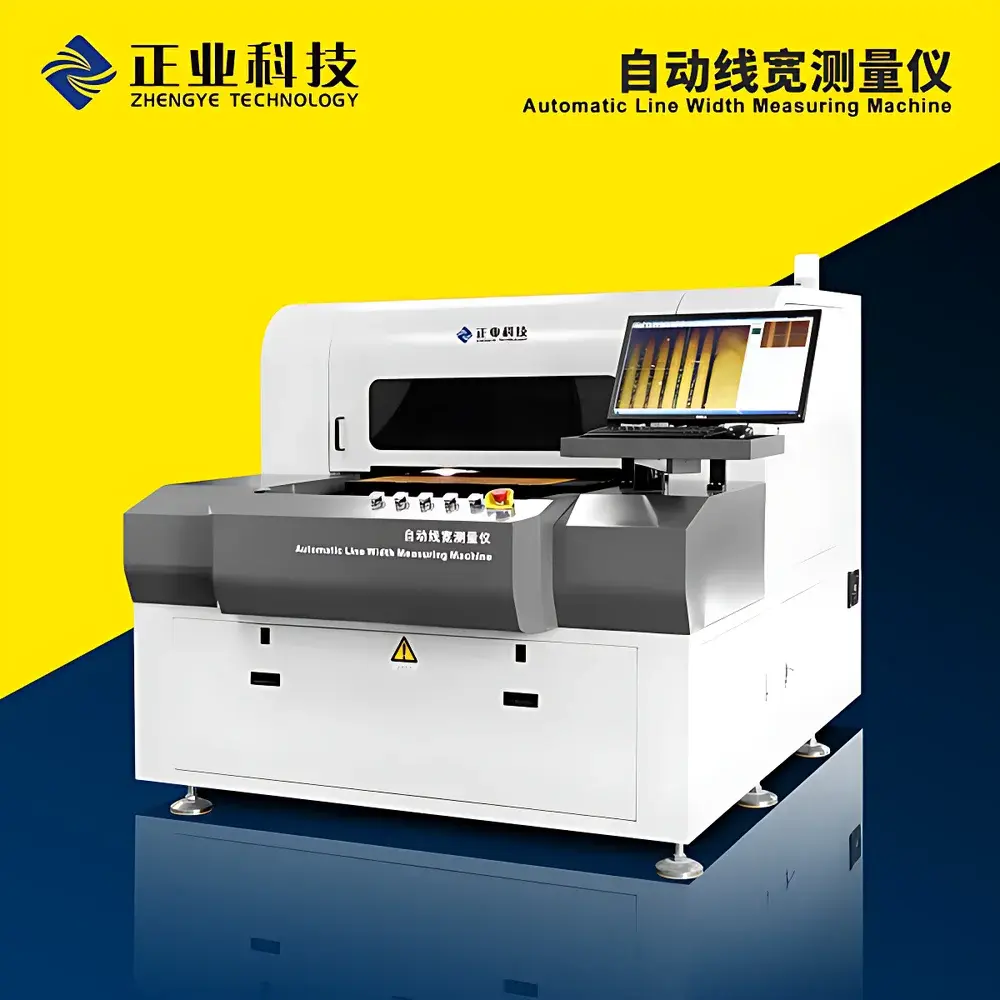
Zhengye ZYXK32 Automated PCB Line Width & Spacing Measurement System
| Brand | Zhengye |
|---|---|
| Origin | Guangdong, China |
| Manufacturer Type | OEM/ODM Manufacturer |
| Region Classification | Domestic (China) |
| Model | ZYXK32 |
| Pricing | Upon Request |
Overview
The Zhengye ZYXK32 Automated PCB Line Width & Spacing Measurement System is a high-precision optical metrology platform engineered for non-contact, quantitative inspection of photolithographic features on printed circuit boards (PCBs) and flat-panel display substrates. It operates on the principle of digital image acquisition combined with sub-pixel edge detection algorithms, enabling traceable measurement of critical dimensional parameters—including upper/lower line widths, line-to-line spacing, pad-to-edge distances, via diameters (through-hole, blind, and buried), and fine-pitch conductor geometries. Designed for inline or offline use in PCB fabrication facilities, the system supports measurement prior to solder mask application (post-etch, pre-coverlay), ensuring process control compliance with IPC-6012, IPC-A-600, and JIS C 5012 standards. Its architecture integrates industrial-grade optics, motorized precision stages, and deterministic autofocus—delivering repeatable results under variable environmental conditions typical of high-volume manufacturing environments.
Key Features
- Automated Positioning via CAM Data Integration: Supports direct import of Gerber RS-274X files for coordinate-based measurement program generation; eliminates manual point definition and enables full traceability from design data to physical measurement.
- Real-Time Autofocus: Closed-loop focus control ensures optimal image sharpness across varying substrate topographies and Z-height deviations—critical for consistent edge detection on warped or multilayer boards.
- Motorized Zoom Lens System: Enables seamless, software-controlled magnification switching without mechanical intervention; maintains calibration integrity across magnifications and supports multi-scale inspection protocols.
- On-Screen Navigation Map: Integrated overview camera provides real-time macro navigation with crosshair overlay, accelerating operator localization of target features—even on large-format panels (up to 610 × 610 mm).
- Sub-Pixel Edge Detection Engine: Proprietary algorithm suite performs simultaneous dual-edge recognition on conductive traces, delivering independent upper and lower width measurements per segment, with pixel-level resolution and configurable tolerance thresholds.
- Comprehensive Dimensional Reporting: Measures line width, line spacing, pad dimensions, circular feature diameters (including ellipticity assessment), and angular alignment deviation—all compliant with ISO 17025–recommended uncertainty estimation practices.
Sample Compatibility & Compliance
The ZYXK32 accommodates rigid FR-4, flexible polyimide, and rigid-flex PCBs up to 3.2 mm thickness and 610 mm × 610 mm footprint. It is equally applicable to silicon wafers (IC packaging substrates), TFT-LCD glass panels, and touch sensor ITO patterns. All measurement workflows adhere to industry-standard traceability requirements: calibration certificates are issued per ISO/IEC 17025 guidelines, and measurement uncertainty budgets are documented for each configured magnification and lighting condition. The system supports audit-ready operation under ISO 9001, IATF 16949, and IPC-6012 Class 2/3 production environments.
Software & Data Management
The proprietary Zhengye Line Width Measurement Software (v4.2+) provides full GUI-driven workflow management—from recipe creation and batch execution to statistical evaluation. Raw image archives, measurement logs, and metadata (timestamp, operator ID, job ID, stage coordinates) are stored in structured SQLite or Microsoft SQL Server databases. Excel export (XLSX format) includes raw values, pass/fail flags, Cp/Cpk indices, and annotated measurement images. SPC module supports real-time X̄-R and X̄-S charting, outlier detection per ASTM E2587, and automated alerting upon OOC (out-of-control) condition per Western Electric rules. MES integration is achieved via ODBC-compliant SQL interface, enabling bidirectional data exchange with factory-level systems (e.g., Siemens Opcenter, Rockwell FactoryTalk, or custom ERP platforms) under secure TLS 1.2 encryption.
Applications
- Post-etch dimensional verification of inner/outer layer copper traces prior to solder mask lamination
- Process validation of etch uniformity across panel zones (center vs. edge)
- Failure analysis of microvia misalignment and annular ring integrity
- Quality gate inspection for HDI (High-Density Interconnect) and mSAP (modified Semi-Additive Process) substrates
- Line width monitoring in IC substrate manufacturing (ABF, BT, and Ajinomoto Build-up Films)
- Dimensional stability assessment of flex circuits subjected to thermal cycling or bending tests
FAQ
Does the ZYXK32 support measurement of solder mask openings or silkscreen features?
Yes—when configured with appropriate coaxial illumination and contrast-enhancement filters, the system can quantify solder mask bridge widths and registration offsets relative to underlying copper features.
Is calibration traceable to national metrology institutes?
Calibration is performed using NIST-traceable step gauges and certified photomasks; full calibration reports include uncertainty budgets aligned with GUM (JCGM 100:2008) methodology.
Can measurement recipes be version-controlled and locked for regulated environments?
Yes—software supports role-based access control (RBAC), electronic signatures per FDA 21 CFR Part 11, and immutable recipe archiving with SHA-256 hash logging.
What is the minimum resolvable feature size under standard configuration?
At 10× objective magnification, the system achieves effective resolution of ≤2.5 µm (with 0.5 µm repeatability at 2σ confidence level), verified per ISO 10360-8 Annex B protocols.
Does the system comply with IPC TM-650 test methods?
All measurement procedures align with IPC TM-650 2.2.12 (Optical Microscopy) and 2.5.5.4 (Dimensional Measurements), including lighting setup, magnification verification, and operator qualification requirements.






