
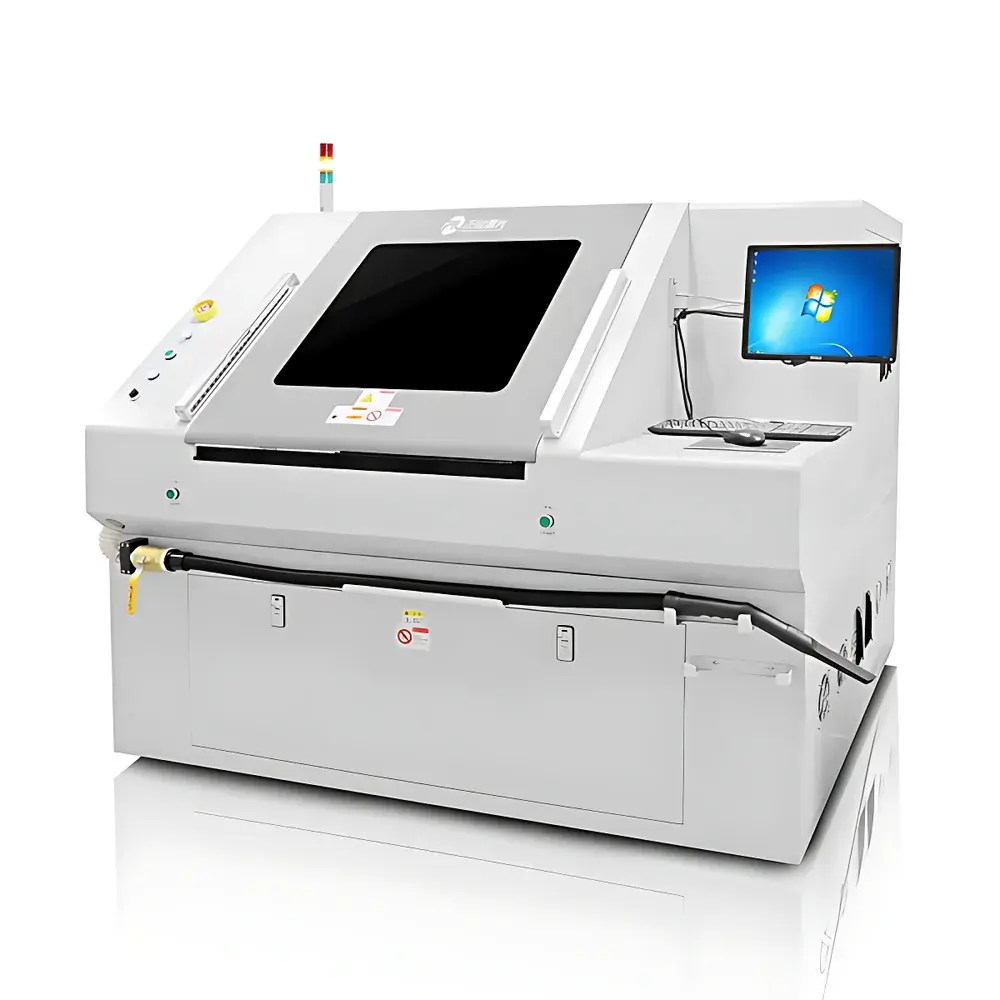
FPC Flexible Circuit Board UV Laser Cutting System – Zhengye ZYUV-Cutting
| Brand | Zhengye |
|---|---|
| Origin | Guangdong, China |
| Manufacturer Type | Direct Manufacturer |
| Regional Category | Domestic (China) |
| Model | ZYUV-Cutting |
| Price Range | USD 70,000–112,000 |
| Instrument Type | Precision UV Laser Cutting System |
| Laser Wavelength | 355 nm |
| Max. Avg. Laser Power | 10 W (standard), up to 15 W (optional) |
| Pulse Repetition Rate | 30–120 kHz |
| Max. Working Area | 500 mm × 400 mm (dual-station), 650 mm × 550 mm (dual-station) |
| Platform Travel Speed | 800 mm/s |
| Positioning Accuracy | ±3 μm |
| Repeatability | ±1 μm |
| Overall Processing Accuracy | ±20 μm |
| Focused Spot Size | 20 ± 5 μm |
| Galvo Scan Field | 45 mm × 45 mm |
| Supported File Formats | *.gbr, *.dxf, *.lay |
Overview
The Zhengye ZYUV-Cutting is a high-precision ultraviolet (UV) nanosecond pulsed laser cutting system engineered for the clean, non-contact, and thermally controlled ablation of flexible printed circuit boards (FPCs), coverlays (CVL), rigid-flex laminates (RF), and thin multilayer substrates. Operating at 355 nm, the frequency-tripled Nd:YAG laser delivers high photon energy with minimal heat-affected zone (HAZ), enabling micron-level feature definition without delamination, charring, or thermal distortion—critical for polyimide (PI), PET, and PI-copper composite structures. Unlike mechanical or CO₂-based systems, this UV platform leverages cold ablation physics to achieve sub-20 µm dimensional tolerances across complex contour cuts, micro-vias, window openings, and selective coverlay removal—making it indispensable in R&D labs, pilot-line fabrication, and quality assurance environments where sample integrity and process traceability are paramount.
Key Features
- Dual-station (X-Y) gantry architecture with independent motion control—enables zero-load/unload downtime via interleaved processing cycles;
- Real-time optical preview mode integrated into the CAM interface, allowing full-path simulation and collision-free trajectory validation prior to laser firing;
- Integrated industrial-grade QR code marking module compliant with IPC-A-600 and IPC-6013 standards for direct part identification (DPI) and lot traceability;
- High-dynamic galvanometric scanning system with 45 mm × 45 mm field coverage, optimized for rapid vector-based contouring and nested pattern processing;
- Thermally stabilized optical path and active beam homogenization to ensure consistent pulse-to-pulse energy density across the full working envelope;
- Modular laser source design supporting field-upgradable power output (10 W → 15 W) without mechanical reconfiguration or recalibration.
Sample Compatibility & Compliance
The ZYUV-Cutting accommodates standard FPC substrate thicknesses ranging from 25 µm to 250 µm—including single-layer copper-clad polyimide, double-sided adhesiveless laminates, and embedded flex-rigid hybrids. It supports both bare copper and solder-masked surfaces, as well as pre-laminated coverlays with acrylic or epoxy adhesives. All motion and laser subsystems meet CE machinery directive (2006/42/EC) and IEC 60825-1:2014 Class 4 laser safety requirements. The system is compatible with ISO 9001-certified lab workflows and supports audit-ready documentation per GLP/GMP frameworks when paired with optional logging modules. While not FDA-cleared, its precision ablation performance aligns with IPC-2221B and IPC-2223C design guidelines for flexible interconnect reliability testing.
Software & Data Management
Controlled via Zhengye’s proprietary ZYCut Suite v4.x—a Windows-based engineering interface supporting native import of Gerber (*.gbr), DXF (*.dxf), and PCB layout (*.lay) files. The software includes automatic fiducial recognition, layer registration alignment, and real-time power calibration mapping across the scan field. Process recipes—including pulse width, overlap ratio, scan velocity, and Z-focus offset—are stored with full version history and user-access permissions. Audit logs record operator ID, timestamp, file hash, parameter set, and pass/fail status per job—meeting baseline requirements for 21 CFR Part 11 compliance when deployed with network authentication and electronic signature add-ons. Export options include CSV-formatted metrology reports and PNG-based overlay previews aligned to original CAD coordinates.
Applications
- Prototyping and low-volume production of antenna substrates, wearables, and medical flex sensors;
- Controlled depaneling of FPC arrays with minimal edge burr and no mechanical stress transfer;
- Selective coverlay opening for gold finger exposure, connector access, or thermal pad definition;
- Micro-cutting of stiffeners (e.g., FR-4 or stainless steel reinforcement tabs) bonded to flex regions;
- Failure analysis sample preparation—precise isolation of defective traces or vias without collateral damage;
- Qualification testing of new dielectric materials under controlled ablation thresholds for HAZ assessment.
FAQ
What material thicknesses can the ZYUV-Cutting process reliably?
Standard operation covers 25–250 µm polyimide-based FPCs; thicker hybrid stacks (up to 400 µm total) are feasible with multi-pass strategies and adaptive focus compensation.
Is the system compatible with automated material handling interfaces?
Yes—RS-232 and TCP/IP APIs are provided for integration with third-party cassette loaders, robotic arms, and MES platforms via Modbus RTU or OPC UA protocols.
Does the system support real-time power monitoring during cutting?
Integrated photodiode-based pulse energy feedback ensures closed-loop stability; raw sensor data is accessible via diagnostic port for metrology correlation studies.
How is beam alignment maintained over extended operation?
The optical train incorporates passive thermal compensation mounts and quarterly verification routines using NIST-traceable step gauges and interferometric alignment targets.
Can the ZYUV-Cutting perform simultaneous cutting and marking in one setup?
Yes—time-synchronized galvo and stage motion allows sequential ablation and QR encoding within a single vacuum-chuck cycle, reducing handling-induced misregistration.
Related Products



