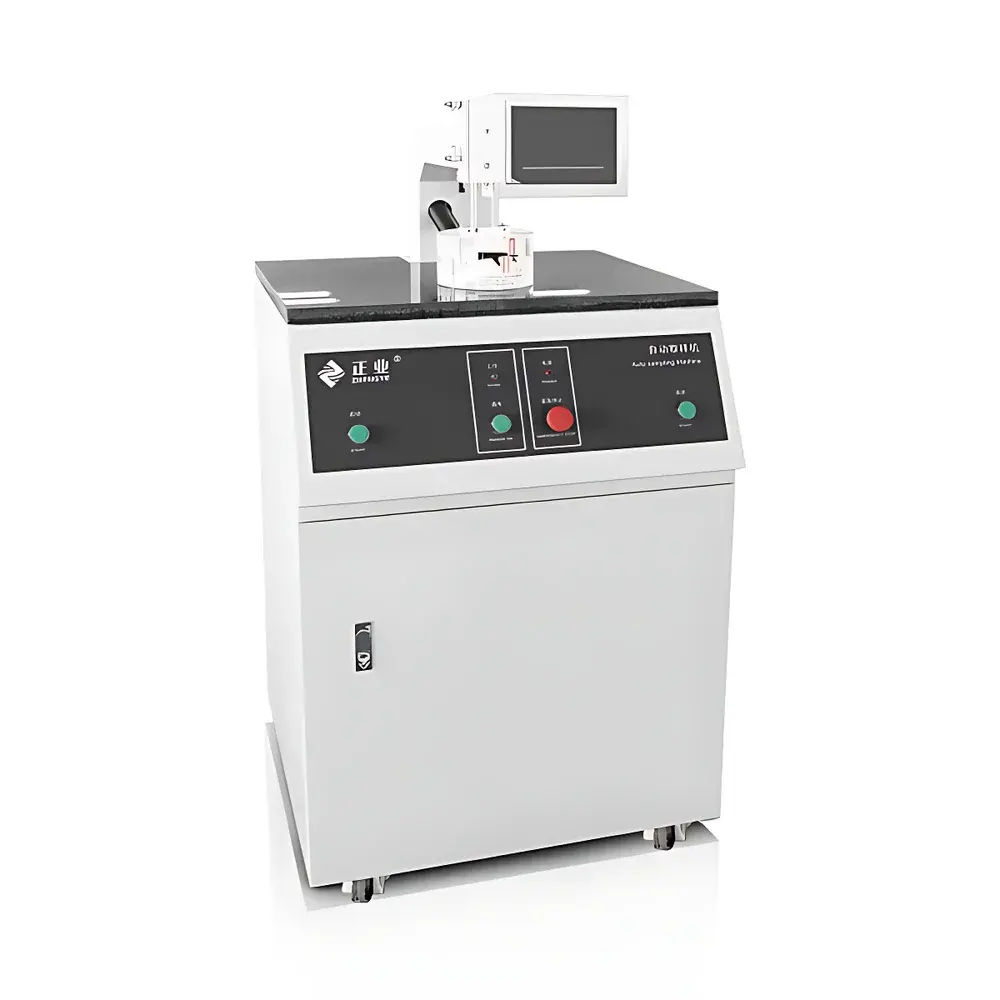
Zhengye QY221 Automated Microsection Sampling System for PCB and CCL In-Process Metrology
| Brand | Zhengye |
|---|---|
| Origin | Guangdong, China |
| Manufacturer Type | OEM/ODM Manufacturer |
| Country of Origin | China |
| Model | QY221 |
| Price Range | USD 7,000 – 14,000 |
| Sampling Dimension Range | 5 × 5 × 0.5 to 50 × 50 mm (L × W × H) |
| Max Sample Width | 508 mm |
| Min Sample Size | 120 × 100 mm |
| Sampling Thickness | 0.5–8 mm |
| Throat Depth | 280 mm |
| Cutting Tool Diameter | Φ2.0 mm / Φ2.4 mm |
| Rated Power/Voltage/Frequency | 1500 W / AC 220 V / 50 Hz |
| Current Rating | 10 A |
| Overall Dimensions (L×W×H) | 740 × 625 × 138 mm |
| Pneumatic Supply Pressure | 0.6–0.8 MPa |
| Net Weight | 190 kg |
Overview
The Zhengye QY221 Automated Microsection Sampling System is an in-machine metrology solution engineered for high-precision, repeatable specimen preparation in rigid printed circuit board (PCB) and copper-clad laminate (CCL) manufacturing environments. Designed specifically for cross-sectional analysis in quality control laboratories and inline process validation stations, the system employs a synchronized pneumatic-driven X-Y precision motion platform coupled with a high-rigidity electric spindle to perform automated microsectioning—enabling consistent, burr-free metallographic sampling without manual intervention. Unlike conventional benchtop cutters or manual sectioning tools, the QY221 integrates directly into production workflows, supporting real-time inspection readiness for IPC-A-600, IPC-6012, and IEC 61189-2 compliant microstructural evaluation. Its compact footprint (740 × 625 × 138 mm) and low-noise, dust-controlled operation meet stringent cleanroom-adjacent facility requirements while maintaining full traceability under GLP-aligned laboratory practices.
Key Features
- Pneumatically actuated, high-resolution X-Y linear stage with sub-10 µm repeatability for precise positioning across sample surfaces up to 508 mm wide.
- Dual-standard cutting tool compatibility (Φ2.0 mm and Φ2.4 mm solid carbide end mills), optimized for controlled-depth milling of copper, FR-4, polyimide, and hybrid laminates.
- Integrated electric spindle delivering stable rotational speeds up to 30,000 rpm with active thermal management—ensuring dimensional fidelity during repeated 0.5–8 mm thickness cuts.
- Transparent polycarbonate safety enclosure with interlocked door sensors and real-time visual monitoring, eliminating operator exposure to rotating tools and particulate generation.
- Programmable logic controller (PLC)-based motion control architecture with USB/RS-232 interface, supporting custom macro scripting for batch-defined sampling patterns, multi-location indexing, and stepwise depth profiling.
- Human-machine interface (HMI) featuring 7-inch TFT touchscreen with multilingual support (English, Simplified Chinese), intuitive parameter entry, and real-time status diagnostics including air pressure verification and spindle load feedback.
Sample Compatibility & Compliance
The QY221 accommodates rigid substrates used across PCB fabrication—including standard FR-4, high-Tg epoxy, BT resin, polyimide flex-rigid hybrids, and ceramic-filled laminates—as well as finished multilayer boards with surface finishes such as ENIG, OSP, immersion silver, and lead-free HASL. Minimum specimen size (120 × 100 mm) ensures compatibility with industry-standard microsection mounting fixtures and epoxy encapsulation workflows. All mechanical and electrical subsystems conform to CE machinery directive (2006/42/EC) and EMC directive (2014/30/EU) requirements. The system supports audit-ready documentation protocols aligned with ISO/IEC 17025 calibration traceability frameworks when paired with validated measurement artifacts and documented SOPs.
Software & Data Management
The embedded firmware enables deterministic execution of preloaded sampling routines with timestamped log export (CSV format) containing cycle count, tool wear index, spindle RPM, cut duration, and pneumatic pressure stability metrics. Optional Ethernet-enabled data logging allows integration into MES platforms via Modbus TCP or OPC UA gateways. While no proprietary desktop software is required for basic operation, optional PC-based configuration utility (Windows 10/11 compatible) provides advanced path optimization, G-code preview, and firmware update capability. Audit trails comply with FDA 21 CFR Part 11 principles through user-authenticated session initiation and immutable event logging.
Applications
- In-process verification of plating thickness uniformity and via fill integrity at lamination, drilling, and electroplating stages.
- Final QA release testing for solder mask alignment, copper thickness distribution, and dielectric layer consistency per IPC TM-650 2.1.1.
- Failure analysis root cause determination—including delamination mapping, void detection, and interfacial adhesion assessment in thermal stress or humidity testing follow-up.
- Supplier qualification and incoming material inspection for CCL vendors supplying automotive or aerospace-grade substrates.
- Calibration sample preparation for SEM-EDS, FIB-SEM, and optical microscopy systems requiring geometrically accurate cross-sections.
FAQ
What substrate materials can the QY221 process without chipping or thermal damage?
The system is validated for FR-4, polyimide, BT, Rogers RO4000®, and aluminum/ceramic metal-core laminates using optimized feed/speed parameters and coolant-free dry-cutting methodology.
Is the QY221 compatible with automated material handling systems (AMHS)?
Yes—standardized mounting holes and RS-232/Modbus TCP interfaces enable integration with robotic end-effectors and conveyor-linked staging modules.
Does the system require external dust extraction?
No. Integrated HEPA-filtered recirculation and sealed chamber design eliminate airborne particulates; ambient room ventilation suffices per ISO 14644-1 Class 8 requirements.
Can sampling coordinates be imported from CAD-generated Gerber or ODB++ files?
Not natively—but coordinate sets exported from CAM software can be manually loaded as CSV-formatted XYZ point lists for sequential sectioning.
What maintenance intervals are recommended for pneumatic and spindle subsystems?
Compressed air filter elements every 500 operating hours; spindle grease replenishment every 2,000 hours; linear guide lubrication every 1,000 hours—documented in the included maintenance logbook and accessible via HMI service menu.