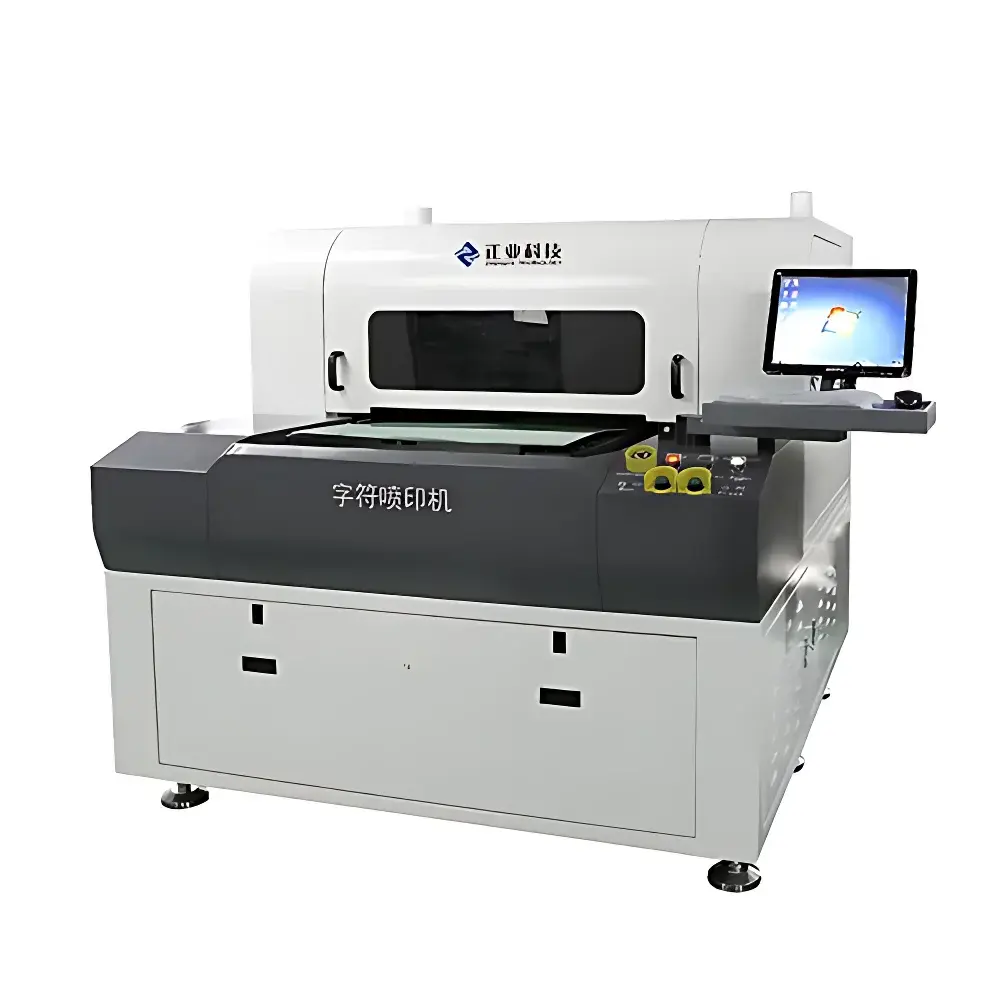
Zhengye PY300B PCB Legend Inkjet Printer
| Brand | Zhengye |
|---|---|
| Origin | Guangdong, China |
| Manufacturer Type | OEM/ODM Manufacturer |
| Country of Origin | China |
| Model | PY300B |
| Positioning Accuracy | ±35 µm |
| Repeatability | ±5 µm |
| Print Resolution | 720 × 360 dpi to 1440 × 1440 dpi |
| Minimum Line Width | 75–100 µm |
| Minimum Character Height | Not Specified |
| Substrate Size | 650 mm × 610 mm (26″ × 24″) |
| Board Thickness Range | 0.1–6 mm (4–236 mil) |
| Dual-Head Configuration | 2 × 1024-nozzle industrial piezoelectric printheads |
| Platform Dimensions | 610 mm × 560 mm (24″ × 22″) |
| Throughput (Bidirectional, Standard Mode, 1-pass) | 180 panels/hour |
| Throughput (Bidirectional, High-Precision Mode, 4-pass) | 80 panels/hour |
| UV-Curing System | LED-based, instant curing |
| Machine Dimensions (L×W×H, excl. monitor) | 2050 × 1650 × 1650 mm |
| Net Weight | 1450 kg |
Overview
The Zhengye PY300B PCB Legend Inkjet Printer is an industrial-grade, non-contact digital marking system engineered for high-accuracy legend printing on rigid and flexible printed circuit boards. Unlike conventional screen-printing processes—which require stencil fabrication, alignment calibration, and solvent-based inks—the PY300B employs precision piezoelectric inkjet technology with real-time board registration, dynamic scaling, and automatic dimensional compensation. It operates on the principle of drop-on-demand (DOD) ink ejection, where micro-droplets of UV-curable ink are deposited pixel-by-pixel onto the solder mask surface under closed-loop servo control. This enables direct digital transfer of silkscreen legends—including component outlines, polarity marks, test points, and revision identifiers—without physical tooling. Designed for integration into automated SMT lines and PCB fabrication facilities, the PY300B supports both single-sided and double-sided legend application while maintaining traceability compliance with IPC-2221, IPC-A-600, and IPC-J-STD-020 standards.
Key Features
- Precision motion architecture: Linear motor-driven X-Y gantry with granite base and high-rigidity cross-roller guides ensures ±35 µm absolute positioning accuracy and ±5 µm repeatability across full working envelope.
- Dual-head configuration: Two synchronized 1024-channel industrial piezoelectric printheads deliver scalable resolution from 720 × 360 dpi (high-speed production mode) to 1440 × 1440 dpi (fine-feature mode), supporting minimum line widths of 75–100 µm depending on solder mask topography and ink rheology.
- Real-time board compensation: Integrated optical fiducial recognition system performs multi-point registration and automatic XYθ scaling to correct for thermal expansion, mechanical stretch, and panel warpage—critical for high-density HDI and flex-rigid PCBs.
- LED-UV curing subsystem: Cold-spectrum 365 nm LED array delivers uniform irradiance (>1500 mW/cm²) with sub-second dwell time, enabling immediate post-print handling and eliminating VOC emissions associated with thermal or mercury-lamp curing.
- Modular dual-platform design: Optional A/B station configuration allows concurrent loading/unloading and printing, reducing cycle downtime and supporting seamless transition to future green solder mask (LPI) jetting applications.
- Firmware-level customization: Proprietary real-time RIP engine and motion controller firmware support customer-specific print logic, layer mapping protocols, and OEE data logging via Ethernet/IP or Modbus TCP interfaces.
Sample Compatibility & Compliance
The PY300B accommodates standard FR-4, polyimide, metal-core, and ceramic substrates with thicknesses ranging from 0.1 mm to 6.0 mm (4–236 mil). Its vacuum-assisted clamping system maintains flatness tolerance within ±25 µm over 650 mm × 610 mm panels. All ink formulations used are RoHS 2015/863/EU and REACH SVHC-compliant; certified material safety data sheets (MSDS) and compatibility reports for common LPI types—including Taiyo PSR-4000, Dupont Pyralux, and Hitachi PI-1000—are available upon request. The system meets CE machinery directive 2006/42/EC and electromagnetic compatibility requirements per EN 61000-6-2/6-4. For regulated environments, optional audit trail logging and user-access control modules comply with FDA 21 CFR Part 11 Annex 11 principles when integrated with validated MES platforms.
Software & Data Management
Controlled via Windows-based HMI with dual-monitor interface, the PY300B runs Zhengye’s proprietary LegendJet Suite v4.x—a deterministic print workflow manager supporting Gerber RS-274X, ODB++, and IPC-2581 import. The software includes built-in DFM preflight analysis, automatic legend vectorization, font kerning optimization, and grayscale dithering for variable ink laydown. All print jobs are timestamped and archived with SHA-256 checksums; revision history, operator ID, environmental sensor logs (temperature/humidity), and nozzle health diagnostics are exportable in CSV or XML for QA documentation. Optional API integration enables bidirectional communication with factory MES, ERP, and CIMS systems using RESTful webhooks or OPC UA.
Applications
- High-mix, low-volume PCB prototyping where rapid legend revision cycles eliminate screen rework costs.
- Automotive and aerospace PCBs requiring IPC Class 3-compliant legibility, adhesion, and abrasion resistance per MIL-STD-202G Method 215.
- Flex and rigid-flex assemblies with irregular contours or cutouts unsuitable for screen frames.
- Embedded passive substrate manufacturing needing sub-100 µm legend fidelity for laser-trimmed resistor markings.
- Green solder mask (LPI) development labs evaluating direct-jet patterning as alternative to photolithographic definition.
FAQ
What file formats does the PY300B accept for legend data?
Gerber RS-274X (with aperture macros), ODB++ (v7.0+), and IPC-2581B are natively supported; DXF and PDF imports require preprocessing through LegendJet Suite’s vector conversion module.
Is the system compatible with lead-free and halogen-free solder masks?
Yes—ink adhesion validation has been performed on >20 commercial LPI formulations, including lead-free variants meeting J-STD-020C MSL ratings.
Can the printer be integrated into a Class 1000 cleanroom environment?
The enclosure meets ISO 14644-1 Class 7 specifications; optional HEPA-filtered air purge and static-dissipative chassis upgrades are available for Class 6 deployment.
Does the system support offline calibration and remote diagnostics?
Full calibration routines—including nozzle alignment, ink viscosity monitoring, and Z-height profiling—can be executed without production interruption; remote access via TLS-secured VNC is enabled with customer-defined firewall rules.
What maintenance intervals are recommended for printhead longevity?
Daily capping and automated purge cycles are mandatory; bi-weekly nozzle inspection and quarterly head recalibration are advised. Average printhead service life exceeds 12,000 operational hours under controlled humidity (<55% RH) and particulate conditions.