
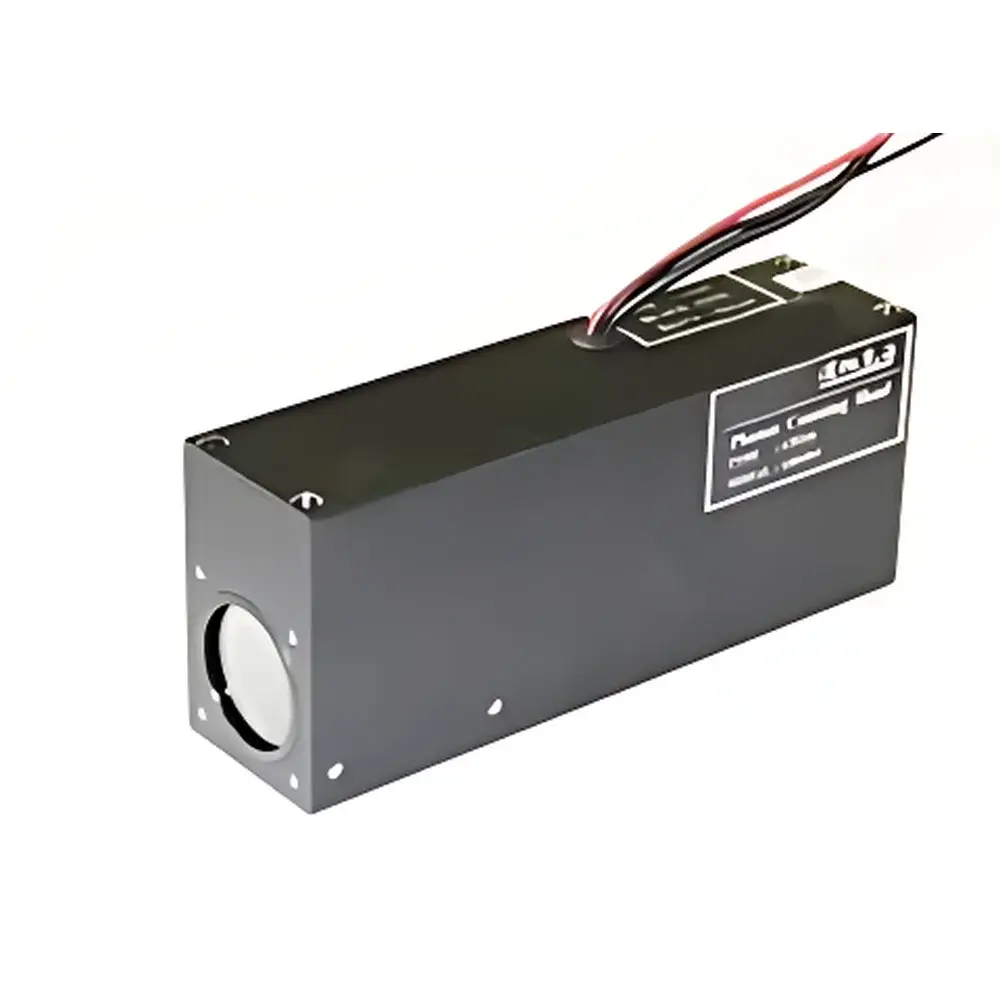
Hamamatsu CH326 Photon Counting Detector
| Brand | Hamamatsu Photonics (BHP) |
|---|---|
| Origin | Hebei, China |
| Manufacturer Type | Authorized Distributor |
| Origin Category | Domestic (PRC) |
| Model | CH326 |
| Component Category | Optical Component |
| Input Voltage | +11.5–+12.5 V DC |
| Max Input Current | 70 mA |
| Active Area | Ø25 mm |
| Spectral Response Range | 300–650 nm |
| Peak Wavelength | 420 nm |
| Photon Detection Efficiency (Typ.) | 300 nm — 1.9×10⁵ s⁻¹·pW⁻¹ |
| Max Linear Count Rate | 6×10⁶ s⁻¹ |
| Dark Count Rate (Typ.) | 60 s⁻¹ |
| Dark Count Rate (Max) | 150 s⁻¹ |
| Uniformity | ±10% |
| 8-hr Stability (CV, Typ.) | 1% |
| Output Pulse Polarity | Positive Logic TTL |
| Min. Output Amplitude | 2 V |
| Typ. Output Amplitude | 2.2 V |
| Output Pulse Width | 9 ns |
| Pulse Pair Resolution Time | 17 ns |
| Recommended Load Impedance | 50 Ω |
| Operating Temperature | 5–40 °C |
| Operating Humidity | ≤90% RH (non-condensing) |
| Storage Temperature | −20–+50 °C |
| Storage Humidity | ≤93% RH |
| Weight | 410 g |
Overview
The Hamamatsu CH326 Photon Counting Detector is a compact, integrated single-photon detection module engineered for high-sensitivity, time-resolved optical measurements in low-light regimes. Built around a side-on, end-window photomultiplier tube (PMT), the CH326 incorporates a stabilized high-voltage power supply and optimized pulse-shaping discriminators to deliver robust, TTL-compatible digital output without external amplification or threshold tuning. Its Ø25 mm photocathode provides a large active area while maintaining sub-20 ns temporal resolution—critical for fluorescence lifetime spectroscopy (FLS), time-correlated single-photon counting (TCSPC), bioluminescence assays, and ultra-low-flux quantum optics experiments. The detector operates on a single +12 V DC supply, with factory-calibrated gain and discrimination thresholds ensuring immediate plug-and-play functionality in OEM instruments or laboratory setups requiring rapid integration.
Key Features
- Integrated architecture combining PMT, HV supply, and fast comparator circuitry—no external biasing or signal conditioning required
- Ø25 mm bialkali photocathode with broad spectral response (300–650 nm) and peak quantum efficiency at 420 nm
- TTL-compatible positive logic output pulses (≥2 V amplitude, 9 ns width, 17 ns dead time) matched to standard 50 Ω digitizers and time-to-digital converters (TDCs)
- High linearity up to 6 × 10⁶ counts per second, enabling quantitative photon flux measurement under moderate illumination
- Low dark count rate (typ. 60 s⁻¹) and excellent 8-hour stability (CV < 1%), supporting long-duration kinetic studies and background-subtracted quantitation
- Factory-optimized operating parameters—including gain, discriminator threshold, and pulse shaping—eliminating user calibration overhead
- Compact mechanical design (410 g) with standardized mounting interface and low-power consumption (≤70 mA @ 12 V)
Sample Compatibility & Compliance
The CH326 is compatible with standard optical interfaces including SMA-905 fiber couplers, lens tubes (SM1-threaded), and free-space collimated beams. Its spectral range aligns with common fluorophores (e.g., FITC, GFP, Cy3), chemiluminescent substrates (luciferin/luciferase), and scintillation materials (NaI:Tl, LYSO). While not certified for medical device use, the module complies with IEC 61000-6-3 (EMC emission limits) and IEC 61010-1 (safety requirements for electrical equipment for measurement). It supports GLP-aligned workflows when deployed in validated instrument platforms—its stable dark count performance and reproducible pulse timing facilitate traceable intensity calibration per ISO/IEC 17025 guidelines.
Software & Data Management
The CH326 outputs hardware-level TTL pulses and does not include embedded firmware or USB connectivity. Integration is achieved via external counting electronics—such as National Instruments PCIe-6612 counters, Becker & Hickl SPC-150N TCSPC modules, or custom FPGA-based acquisition systems. Pulse timestamps are recorded with picosecond resolution when paired with high-precision TDCs. Data files (e.g., .ptu, .sdt, or binary timestamp lists) are processed using industry-standard tools including SymPhoTime 64, FluoFit, or Python-based libraries (e.g., photonstream, tttrlib). Audit trails, calibration logs, and instrument configuration metadata must be maintained externally in accordance with FDA 21 CFR Part 11 requirements if used in regulated QC environments.
Applications
- Time-resolved fluorescence spectroscopy and anisotropy decay analysis
- Single-molecule detection in confocal and total internal reflection fluorescence (TIRF) microscopy
- Chemiluminescent and bioluminescent immunoassays (CLIA/BLIA)
- Quantum yield determination and scintillation counting in radiation detection systems
- Low-light reflectometry and diffuse optical tomography (DOT) signal acquisition
- Calibration reference source for photodetector linearity verification (per ASTM E1318)
FAQ
Does the CH326 require external high-voltage adjustment?
No—the internal HV module is pre-set and temperature-compensated; users only supply +12 V DC.
Can it be used in vacuum or cryogenic environments?
No—it is rated for ambient operation only (5–40 °C, non-condensing humidity); extended environmental operation requires custom enclosure engineering.
Is the pulse output compatible with National Instruments DAQ devices?
Yes—TTL pulses meet NI’s digital input specifications (≥2 V, <15 ns rise time); verify termination impedance (50 Ω) and sampling clock synchronization.
What is the recommended method for dark count characterization?
Measure continuous output over ≥100 s in complete darkness using a calibrated counter; report mean rate and coefficient of variation (CV) per ISO 15739 Annex B.
How is spectral responsivity verified during factory calibration?
Using NIST-traceable monochromator-based irradiance standards (SRM 2031, 2032) and calibrated reference photodiodes across 300–650 nm.




