
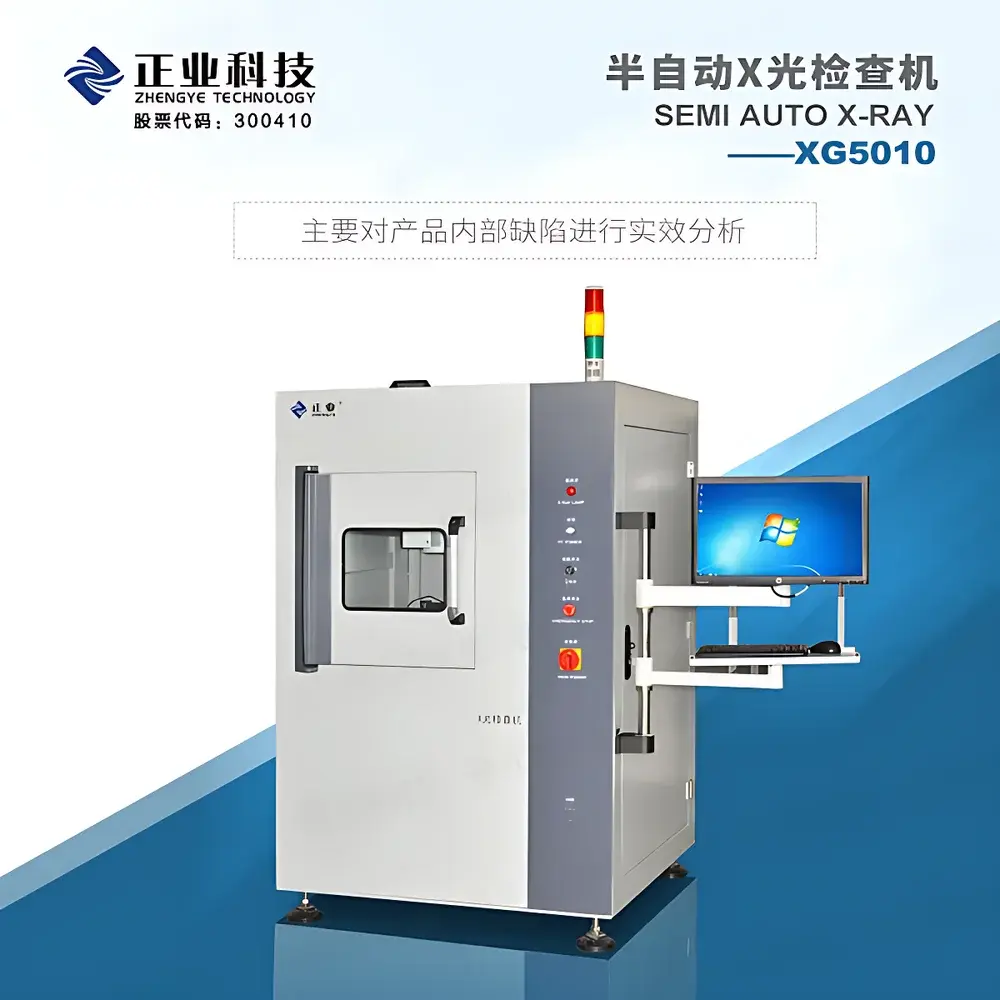
Zhengye X-ray Inspection System – Industrial Micro-CT Platform for Online Battery Defect Analysis
| Brand | Zhengye |
|---|---|
| Origin | Guangdong, China |
| Manufacturer Type | OEM/ODM Manufacturer |
| Product Category | Domestic |
| Model | Zhengye X-ray Inspection System |
| Pricing | Available Upon Request |
Overview
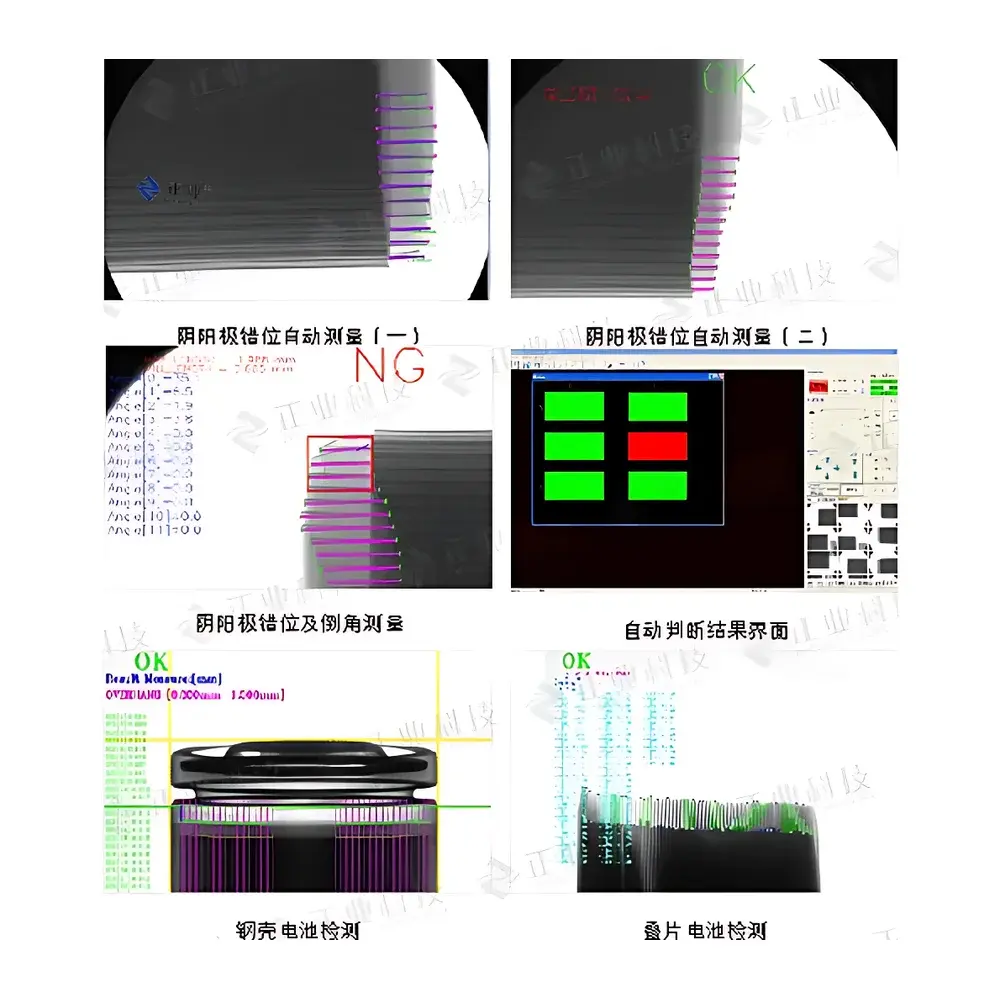
The Zhengye X-ray Inspection System is an industrial-grade micro-computed tomography (micro-CT) platform engineered for non-destructive, real-time inline quality assurance in high-precision manufacturing environments—particularly lithium-ion battery production. Operating on the principle of X-ray transmission radiography, the system generates high-contrast 2D projection images by measuring differential X-ray attenuation across internal material structures. Unlike conventional film-based or static radiographic methods, this system integrates a digitally controlled X-ray source, high-sensitivity image intensifier, and synchronized triaxial motion mechanics (X/Y/Z) to enable repeatable, geometrically stable imaging at sub-millimeter spatial resolution. Designed for integration into automated production lines, it supports continuous scanning of moving or stationary samples without mechanical interruption, delivering consistent detection sensitivity for voids, delamination, electrode misalignment, foreign particles, and weld defects within sealed battery cells and modules.
Key Features
- Triaxial Precision Motion Architecture: X-ray tube and image intensifier mounted on a rigid, low-vibration gantry with independent X/Y/Z translation stages driven by stepper motors and precision ground ball screws—ensuring positional repeatability ≤ ±5 µm and smooth trajectory control for multi-angle inspection.
- CNC Path Programming & Recall: Operator-defined inspection routines—including stage positions, exposure parameters, and ROI selection—can be saved as reusable CNC programs, enabling rapid setup for small-batch or mixed-product lines with minimal reconfiguration time.
- Real-Time Navigation & Targeted Localization: A large-format navigation interface overlays a live thumbnail map of the full field-of-view; clicking any region triggers automatic stage repositioning to that coordinate with sub-pixel targeting accuracy, reducing manual search time by >70% during defect verification.
- 2.5D Metrology Suite: Integrated measurement engine supports calibrated dimensional analysis including linear distance, circle diameter, concentricity of nested features, and point-to-center offset—all traceable to NIST-traceable reference standards and exportable in CSV or XML format.
- Digital Image Processing Pipeline: Supports DICOM, TIFF, BMP, and JPEG import/export; includes real-time contrast enhancement, noise suppression (adaptive median filtering), edge sharpening, and dynamic range optimization—preserving diagnostic fidelity without introducing interpolation artifacts.
Sample Compatibility & Compliance
The system accommodates cylindrical, prismatic, and pouch-type battery cells (up to Ø120 mm × H200 mm), as well as PCB assemblies, metal castings, and polymer encapsulated components. Mechanical loading uses a fixed-stage design with adjustable clamping fixtures to minimize vibration-induced blur during exposure. All radiation shielding meets GBZ 138–2022 (Chinese national standard for industrial X-ray equipment safety) and complies with IEC 61000-6-4 (EMC immunity) and IEC 61000-6-3 (EMC emission) requirements. Software architecture supports audit trail logging and user access levels per ISO 9001:2015 and IATF 16949 process control guidelines.
Software & Data Management
The proprietary inspection software provides full workflow automation—from auto-exposure calibration and ROI-based threshold segmentation to pass/fail classification using configurable defect criteria (e.g., void area > 0.05 mm², particle density > 3/mm²). All measurement data, raw images, and decision logs are timestamped and stored in a local SQL database with optional network backup. The system supports GLP-compliant electronic signatures and maintains immutable records for FDA 21 CFR Part 11 readiness when deployed in regulated battery cell qualification labs.
Applications
- Lithium-ion battery cell QC: Anode/cathode alignment verification, separator integrity assessment, jelly-roll winding uniformity, and tab weld porosity detection.
- EV battery module assembly: Busbar solder joint inspection, thermal pad coverage validation, and housing seal integrity screening.
- Power electronics: Solder void mapping in IGBT modules, wire bond lift-off detection, and ceramic substrate crack identification.
- Medical device packaging: Sterile barrier integrity confirmation and component presence verification inside Tyvek-sealed trays.
FAQ
What X-ray energy range does this system operate within?
The system utilizes a microfocus tungsten-target X-ray source with adjustable tube voltage from 40 kV to 130 kV and current up to 1.0 mA, optimized for aluminum- to steel-equivalent material thicknesses.
Is the software compatible with third-party MES or SCADA systems?
Yes—via OPC UA and TCP/IP socket interfaces, enabling bi-directional data exchange with factory-level monitoring platforms for SPC charting and OEE reporting.
Does the system support CT reconstruction?
This configuration is optimized for high-speed 2D radiography; optional add-on modules provide cone-beam CT reconstruction capability with voxel resolution down to 5 µm.
How is radiation safety ensured during operation?
The fully enclosed lead-lined cabinet meets Class I radiation safety requirements per GBZ 138–2022, with interlocked door switches, real-time dose monitoring, and annual third-party certification documentation provided.



