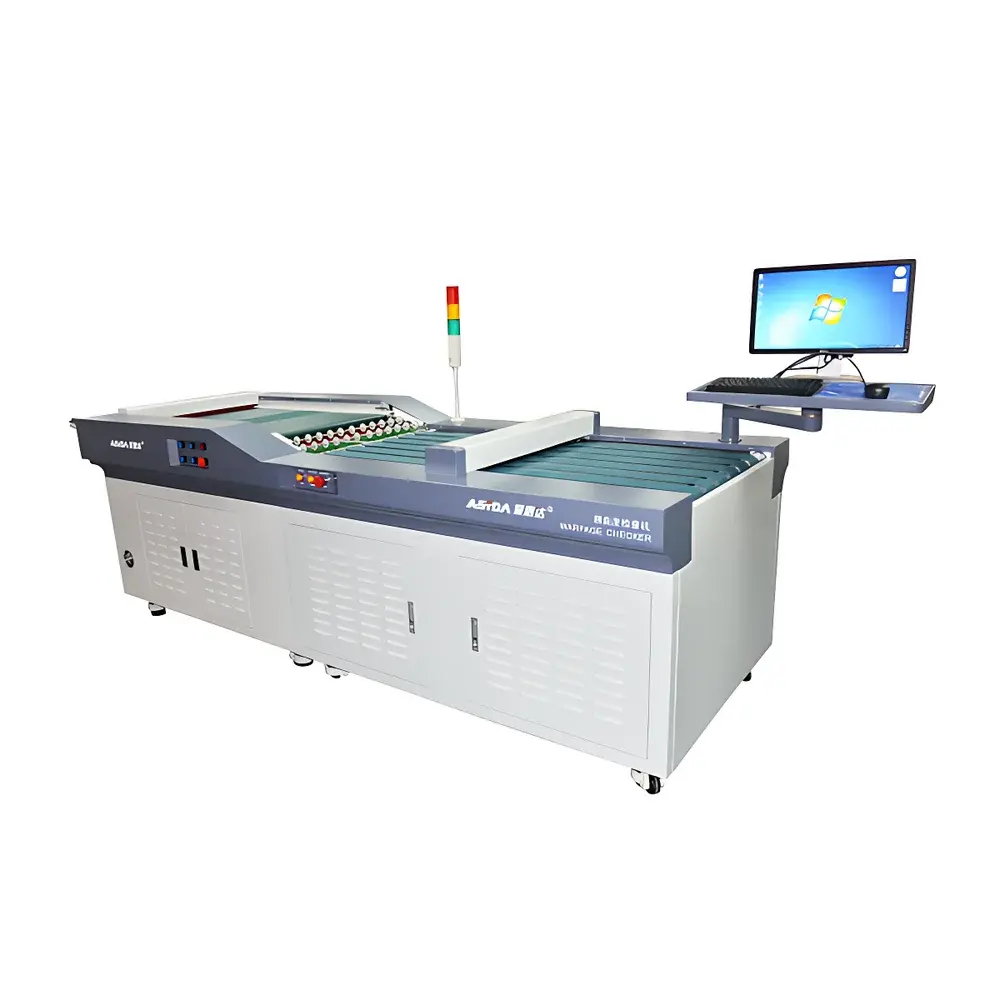
ASIDA QQ1000 PCB Warpage Inspection System
| Brand | ASIDA |
|---|---|
| Model | QQ1000 |
| Origin | Guangdong, China |
| Detection Principle | Non-contact CCD-based laser triangulation |
| Max. PCB Size | 630 × 550 mm |
| Min. PCB Size | 40 × 80 mm |
| Thickness Range | 0.3–5.0 mm |
| Warpage Measurement Range | 0.3–3.0 mm |
| Accuracy | ±0.1 mm |
| Conveyor Speed Options | 6.5 m/min or 12.5 m/min |
| Minimum Board Spacing | ≥40 mm |
| Operating Temperature | 22 °C ± 5 °C |
| Power Supply | AC 220 V, 50 Hz |
| Air Pressure Requirement | 0.5–0.7 MPa |
| Dimensions (L×W×H) | 3510 × 1160 × 1050 mm |
| Weight | 450 kg |
Overview
The ASIDA QQ1000 PCB Warpage Inspection System is an automated, non-contact metrology platform engineered for high-throughput measurement of board-level warpage—specifically bow and twist—in rigid and multilayer printed circuit boards (PCBs) and copper-clad laminates (CCL). It employs a precision CCD-laser triangulation sensor array to capture topographical surface deviations across the full XY plane of each board, generating quantitative 3D warpage profiles in real time. Designed for integration into final QA/QC stations or inline process monitoring points, the system delivers objective, repeatable warpage data aligned with IPC-TM-650 2.4.22 (Bow and Twist Test) and JEDEC JESD22-B112A standards. Its architecture supports both discrete batch inspection and continuous conveyor-based operation, enabling traceable, statistically valid warpage assessment prior to shipment or after critical lamination, drilling, or solder mask curing steps.
Key Features
- High-resolution CCD-laser triangulation sensors with sub-0.1 mm repeatability, calibrated per ISO 17025-accredited procedures;
- Programmable board dimension input (40 × 80 mm to 630 × 550 mm) and user-defined warpage tolerance thresholds—unlimited parameter sets stored per product code;
- Dual-speed conveyor configuration (6.5 m/min standard; optional 12.5 m/min mode) optimized for throughput without compromising measurement density;
- Real-time OK/NG classification logic based on configurable bow/twist limits, synchronized with pneumatic sorting gates for automatic board segregation;
- Modular mechanical design with tool-less access to optical modules, sensor calibration ports, and air purge nozzles—reducing mean time to repair (MTTR);
- Intuitive touch-enabled HMI with guided setup wizards, multilingual interface (English, Japanese, Simplified Chinese), and audit-trail-enabled operation logs.
Sample Compatibility & Compliance
The QQ1000 accommodates rigid FR-4, high-Tg, metal-core, and hybrid laminate PCBs ranging from 0.3 mm to 5.0 mm in thickness. Boards must be flat enough to maintain stable contact with the conveyor belt’s vacuum-assisted positioning system; minimum spacing between consecutive boards is 40 mm to ensure unambiguous profile separation. The system complies with CE electromagnetic compatibility (EMC) directives and meets safety requirements under IEC 61000-6-2/6-4. Measurement methodology adheres to IPC-TM-650 Section 2.4.22 for bow and twist quantification, and raw height-map data can be exported for GLP-compliant statistical process control (SPC) analysis per ISO 22514-2. Optional 21 CFR Part 11-compliant software module available for regulated electronics manufacturing environments.
Software & Data Management
The embedded inspection software provides real-time 3D warpage visualization, including contour heatmaps, cross-sectional slice plots, and vector deviation overlays. All measurements are timestamped, tagged with board ID (via optional barcode/OCR integration), and archived in SQLite-based local storage with daily auto-backup to network drives. Export formats include CSV (for SPC tools), STL (for CAD comparison), and XML (for MES integration). Firmware updates are delivered via secure HTTPS with SHA-256 signature verification. Audit trails record operator login/logout events, parameter changes, calibration actions, and NG disposition decisions—retained for ≥18 months as required by ISO 9001:2015 Clause 8.5.2.
Applications
- Final outgoing quality assurance for automotive-grade PCBs requiring ≤0.75% twist tolerance;
- In-process monitoring after thermal lamination cycles to correlate press parameters with residual stress-induced warpage;
- Supplier qualification audits for CCL vendors, where warp stability under humidity cycling (IPC-MS-01-01) is validated;
- Failure analysis root-cause investigation linking solder joint voiding or BGA misalignment to substrate-level deformation;
- Design for manufacturability (DFM) feedback loop—correlating stack-up asymmetry with measured bow magnitude across panel zones.
FAQ
What standards does the QQ1000 reference for warpage calculation?
It implements IPC-TM-650 2.4.22 definitions for bow (maximum deviation from a reference plane formed by three corners) and twist (diagonal height difference normalized by diagonal length), with optional JEDEC JESD22-B112A mode.
Can the system inspect panels or only individual PCBs?
It is configured for single-board handling; panel-level inspection requires custom fixturing and is not supported in standard configuration.
Is offline calibration possible without interrupting production?
Yes—modular sensor cartridges support hot-swap calibration using NIST-traceable ceramic reference tiles; full recalibration takes <8 minutes and requires no system shutdown.
Does the software support statistical process control (SPC) charting?
Raw height data exports enable external SPC tools (e.g., Minitab, InfinityQS); built-in trend charts display Cp/Cpk indices per lot when linked to ERP/MES identifiers.
What maintenance intervals are recommended?
Daily visual inspection of lens cleanliness and air filter status; quarterly verification of laser alignment and sensor linearity using certified step gauges; annual full metrological validation by ASIDA-certified service engineers.