
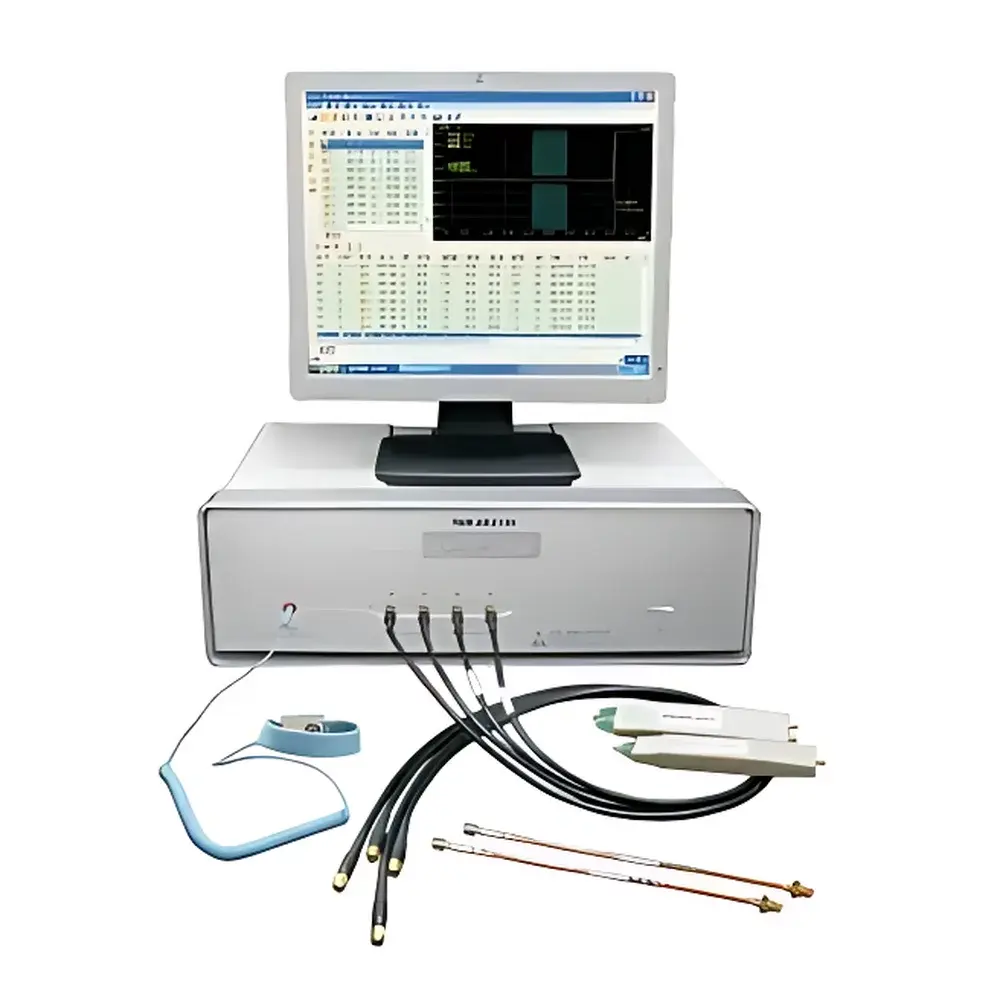
Zhengye ZK2130 High-Frequency Characteristic Impedance Analyzer
| Brand | Zhengye |
|---|---|
| Model | ZK2130 |
| Measurement Principle | Time-Domain Reflectometry (TDR) |
| Impedance Range | 20–150 Ω |
| Accuracy | ±1% at 50 Ω |
| Measurement Length | 0.05–2 m |
| Horizontal Resolution | 0.2 mm |
| Vertical Resolution | 0.05 Ω |
| Bandwidth | 3 GHz |
| Test Modes | Single-Ended & Differential |
| Channel Configurations | 2-channel or 4-channel |
| Compliance | IPC-TM-650, IPC-2141 |
| Data Analysis | Integrated SPC module for statistical process control |
| Operating System | Windows-based GUI |
| Reporting | Automated report generation with waveform export, CSV data logging, and printer support |
Overview
The Zhengye ZK2130 High-Frequency Characteristic Impedance Analyzer is an industrial-grade time-domain reflectometry (TDR) instrument engineered for precision characterization of transmission line impedance in printed circuit board (PCB) fabrication environments. Unlike conventional LCR meters or vector network analyzers (VNAs), the ZK2130 employs calibrated step-pulse TDR methodology to directly measure distributed impedance along PCB traces—capturing localized discontinuities, impedance mismatches, and transition effects with sub-millimeter spatial resolution. Its 3 GHz bandwidth ensures fidelity for high-speed digital designs operating up to 10 Gbps (e.g., PCIe Gen4, USB 3.2, DDR4/5 interconnects), while maintaining traceability to IPC-defined reference standards. Designed specifically for production-integrated metrology, the ZK2130 bridges the gap between R&D validation and high-throughput manufacturing QA—delivering repeatable, auditable impedance profiles without requiring RF calibration expertise.
Key Features
- Automated batch testing with programmable job sequencing—supports unattended operation across hundreds of test points per session.
- Real-time TDR waveform acquisition and overlay comparison against user-defined impedance templates.
- Dual-mode measurement architecture: single-ended (SE) and differential (DIFF) impedance analysis with independent channel triggering and synchronization.
- Configurable multi-channel operation (2-channel or 4-channel variants) enabling parallel testing of multiple nets or layer stacks—reducing cycle time by up to 60% versus sequential probing.
- Integrated parameter editor for rapid setup of trace length, reference impedance, propagation delay, and termination conditions—compatible with Gerber and ODB++ import workflows.
- Onboard statistical process control (SPC) engine compliant with ISO 7870-2:2013 guidelines, calculating Cp/Cpk, X-bar & R charts, and outlier detection per IPC-A-600 acceptance criteria.
- Full audit trail functionality: all measurements, parameter changes, and operator actions are timestamped and logged in encrypted binary format for GLP/GMP traceability.
Sample Compatibility & Compliance
The ZK2130 accommodates standard PCB substrates including FR-4, Rogers RO4000®, polyimide flex circuits, and embedded dielectric laminates. It interfaces directly with bare boards, assembled prototypes, and production panels via spring-loaded coaxial probes or edge-mount SMA fixtures. All measurement protocols align with IPC-TM-650 Section 2.5.1 (TDR-based impedance verification) and IPC-2141A (design guidelines for controlled impedance). Instrument firmware includes built-in compliance reporting modules for IPC Class 2 and Class 3 requirements, supporting automated pass/fail flagging against design-specified tolerance bands (±5%, ±10%, or custom thresholds). Calibration is performed using NIST-traceable TDR standards; certificate of conformance is issued with each unit shipment.
Software & Data Management
The ZK2130 runs on a dedicated Windows 10 IoT Enterprise platform with deterministic real-time kernel extensions for low-latency waveform capture. Its native software suite provides full API access (COM/.NET) for integration into MES, SPC dashboards, or factory automation systems (e.g., Siemens Opcenter, Rockwell FactoryTalk). Raw TDR waveforms are stored in IEEE Std 1159-compliant .tdr binary format; processed results export to CSV, PDF, and XML with embedded metadata (operator ID, timestamp, revision level, environmental conditions). Audit logs meet FDA 21 CFR Part 11 requirements—including electronic signatures, role-based access control, and immutable history retention. Optional cloud sync enables centralized fleet monitoring and predictive maintenance alerts based on probe wear metrics and signal integrity drift trends.
Applications
- Pre-production impedance validation during PCB stack-up verification and design rule checking (DRC).
- In-line impedance monitoring during etch and plating processes to detect microstructural variations affecting conductor geometry.
- Final QA screening of HDI, rigid-flex, and high-frequency RF modules prior to component assembly.
- Root-cause analysis of signal integrity failures—correlating impedance anomalies with eye diagram degradation observed on oscilloscopes or BERT testers.
- Supplier qualification audits where impedance consistency across multiple fabricators must be statistically benchmarked.
- Process capability studies supporting PPAP documentation for automotive (IATF 16949) and aerospace (AS9100) supply chains.
FAQ
What impedance measurement standards does the ZK2130 support?
The instrument natively implements IPC-TM-650 Method 2.5.1 and IPC-2141A, with configurable reporting templates aligned to IPC Class 2 and Class 3 requirements.
Can the ZK2130 measure impedance on assembled PCBs?
Yes—provided test points or edge connectors are accessible; it supports non-destructive probing via 50 Ω coaxial fixtures with <1 pF loading capacitance.
Is SPC data export compatible with common quality management platforms?
All SPC outputs conform to Minitab .mtw and JMP .jmp formats; CSV exports include column headers compliant with SQCpack and InfinityQS QI Macros schema.
How often does the system require recalibration?
Annual calibration is recommended; however, daily verification using the included traceable open/short/load reference kit satisfies ISO/IEC 17025 interim check requirements.
Does the ZK2130 support custom impedance models for non-uniform transmission lines?
Yes—the waveform analysis engine allows user-defined convolution kernels for modeling tapered traces, vias, and stub discontinuities per IEEE P370 guidelines.



