
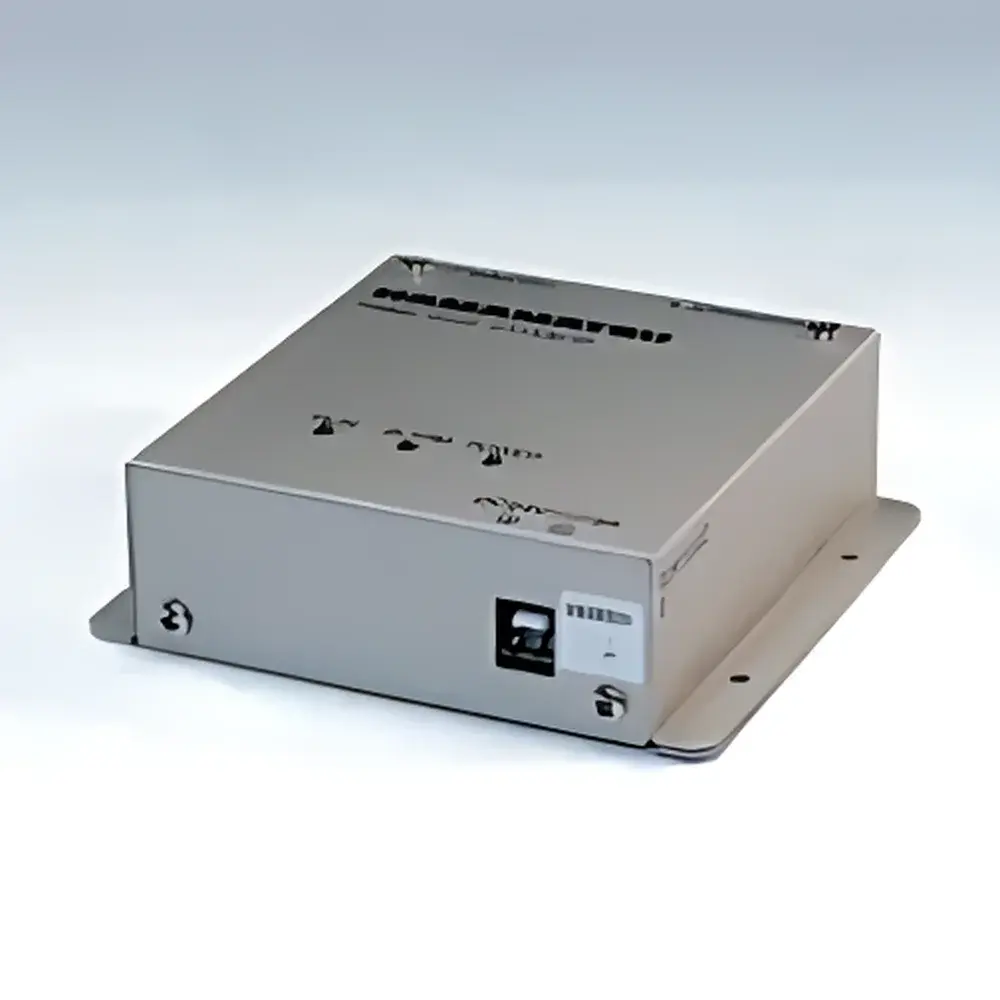
Hamamatsu C11330 Thermoelectric Cooler (TEC) Driver for Quantum Cascade Lasers
| Brand | Hamamatsu |
|---|---|
| Origin | Japan |
| Manufacturer Type | Original Equipment Manufacturer (OEM) |
| Product Category | Imported Instrumentation |
| Model | C11330 |
| Core Function | Precision Temperature Control for QCLs |
| Temperature Stability | ±0.01 °C |
| Control Architecture | Digital PID with Bipolar Output |
| Integrated Monitoring | TEC Heat Sink Temperature Sensing |
| Form Factor | Embedded OEM Module |
| Compliance | Designed for Integration into CE- and FCC-compliant Laser Systems |
Overview
The Hamamatsu C11330 is a high-performance, embedded thermoelectric cooler (TEC) driver engineered specifically for quantum cascade laser (QCL) systems requiring sub-millikelvin thermal stability. Operating on the Peltier principle, the C11330 delivers bidirectional current control to drive TEC elements in both heating and cooling modes—enabling precise, dynamic thermal regulation of QCL gain chips. Unlike generic benchtop temperature controllers, the C11330 is designed as an OEM module with compact mechanical footprint, low-noise analog interfaces, and deterministic digital control latency—making it suitable for integration into turnkey mid-infrared spectroscopy platforms, trace gas analyzers, and industrial process monitoring instruments where spectral accuracy depends critically on laser diode junction temperature stability.
Key Features
- Bipolar output stage capable of delivering up to ±3.5 A at ±4.5 V (configurable current limit), supporting standard 1–3-stage TEC modules commonly used with QCL packages.
- Digital PID controller with user-adjustable proportional, integral, and derivative gains—tuned via UART interface or pre-configured firmware parameters for minimal overshoot and rapid settling (<10 s to ±0.01 °C under typical load conditions).
- Integrated heat sink temperature monitoring via onboard thermistor input (10 kΩ NTC, 2% tolerance), enabling real-time thermal safety interlock and active derating to prevent TEC overdrive or condensation risk.
- Low-noise analog temperature feedback path (<5 µV RMS noise, 20 kHz bandwidth) compatible with industry-standard 10 kΩ thermistors or PT1000 sensors mounted directly on the QCL submount.
- OEM-optimized form factor (70 × 50 × 15 mm) with 2×10-pin SMT header interface—supports I²C or UART communication, analog setpoint input (0–5 V), and status flag outputs for system-level synchronization.
- Internal thermal protection, overcurrent shutdown, and open-circuit TEC detection—all logged via non-volatile fault register accessible through host interface.
Sample Compatibility & Compliance
The C11330 is validated for use with Hamamatsu’s QCL product family (e.g., L12081 series) and third-party QCLs packaged in HHL, TO-66, or butterfly configurations featuring integrated thermistors and TEC elements. Its control loop architecture supports thermal time constants ranging from 0.5 s (chip-scale micro-TECs) to >10 s (bulk-cooled laser mounts). From a regulatory standpoint, the module complies with IEC 61000-6-3 (emission) and IEC 61000-6-2 (immunity) when installed per Hamamatsu’s layout guidelines. While not certified as a standalone medical or industrial device, the C11330 meets functional safety requirements for Class 1 laser systems per IEC 60825-1:2014 and supports design-in compliance with FDA 21 CFR Part 11 when paired with audit-trail-capable host software.
Software & Data Management
Configuration and real-time monitoring are implemented via Hamamatsu’s proprietary C11330 Command Set—a lightweight ASCII-based protocol transmitted over 3.3 V logic-level UART (up to 115.2 kbps). Host systems can read live temperature error, output current, heat sink temperature, and internal fault codes; write PID coefficients, setpoint values, and current limits; and trigger calibration routines for sensor offset compensation. The driver does not include onboard data logging memory but supports streaming telemetry to external DAQ systems via synchronized TTL-ready status outputs. Firmware updates are performed in-field using Hamamatsu’s signed binary loader—ensuring integrity verification and rollback capability during maintenance cycles.
Applications
- Mid-infrared absorption spectroscopy for environmental monitoring (e.g., CH₄, NO₂, CO detection at 4–12 µm).
- Portable and fixed-site trace gas analyzers requiring long-term drift <0.05 °C/week under ambient temperature fluctuations.
- Frequency-stabilized QCL sources for heterodyne detection and cavity-enhanced spectroscopy.
- OEM integration into FTIR accessories, photoacoustic gas cells, and laser-based breath analyzers.
- Research-grade laser test benches where thermal crosstalk between pump diodes and QCLs must be minimized via independent TEC control loops.
FAQ
Is the C11330 compatible with non-Hamamatsu QCLs?
Yes—the driver accepts standard thermistor feedback and provides bipolar current output compatible with most commercially available QCL packages that integrate a 10 kΩ NTC and TEC rated ≤4.5 V / 3.5 A.
Does it support analog setpoint modulation?
Yes—0–5 V analog input maps linearly to temperature setpoint (e.g., 0 V = 15 °C, 5 V = 35 °C), enabling external sweep or lock-in modulation schemes.
Can multiple C11330 units be synchronized?
Not natively—but external triggering via the “SYNC_IN” pin allows simultaneous setpoint update or PID reset across distributed modules using a common clock signal.
What is the recommended heatsink thermal resistance for stable operation?
For optimal stability at ±0.01 °C, Hamamatsu recommends a heatsink thermal resistance ≤0.5 K/W (measured from TEC cold side to ambient) with forced-air or liquid cooling.
Is calibration required after installation?
Factory calibration covers thermistor linearity and current sense accuracy; however, end-users should perform system-level thermal calibration using a reference thermometer mounted adjacent to the QCL submount.



