
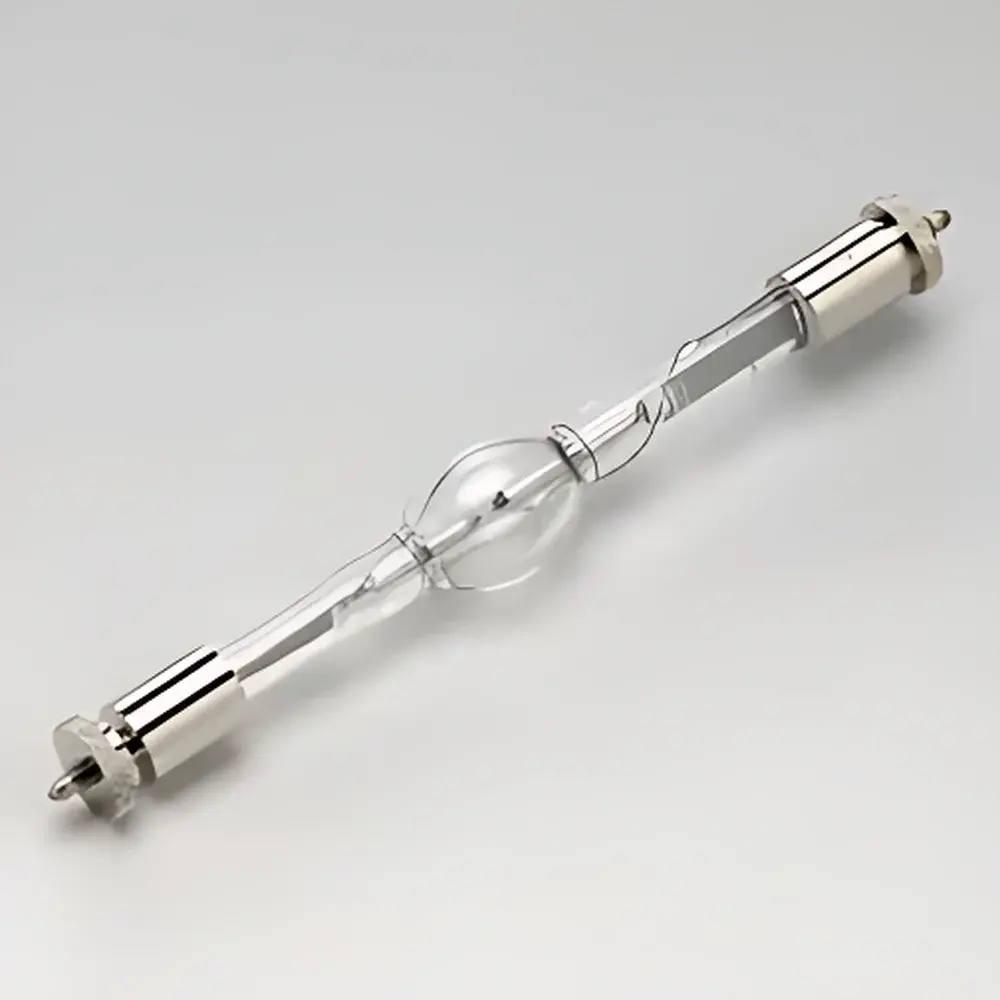
Hamamatsu L11033 Long-Life 150 W Xenon Arc Lamp
| Brand | Hamamatsu |
|---|---|
| Origin | Japan |
| Manufacturer | Hamamatsu Photonics K.K. |
| Type | L11033 |
| Light Source Type | Xenon Arc Lamp |
| Illumination Mode | External Illumination |
| Power | 150 W |
| Arc Length | 2 mm |
| Operating Current | 8.5 ± 0.5 A |
| Operating Voltage | 17 V DC |
| Window Material | Fused Silica |
| Spectral Range | 185–2000 nm |
| Output Drift (Typical) | ±0.5 %/h |
| Peak-to-Peak Output Ripple (Max) | 1 % |
| Guaranteed Lifetime | 3000 h |
| Average Lifetime | 4000 h |
| Orientation Tolerance | ±15° (Vertical or Horizontal) |
| Cooling Method | Natural Convection |
| Minimum Supply Voltage | 65 V DC |
| Ignition Voltage | 20 kV |
| Mass | 45 g |
Overview
The Hamamatsu L11033 is a high-stability, long-life 150 W xenon short-arc lamp engineered for demanding optical laboratory applications requiring broad-spectrum, continuous-wave illumination from the deep ultraviolet (185 nm) through the near-infrared (2000 nm). Its compact envelope and precisely defined 2 mm arc length enable high spatial coherence and excellent coupling efficiency into monochromators, spectrographs, and fiber-optic light guides. Unlike pulsed or LED-based alternatives, the L11033 delivers true continuum radiation with minimal spectral discontinuities—critical for absolute spectral radiance calibration, UV-Vis-NIR spectrophotometry, and photochemical reaction studies where broadband excitation fidelity is non-negotiable. The lamp employs a hermetically sealed fused silica envelope rated for UV transmission down to 185 nm, ensuring stable output in oxygen-sensitive environments without ozone generation concerns typical of quartz variants below 200 nm. Its convection-cooled architecture eliminates reliance on forced-air or liquid cooling systems, reducing mechanical noise and integration complexity in vibration-sensitive setups such as interferometric or ellipsometric platforms.
Key Features
- Guaranteed operational lifetime of 3000 hours under specified DC current (8.5 ± 0.5 A) and voltage (17 V) conditions, with an average service life exceeding 4000 hours—significantly extending maintenance intervals in automated or unattended instrumentation.
- Exceptional short-term stability: output drift ≤ ±0.5 % per hour and peak-to-peak ripple ≤ 1 %, enabling reliable quantitative measurements in time-resolved absorbance or fluorescence kinetics experiments.
- Fused silica window ensures high UV transmittance and thermal shock resistance, supporting repeated thermal cycling between ambient and operating temperatures without degradation of spectral integrity.
- Low-mass design (45 g) and ±15° mechanical alignment tolerance simplify integration into custom optical benches, modular spectroscopy systems, and OEM instrumentation where space and mounting flexibility are constrained.
- Ignition via 20 kV pulse allows cold-start reliability without preheating delays; compatible with standard DC power supplies delivering ≥65 V DC, eliminating need for proprietary ballasts in many benchtop configurations.
Sample Compatibility & Compliance
The L11033 is routinely deployed in ISO/IEC 17025-accredited laboratories for reference-standard illumination in spectroradiometric calibration workflows compliant with CIE S 025/E:2015 and ASTM E308. Its spectral continuity supports traceable validation of detector linearity across UV-Vis-NIR bands per NIST SRM protocols. As a Class 3B laser-equivalent optical hazard device (IEC 62471), it requires appropriate interlocks and beam containment per ANSI Z136.1 when used in open-beam configurations. No hazardous substances are employed in its construction, meeting RoHS Directive 2011/65/EU requirements. While not intrinsically certified for hazardous locations, its convection-only thermal management enables safe operation in cleanroom environments (ISO Class 5–7) without particulate generation from fans or pumps.
Software & Data Management
Though the L11033 operates as a passive light source without embedded firmware or digital interfaces, its stability metrics are fully integratable into instrument control architectures via external photodiode monitoring channels. When paired with Hamamatsu’s C12701 series optical power meters or third-party lock-in amplifiers (e.g., Stanford Research Systems SR830), real-time output normalization and drift compensation can be implemented within LabVIEW, Python (using PyVISA), or MATLAB environments. Audit trails for lamp runtime, ignition cycles, and output calibration history may be maintained in accordance with FDA 21 CFR Part 11-compliant electronic lab notebooks (ELNs) when linked to timestamped sensor logs and instrument metadata.
Applications
- Primary and secondary calibration of UV-Vis-NIR spectrophotometers and array detectors against NIST-traceable standards.
- Illumination source for solar simulator classification (IEC 60904-9:2020 Class AAA) in photovoltaic quantum efficiency testing.
- Excitation source in time-resolved fluorescence spectroscopy, particularly for multi-wavelength decay analysis requiring spectral uniformity.
- Photochemical reactor illumination in controlled-environment chambers for ASTM D4329 accelerated weathering studies.
- Reference emitter in hyperspectral imaging system characterization, especially for push-broom sensor linearity verification across 185–2000 nm.
FAQ
What is the recommended power supply configuration for stable operation?
A regulated DC power supply capable of delivering 8.5 ± 0.5 A at 17 V with ≤0.1 % ripple is required; Hamamatsu recommends using their C10212 series constant-current drivers for optimal lifetime and stability.
Can the L11033 be operated horizontally or vertically without performance loss?
Yes—the lamp is qualified for both orientations within ±15° mechanical tolerance; however, vertical orientation (anode up) is preferred to minimize arc wander and maximize lifetime consistency.
Is ozone generation a concern during operation below 200 nm?
No—fused silica transmission cutoff at ~185 nm suppresses significant VUV emission; measurable ozone production is negligible under standard atmospheric conditions.
How is lamp end-of-life determined in practice?
End-of-life is defined as the point where arc voltage increases by >15 % above initial value or radiant flux drops >10 % at 500 nm, per Hamamatsu’s internal aging protocol C-0012.
Does Hamamatsu provide spectral irradiance data for the L11033?
Yes—NIST-traceable relative spectral power distribution (SPD) files in CSV format are available upon request under Hamamatsu’s Calibration Data Service (CDS-037).





