
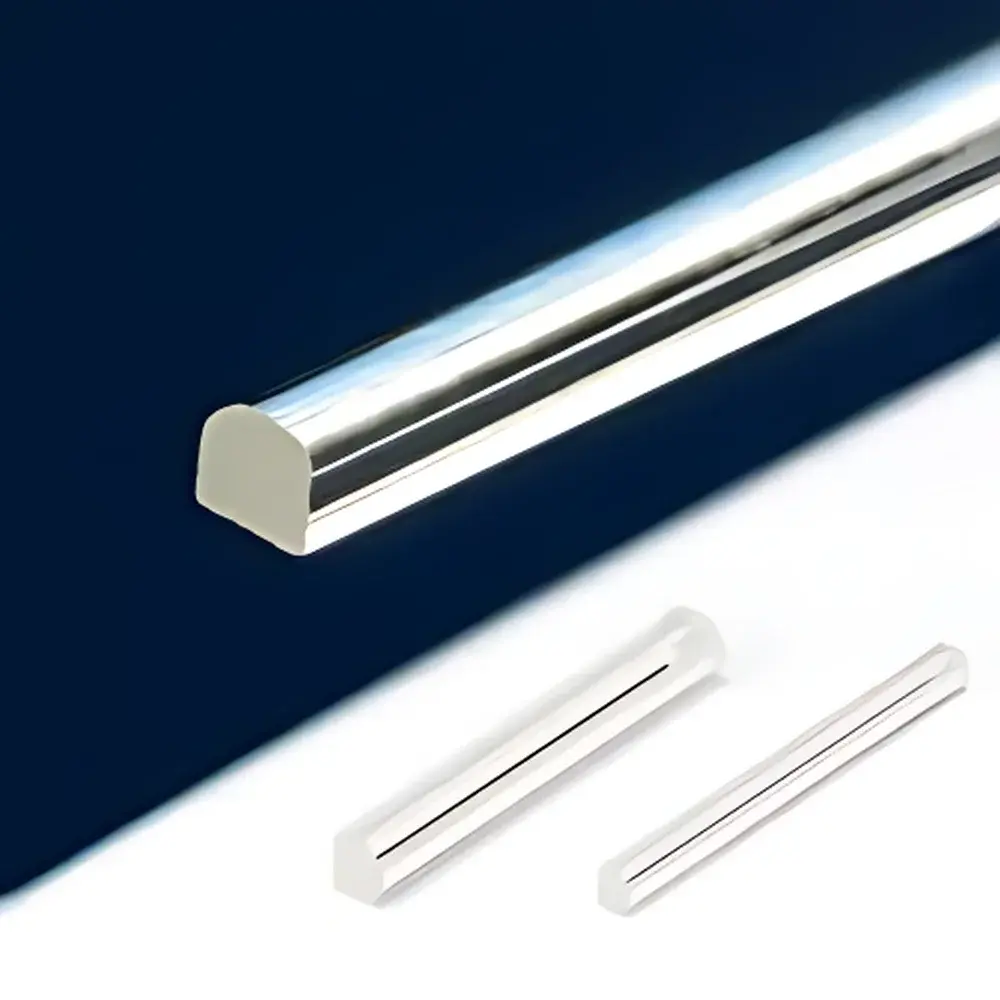
Hamamatsu J10919 FAC Lens
| Brand | Hamamatsu |
|---|---|
| Origin | Japan |
| Manufacturer Type | Original Equipment Manufacturer (OEM) |
| Product Category | Imported |
| Model | J10919 |
| Component Type | Fiber-Coupled Aspheric Cylindrical Lens |
| Optical Function | Fast-Axis Collimation (FAC) for Semiconductor Laser Diodes |
Overview
The Hamamatsu J10919 FAC Lens is a precision-engineered aspheric cylindrical lens designed specifically for fast-axis collimation of high-power semiconductor laser diode (LD) output beams. Semiconductor laser bars and single-emitter diodes exhibit highly asymmetric beam divergence—typically 30–50° full-width half-maximum (FWHM) in the fast axis (perpendicular to the junction plane) and only 6–10° in the slow axis. Without corrective optics, this anisotropic divergence severely limits coupling efficiency into optical fibers, fiber bundles, or downstream beam-shaping systems. The J10919 addresses this fundamental challenge by applying high-precision non-spherical surface geometry to compress the fast-axis divergence to sub-mrad levels—typically ≤1.5 mrad FWHM—while preserving slow-axis characteristics. Its monolithic fused silica substrate, anti-reflection (AR)-coated for 780–1064 nm operation, ensures minimal wavefront distortion and thermal stability under continuous-wave (CW) or quasi-CW pumping conditions common in industrial and scientific LD applications.
Key Features
- Aspheric cylindrical surface profile optimized for diffraction-limited fast-axis collimation of edge-emitting laser diodes
- Compact footprint (6.0 × 2.0 × 1.5 mm typical) enabling integration into dense optomechanical assemblies and micro-optic modules
- High-precision diamond-turning fabrication process minimizing higher-order aberrations and suppressing side lobes in the far-field intensity distribution
- AR coating optimized for broadband transmission across the near-infrared spectrum (780–1064 nm), with average reflectance <0.25% per surface
- Designed for direct mounting onto laser diode packages or micro-optic submounts using UV-curable adhesives or solder reflow processes
- Robust mechanical architecture compatible with automated pick-and-place assembly and reflow soldering profiles compliant with IPC-J-STD-020
Sample Compatibility & Compliance
The J10919 is validated for use with standard TO-can, C-mount, and butterfly-packaged laser diodes emitting between 780 nm and 1064 nm—including 808 nm pump diodes, 915 nm and 976 nm fiber laser pumps, and 1064 nm DPSS-pumped sources. It supports both single-emitter and linear array configurations with emitter pitches from 100 µm to 400 µm. The lens meets RoHS Directive 2011/65/EU and REACH Regulation (EC) No. 1907/2006 requirements. While not a standalone medical or safety-certified device, its optical performance aligns with beam quality specifications referenced in ISO 11146-1:2021 (laser beam widths, divergence, and propagation ratios) and IEC 60825-1:2014 (laser product safety classification when integrated into Class 4 systems).
Software & Data Management
As a passive optical component, the J10919 does not incorporate embedded firmware, digital interfaces, or onboard data logging. However, Hamamatsu provides comprehensive optical simulation support: Zemax OpticStudio-compatible .ZMX files, ray-trace models (including surface sag tables and coating dispersion data), and measured M² and BPP (beam parameter product) characterization reports for representative LD sources. These resources are accessible via Hamamatsu’s technical portal under part number J10919—enabling users to model collimation performance within system-level simulations and validate compliance with ISO 13694 (laser beam profiling) and ISO 11146 measurement protocols.
Applications
- High-efficiency coupling of multi-emitter laser bars into multimode or photonic crystal fibers
- Beam conditioning in solid-state and fiber laser pumping architectures
- Optical pumping of Ti:sapphire and Cr:LiSAF ultrafast amplifier systems
- Industrial material processing systems requiring uniform line illumination or structured light projection
- Biomedical instrumentation including flow cytometry excitation optics and confocal microscope illumination engines
- Free-space optical interconnects where low-divergence, polarization-maintaining collimation is critical
FAQ
What is the primary optical function of the J10919 FAC lens?
It performs fast-axis collimation of semiconductor laser diode output, reducing fast-axis divergence to ≤1.5 mrad while preserving native slow-axis characteristics.
Is the J10919 suitable for high-power CW operation?
Yes—it is fabricated from synthetic fused silica with high laser-induced damage threshold (LIDT ≥ 5 J/cm² at 1064 nm, 10 ns pulse, 10 Hz), validated for continuous operation up to 10 W optical power per emitter.
Does Hamamatsu provide mounting fixtures or alignment guides for the J10919?
Standardized stainless-steel micro-mounts (e.g., LMS-10 series) and kinematic alignment stages are recommended; Hamamatsu offers application notes on active alignment procedures using quadrant photodiodes and piezo-driven tip/tilt platforms.
Can the J10919 be used with VCSEL arrays?
No—its design targets edge-emitting LDs with vertical cavity emission profiles; VCSELs require different collimation strategies due to their symmetric, low-divergence output.
Are Zemax or CODE V models available for optical system integration?
Yes—Hamamatsu supplies verified non-sequential ray-trace models with surface metrology data, coating dispersion curves, and measured wavefront error maps for integration into commercial optical design software.





