
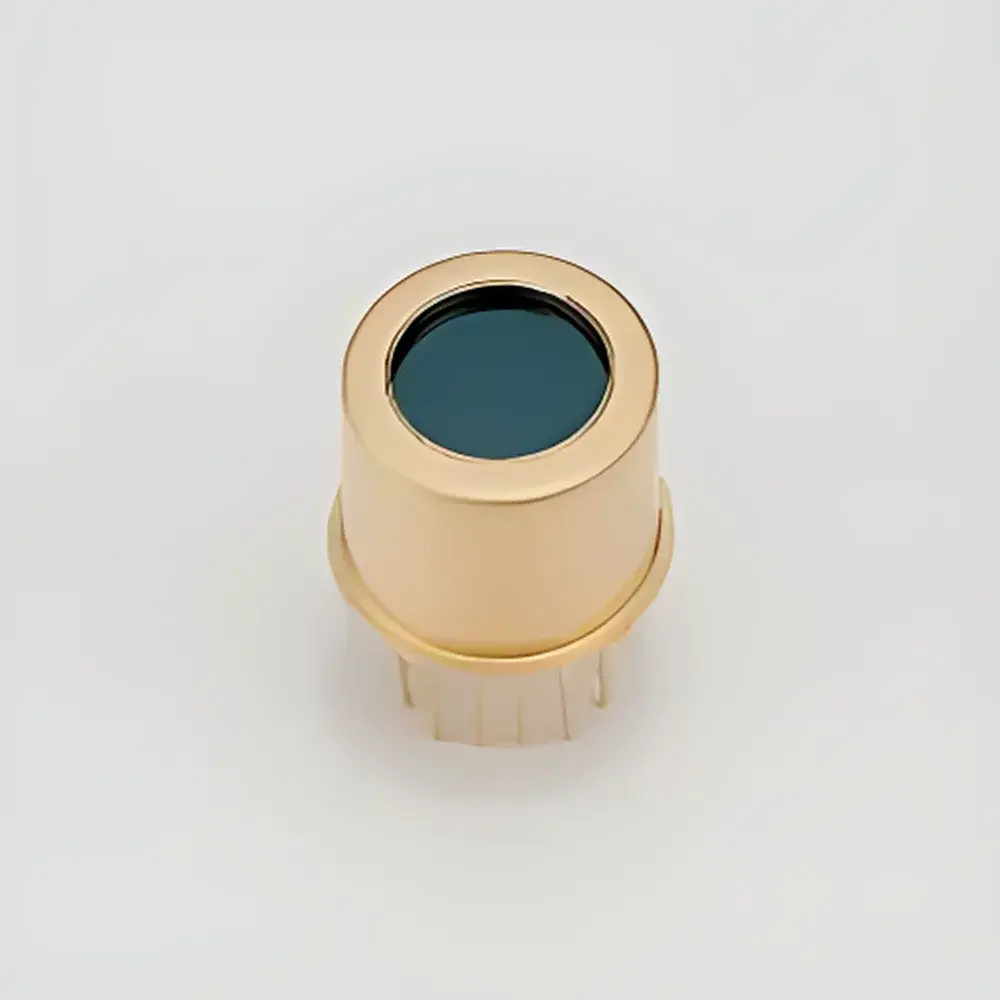
Hamamatsu L12014-2231T-C DFB Pulsed Quantum Cascade Laser
| Brand | Hamamatsu |
|---|---|
| Origin | Japan |
| Manufacturer Type | Original Equipment Manufacturer (OEM) |
| Product Category | Imported Instrument |
| Model | L12014-2231T-C |
| Laser Type | Distributed Feedback (DFB), Pulsed Operation |
| Peak Emission Wavelength (Typ.) | 4.48 µm |
| Operating Temperature Range (QCL) | 10–50 °C |
| Spectral Linewidth (Max.) | 0.2 cm⁻¹ |
| Tuning Range (Min.) | ±1.0 cm⁻¹ |
| Pulsed Radiant Power (Min.) | 50 mW |
| Threshold Current (Max.) | 1.5 A |
| Side Mode Suppression Ratio (Min.) | 25 dB |
| Package | TO-8 |
| Dimensions | Standard TO-8 footprint (13.0 mm diameter, 4.5 mm height) |
Overview
The Hamamatsu L12014-2231T-C is a distributed feedback (DFB) quantum cascade laser (QCL) engineered for high-resolution, mid-infrared (MIR) spectroscopic applications. Unlike conventional diode lasers based on interband transitions, QCLs operate via intersubband transitions within the conduction band of a carefully engineered semiconductor heterostructure—enabling precise, narrow-linewidth emission in the 4–10 µm spectral region. This device emits at a nominal wavelength of 4.48 µm with a typical spectral linewidth ≤0.2 cm⁻¹, making it suitable for gas-phase absorption spectroscopy where rotational-vibrational transitions of target molecules (e.g., CO, NO, CH₄, N₂O, and volatile organic compounds) exhibit strong, spectrally resolved features. Its pulsed operation mode supports time-resolved detection schemes—including photoacoustic spectroscopy (PAS) and cavity-enhanced absorption techniques—while minimizing thermal load during extended duty cycles.
Key Features
- DFB grating-integrated design ensures single-mode, stable longitudinal emission without external cavity components.
- Pulsed operation enables peak power delivery (≥50 mW) with low average power dissipation, supporting high signal-to-noise ratio (SNR) detection in lock-in or gated acquisition systems.
- Narrow intrinsic linewidth (≤0.2 cm⁻¹) and tunability of ±1.0 cm⁻¹ allow scanning across molecular absorption lines while maintaining spectral fidelity.
- Robust TO-8 metal-can package provides hermetic sealing, mechanical stability, and compatibility with standard thermoelectric cooler (TEC) mounts and optical alignment fixtures.
- Specified operating temperature range of 10–50 °C permits integration into compact, field-deployable sensor platforms without requiring cryogenic cooling.
- High side-mode suppression ratio (≥25 dB) minimizes mode-hopping artifacts critical for quantitative trace-gas analysis under varying thermal or drive conditions.
Sample Compatibility & Compliance
The L12014-2231T-C is designed for use in analytical systems targeting gaseous samples in ambient or controlled environments. It is compatible with multipass gas cells (e.g., White or Herriott configurations), photoacoustic resonators, and integrated waveguide-based sensing modules. As a core optical source, it supports compliance-driven measurement workflows aligned with ISO 14001 environmental monitoring frameworks and ASTM D6348–22 for gaseous emissions analysis. While the laser itself is not a standalone certified instrument, its performance characteristics meet the optical source requirements specified in EPA Method 320 and EN 15267-3 for continuous emission monitoring systems (CEMS). Device-level electrical and thermal specifications conform to IEC 61000-6-3 (EMC emission limits) and JEDEC JESD22-A108 (temperature cycling reliability).
Software & Data Management
The laser operates as a hardware component within larger OEM instrumentation architectures. Drive electronics—including current pulsing, temperature control, and wavelength modulation—are typically managed via analog/digital interfaces (e.g., TTL-triggered pulse input, 0–5 V TEC setpoint control) compatible with industrial DAQ systems (National Instruments, Keysight, or custom FPGA-based controllers). Hamamatsu provides detailed driver interface documentation and characterization datasets (L-I-V curves, spectral scans, thermal drift profiles) for integration into GLP/GMP-compliant software environments. When embedded in validated instruments, full audit trails—including laser operating hours, pulse count, temperature logs, and calibration history—can be maintained per FDA 21 CFR Part 11 requirements using compliant data acquisition software.
Applications
- Trace gas detection in industrial stack emissions monitoring and fugitive leak surveys.
- Real-time breath analysis for medical diagnostics (e.g., nitric oxide quantification in asthma management).
- Environmental air quality networks measuring greenhouse gases and urban pollutants.
- Process analytical technology (PAT) in pharmaceutical manufacturing for solvent vapor monitoring.
- Research-grade mid-IR spectroscopy in physics, chemistry, and materials science laboratories.
- Calibration source for Fourier-transform infrared (FTIR) spectrometers and tunable diode laser absorption spectrometers (TDLAS).
FAQ
Is the L12014-2231T-C suitable for continuous-wave (CW) operation?
No—this device is specifically configured for pulsed operation. CW operation is not supported due to thermal and carrier lifetime constraints inherent to its DFB-QCL structure.
What cooling solution is recommended for stable spectral output?
A precision thermoelectric cooler (TEC) with ±0.1 °C temperature stability is required; Hamamatsu recommends mounting the TO-8 package onto a TEC stage with proportional-integral-derivative (PID) control.
Can this laser be wavelength-modulated for second-harmonic detection?
Yes—the ±1.0 cm⁻¹ tuning range allows direct current injection modulation for wavelength modulation spectroscopy (WMS), enabling harmonic detection up to the second derivative (2f) signal.
Does Hamamatsu provide spectral calibration certificates with each unit?
Spectral calibration data (peak wavelength, linewidth, and tuning slope) are included in the factory test report; NIST-traceable calibration is available upon request for OEM integration projects.
What is the expected operational lifetime under recommended drive conditions?
Based on accelerated life testing per JEDEC JESD22-A108, median lifetime exceeds 10,000 hours at 25 °C case temperature and 50% duty cycle with proper ESD protection and current limiting.




