
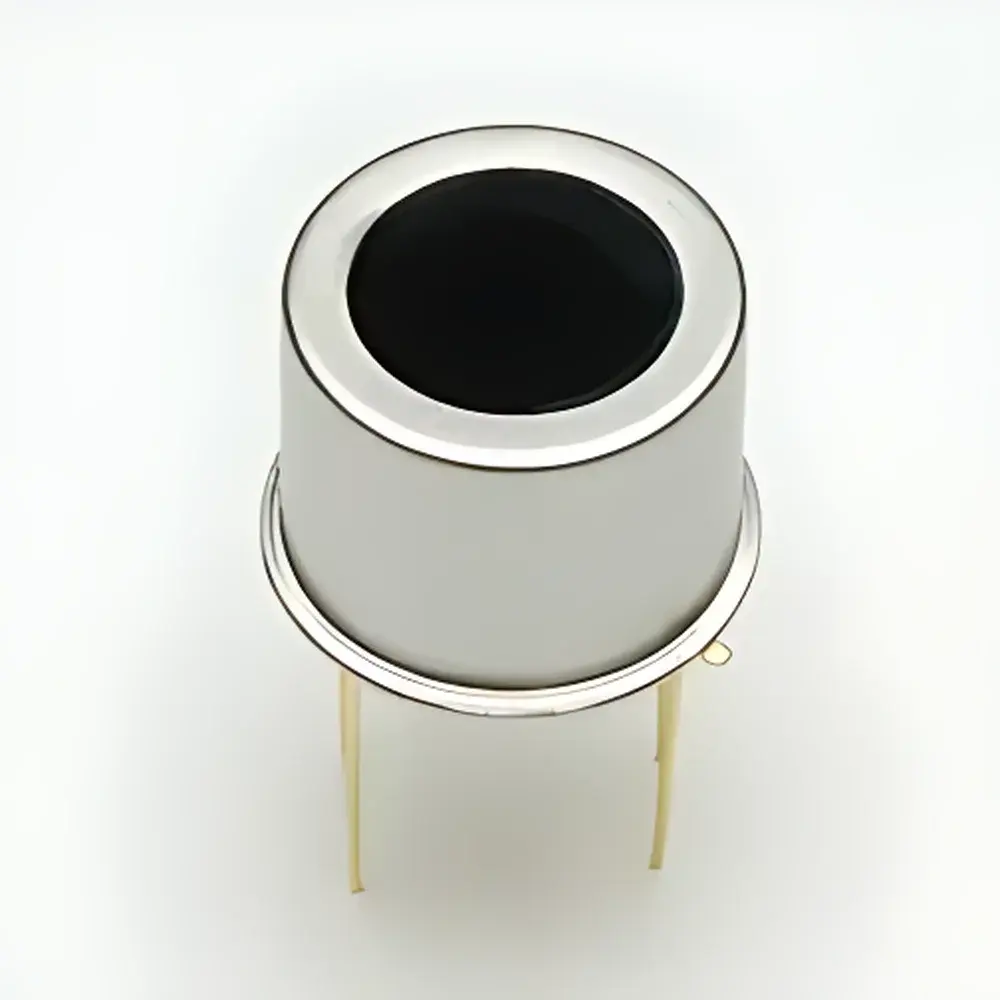
Hamamatsu P12691-201 InAsSb Photovoltaic Infrared Detector
| Brand | Hamamatsu |
|---|---|
| Origin | Japan |
| Manufacturer Type | Original Equipment Manufacturer (OEM) |
| Product Origin | Imported |
| Model | P12691-201 |
| Cooling | Two-stage thermoelectric (TE) cooler |
| Package | TO-8 metal can |
| Active Area | Ø1 mm |
| Pixel Count | 1 |
| Cut-off Wavelength (typ.) | 8.3 µm |
| Peak Wavelength (typ.) | 6.7 µm |
| Spectral Range | ~3.5–8.3 µm |
| Responsivity (typ. at peak, T<sub>d</sub> = −30 °C) | 1.2 A/W |
| Material | Indium Arsenide Antimonide (InAsSb) |
Overview
The Hamamatsu P12691-201 is a single-element photovoltaic infrared detector engineered for high-speed, high-sensitivity spectral detection in the mid-wave infrared (MWIR) range—specifically optimized for gas analysis applications requiring precise, real-time quantification of molecular absorption features between 3.5 µm and 8.3 µm. Unlike cryogenically cooled alternatives, this device employs a two-stage thermoelectric (TE) cooler integrated into a compact, hermetically sealed TO-8 metal package, eliminating the need for liquid nitrogen or bulky dewar assemblies. Its InAsSb photodiode structure forms a robust PN junction, enabling intrinsic zero-bias operation, low noise performance, and sub-microsecond temporal response—critical for time-resolved spectroscopy and fast-modulated QCL-based gas sensing systems. Designed and manufactured in Japan using Hamamatsu’s proprietary bulk crystal growth process, the P12691-201 delivers exceptional quantum efficiency and long-term stability across industrial, environmental, and research-grade monitoring platforms.
Key Features
- Photovoltaic operation: No external bias required—reduces system complexity and eliminates dark current drift.
- Two-stage TE cooling: Achieves stable detector temperature down to −30 °C without cryogens; enables consistent responsivity and noise floor control.
- High responsivity: 1.2 A/W (typ.) at 6.7 µm under Td = −30 °C, supporting low-concentration gas detection with high signal-to-noise ratio (SNR).
- Compact TO-8 metal package: Facilitates direct integration into OEM gas modules, optical benches, and portable analyzers; compatible with standard PCB mounting and wire bonding.
- InAsSb active material: Offers superior cutoff tunability near 8.3 µm while maintaining low Auger recombination—ideal for detecting CO2 (4.26 µm), SOx (7.3 µm), CO (4.67 µm), and NOx (5.3 µm and 6.2 µm bands).
- Rugged, RoHS-compliant construction: Hermetic metal enclosure ensures reliability in field-deployable instrumentation exposed to variable ambient conditions.
Sample Compatibility & Compliance
The P12691-201 is designed for use in non-dispersive infrared (NDIR), photoacoustic spectroscopy (PAS), and tunable laser absorption spectroscopy (TLAS) configurations. Its Ø1 mm active area and broad MWIR spectral response support compatibility with collimated QCL output beams and multi-pass gas cells. The detector meets IEC 61000-6-3 (EMC emission) and IEC 61000-6-2 (immunity) standards for industrial environments. While not intrinsically certified for hazardous locations, it is routinely integrated into Class I, Division 2 (CID2) compliant gas analyzers when housed within appropriate explosion-proof enclosures. Device-level traceability and calibration documentation are available upon request to support ISO/IEC 17025-compliant laboratory validation and GLP/GMP audit requirements.
Software & Data Management
As a core sensor component—not a standalone instrument—the P12691-201 interfaces via standard analog output (current mode) or with optional transimpedance amplifier boards. It is fully compatible with Hamamatsu’s C13642 series evaluation kits and third-party DAQ systems (e.g., National Instruments PXI, Keysight U2300A). When deployed in regulated environments, its analog signal path supports FDA 21 CFR Part 11–compliant data acquisition when paired with validated firmware and audit-trail-enabled software (e.g., LabVIEW with DIAdem or MATLAB with Instrument Control Toolbox). Raw detector output requires spectral calibration against NIST-traceable reference sources (e.g., blackbody radiators or gas cell absorption lines) for quantitative concentration reporting per ASTM E1444 or ISO 46002 guidelines.
Applications
- Continuous emissions monitoring (CEM) of stack gases in power plants and cement kilns.
- Industrial safety systems for CO, NOx, and SO2 leak detection in chemical processing facilities.
- Automotive exhaust analysis and onboard diagnostics (OBD-II) development.
- Atmospheric research platforms measuring greenhouse gas fluxes using open-path or cavity-enhanced configurations.
- OEM integration into handheld or drone-mounted environmental sensors for urban air quality mapping.
- Calibration transfer standards in metrology labs performing inter-laboratory comparison studies.
FAQ
What is the recommended operating temperature for optimal performance?
The detector achieves specified responsivity and noise performance when stabilized at −30 °C using the integrated two-stage TE cooler. Temperature control accuracy should be maintained within ±0.1 °C for high-precision gas quantification.
Can the P12691-201 be used with pulsed QCLs?
Yes—the photovoltaic architecture and sub-500 ns rise time enable faithful detection of QCL pulses up to 1 MHz repetition rates without signal distortion or recovery lag.
Is window material specified for the TO-8 package?
The standard version includes an AR-coated ZnSe window optimized for 3–12 µm transmission; custom windows (e.g., Ge, KRS-5) are available upon request for specialized spectral filtering.
Does Hamamatsu provide spectral calibration data?
Yes—each unit ships with individual spectral responsivity curves measured at −30 °C, traceable to Hamamatsu’s internal reference standards calibrated against NIST SRM 2241.
What is the maximum permissible incident optical power?
The absolute maximum average optical power density is 10 mW/mm²; exceeding this may cause thermal saturation or permanent responsivity drift. For QCL applications, pulse energy should remain below 1 µJ per pulse to avoid nonlinear effects.







