
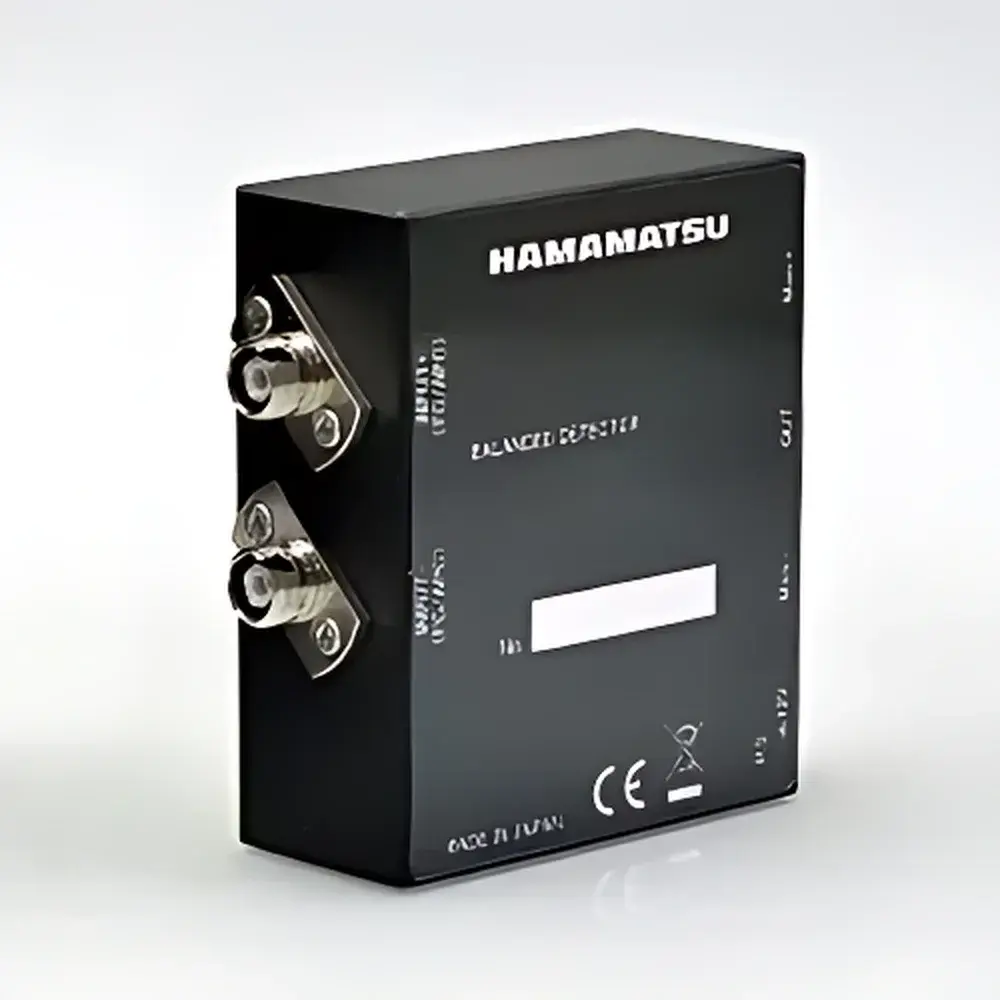
Hamamatsu Balanced Detector C12668-02
| Brand | Hamamatsu |
|---|---|
| Origin | Japan |
| Manufacturer Type | Original Equipment Manufacturer (OEM) |
| Import Status | Imported |
| Model | C12668-02 |
| Frequency Bandwidth | 20 MHz (−3 dB) |
| Common-Mode Rejection Ratio (CMRR) | 35 dB (typ.) |
| Optical Input Interface | FC/APC connector (single-mode fiber compatible) |
| Electrical Output Interface | SMA female |
| Operating Wavelength Range | Optimized for 1300 nm (OCT applications) |
| Package Dimensions | Compact housing (see mechanical drawing per datasheet) |
Overview
The Hamamatsu Balanced Detector C12668-02 is a high-stability, differential photoreceiver module engineered specifically for low-noise optical coherence tomography (OCT) systems operating in the 1300 nm spectral window. It implements a true balanced detection architecture based on two matched, monolithic silicon photodiodes configured in a reverse-series (anti-parallel) arrangement. This topology enables common-mode optical noise—such as intensity fluctuations from the light source, environmental vibration-induced path-length drift, or back-reflection interference between sample and reference arms—to be actively suppressed at the analog front-end. The detector converts minute differential photocurrents—arising from sub-wavelength optical path differences in interferometric OCT signals—into robust voltage outputs with high linearity and temporal fidelity. Its design adheres to fundamental principles of interferometric signal recovery: maximizing signal-to-noise ratio (SNR) by rejecting uncorrelated photon shot noise and laser relative intensity noise (RIN), while preserving phase-sensitive amplitude contrast essential for axial resolution in time-domain and Fourier-domain OCT implementations.
Key Features
- Dual-channel matched photodiode pair fabricated on a single silicon substrate, ensuring thermal and spectral uniformity
- Integrated transimpedance amplifier (TIA) with fixed gain optimized for 1300 nm OCT source spectra and typical fiber-coupled input power levels (−20 to 0 dBm)
- 20 MHz small-signal bandwidth (−3 dB), supporting real-time A-scan acquisition at standard OCT line rates (≥10 kHz)
- Typical common-mode rejection ratio (CMRR) of 35 dB across the 10 kHz–10 MHz range, verified under matched optical input conditions
- Proprietary optical feedthrough suppression structure minimizing internal Fresnel reflections within the detector head—critical for reducing ghost interference artifacts in high-dynamic-range OCT imaging
- FC/APC fiber-optic input interface compliant with IEC 61754-13; SMA output for direct connection to oscilloscopes, digitizers, or lock-in amplifiers
- Compact, shielded metal housing (dimensions: 45 × 30 × 18 mm) designed for integration into space-constrained OCT probe interfaces and benchtop interferometers
Sample Compatibility & Compliance
The C12668-02 is intended for use with single-mode fiber (SMF-28 or equivalent) delivering interferometric light from broadband superluminescent diodes (SLDs) or swept-source lasers centered at 1300 nm. It is not rated for free-space coupling or multimode fiber inputs. The device meets RoHS Directive 2011/65/EU requirements and complies with CE marking directives for electromagnetic compatibility (EN 61326-1) and low-voltage safety (EN 61010-1). While not certified for clinical use per ISO 13485 or FDA 21 CFR Part 820, its performance characteristics align with technical specifications referenced in OCT system validation protocols per ANSI Z80.10 (Ophthalmic Instruments – Optical Coherence Tomography Systems) and IEC 62304 (Medical Device Software Lifecycle Processes) for Class B software-controlled instruments.
Software & Data Management
As a hardware-level analog signal conditioning module, the C12668-02 does not incorporate embedded firmware or digital control interfaces. It operates as a passive analog front-end: no drivers, SDKs, or configuration software are required. Output signals are continuous analog voltages proportional to the instantaneous intensity difference between the two input arms. For systems requiring traceable calibration or audit-ready data acquisition, the detector is fully compatible with third-party DAQ platforms (e.g., National Instruments PXIe-6363, Keysight U2531A) that support IEEE 1788-compliant timestamping and GLP/GMP-compliant audit trails when integrated into validated OCT workstations. Raw output may be logged directly without signal degradation, preserving full dynamic range for post-processing algorithms including dispersion compensation and complex conjugate artifact suppression.
Applications
- Ophthalmic OCT systems for retinal layer segmentation and glaucoma progression monitoring
- Endoscopic OCT probes requiring miniature, low-heat-generation detection modules
- Research-grade swept-source OCT (SS-OCT) and spectral-domain OCT (SD-OCT) interferometers
- Low-coherence interferometry (LCI) setups for non-destructive testing of polymer coatings and semiconductor thin films
- Quantitative phase microscopy systems utilizing dual-beam heterodyne detection schemes
- Calibration references in metrology labs validating OCT system axial resolution per ISO 21554-2
FAQ
Is the C12668-02 compatible with 850 nm or 1060 nm OCT systems?
No. The photodiode responsivity and internal optical path design are optimized for peak performance at 1300 nm. Use at other wavelengths results in reduced quantum efficiency and degraded CMRR.
Does this detector require external bias voltage or temperature stabilization?
No. It operates from a single +5 V DC supply (±5 %) and includes internal thermal compensation; no TEC or external bias circuitry is needed.
Can it be used with polarization-maintaining (PM) fiber inputs?
Yes—provided the PM fiber is terminated with an FC/APC connector and the polarization axis is aligned prior to coupling; however, the detector itself is polarization-insensitive.
What is the maximum allowable optical input power per channel?
The absolute maximum is +3 dBm (2 mW) per arm; sustained operation above −10 dBm requires verification of thermal drift in long-term acquisitions.
Is mechanical mounting hardware included?
No. Mounting holes conform to Hamamatsu’s standard 2-56 UNC pattern; users must specify custom brackets or optomechanical adapters per integration requirements.




