
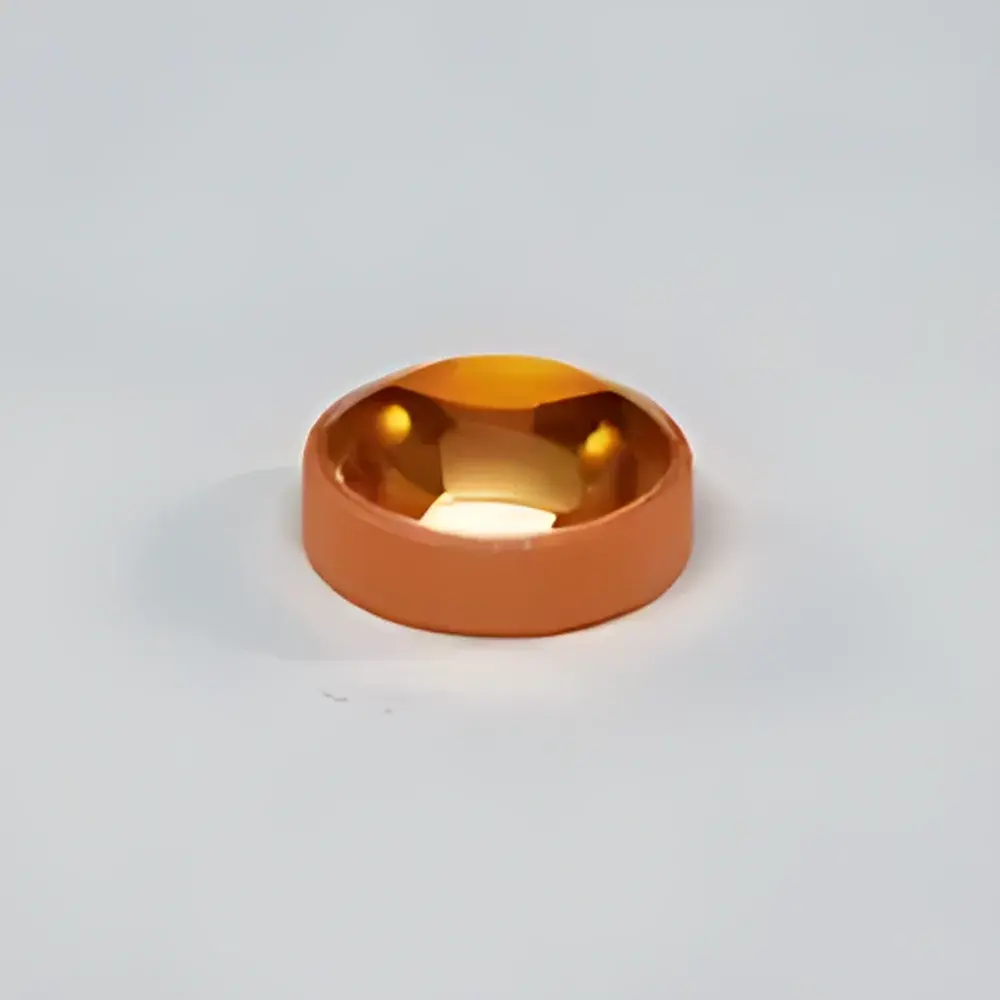
Hamamatsu A11331 Aspheric ZnSe Lens for Quantum Cascade Lasers
| Brand | Hamamatsu |
|---|---|
| Origin | Japan |
| Manufacturer Type | Original Equipment Manufacturer (OEM) |
| Import Status | Imported |
| Model | A11331 |
| Core Component | Aspheric Zinc Selenide (ZnSe) Optical Lens for QCL Beam Conditioning |
| Compatible Mounting Platforms | A11331-0xH Lens Holder Unit, HHL Mounting Kit A11709, Pulsed QCL Driver C11635 |
Overview
The Hamamatsu A11331 is a precision-engineered aspheric zinc selenide (ZnSe) lens designed specifically for beam shaping, collimation, and focusing in mid-infrared (MIR) quantum cascade laser (QCL) systems. Operating optimally across the 3–12 µm spectral range—where ZnSe exhibits high transmission (>70%) and low absorption—this lens leverages aspheric surface geometry to eliminate spherical aberration and deliver diffraction-limited performance in demanding spectroscopic and sensing applications. Unlike standard plano-convex or meniscus lenses, the A11331’s monolithic ZnSe substrate is diamond-turned to sub-micron surface accuracy (λ/4 @ 10.6 µm), enabling high-fidelity wavefront preservation critical for heterodyne detection, cavity-enhanced absorption spectroscopy (CEAS), and photoacoustic gas sensing. Its thermal expansion coefficient (7.4 × 10⁻⁶ K⁻¹) and low thermo-optic coefficient (dn/dT ≈ 6.3 × 10⁻⁶ K⁻¹) ensure stable optical alignment under pulsed or CW QCL operation with duty-cycle-dependent thermal loading.
Key Features
- Material: High-purity, CVD-grown zinc selenide (ZnSe) with >99.99% stoichiometric purity and <0.05 cm⁻¹ bulk absorption at 8 µm
- Surface figure: λ/4 RMS wavefront error over clear aperture (CA), verified via interferometric testing per ISO 10110-5
- Coating: Single-layer anti-reflection (AR) coating optimized for 7–11 µm band; residual reflectivity <0.5% per surface
- Mechanical design: Ø12.7 mm outer diameter, 3.0 mm center thickness, with precision-ground mounting flange compatible with industry-standard kinematic lens mounts
- Thermal stability: Qualified for continuous operation up to 60 °C ambient; no measurable birefringence induction under thermal gradient ≤10 K/cm
- Mounting flexibility: Direct integration into A11331-0xH lens holder units (e.g., A11331-01H, A11331-02H) featuring stainless-steel housing and ±0.5 µm axial repeatability
Sample Compatibility & Compliance
The A11331 lens is engineered for use with both continuous-wave (CW) and nanosecond-pulsed QCL sources—including Hamamatsu’s own C11635 pulsed driver platform—and maintains compatibility with high-power MIR emitters up to 500 mW average power. It meets RoHS 2015/863/EU directive requirements and conforms to JIS B 7153 (optical element surface quality) and ISO 10110-7 (scratch-dig specification: 10-5). When integrated into Hamamatsu’s A11709 HHL (High-Heat-Load) mounting kit, the assembly satisfies MIL-STD-810G mechanical shock and vibration profiles for field-deployable trace-gas analyzers. No regulatory certification (e.g., FDA, CE marking) applies directly to passive optical components; however, final system-level compliance with IEC 60825-1 (laser safety) and EN 61326-1 (EMC for measurement equipment) remains the responsibility of the end-system integrator.
Software & Data Management
As a passive optical component, the A11331 does not incorporate embedded firmware, sensors, or digital interfaces. Its performance parameters—including focal length tolerance (±1.5%), effective focal length (EFL) shift vs. temperature (−0.012%/K), and wavefront distortion maps—are documented in Hamamatsu’s certified calibration report (traceable to NMIJ/AIST, Japan). These data are provided in standardized ASCII text format and compatible with optical design software platforms including Zemax OpticStudio (ZOS), CODE V, and FRED. For system-level validation, Hamamatsu supplies Zemax-compatible .ZMX files for the A11331 series and its associated A11331-0xH holders, enabling accurate stray-light analysis and tolerance stacking simulations prior to mechanical integration.
Applications
- Mid-IR gas spectroscopy: Focusing QCL output into multipass cells (e.g., Herriott, White) for ppb-level detection of NH₃, CH₄, CO, NO₂, and VOCs
- Photoacoustic spectroscopy (PAS): Coupling QCL radiation into resonant acoustic cells with minimal mode mismatch and thermal lensing artifacts
- Free-space optical interconnects: Collimating divergent QCL beams for long-path (>10 m) open-air monitoring or fiber-coupled delivery via chalcogenide fibers
- Industrial process control: Integration into OEM gas analyzers deployed in semiconductor fab cleanrooms, chemical synthesis lines, and biogas upgrading facilities
- Research-grade instrumentation: Enabling dual-comb spectroscopy setups requiring phase-stable beam paths and polarization-maintaining optical trains
FAQ
Is the A11331 lens suitable for high-repetition-rate pulsed QCLs (e.g., >1 MHz)?
Yes—its ZnSe substrate exhibits negligible two-photon absorption below 12 µm and has been validated with pulse widths down to 5 ns and repetition rates up to 5 MHz under average power ≤300 mW.
Can the A11331 be used with CO₂ lasers operating at 10.6 µm?
While ZnSe transmits well at 10.6 µm, the A11331’s AR coating is optimized for the broader 7–11 µm QCL band; for dedicated CO₂ laser applications, Hamamatsu recommends the A11330 series with 10.6 µm-specific coating.
Does Hamamatsu provide custom focal lengths or diameters for the A11331 platform?
Custom aspheric ZnSe optics are available under Hamamatsu’s OEM program (minimum order quantity: 25 units); lead time and metrology validation apply per ISO 10110-3 specifications.
What is the maximum incident power density the lens can withstand without damage?
At 7.7 µm wavelength and 10 ns pulse width, the laser-induced damage threshold (LIDT) is ≥500 MW/cm² (tested per ISO 21254-2); for CW operation, thermal fracture limit is 1.2 kW/cm² at steady-state equilibrium.
Are ZnSe lenses susceptible to humidity-induced degradation?
Untreated ZnSe is hygroscopic; however, the A11331’s AR coating includes a hermetic SiO₂ overcoat, and all units are sealed in nitrogen-purged packaging per MIL-STD-202G Method 107.





