
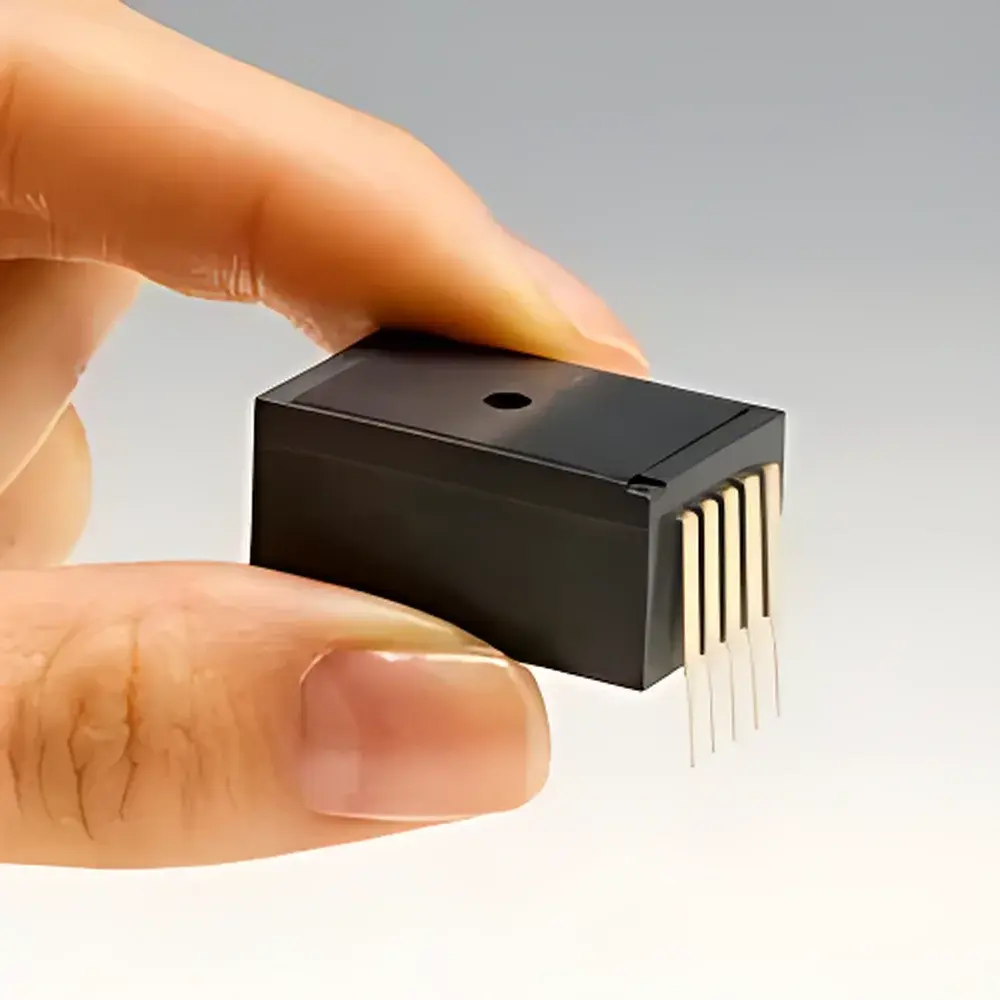
Hamamatsu C11708MA MS Series Miniature Spectrometer
| Brand | Hamamatsu |
|---|---|
| Origin | Japan |
| Manufacturer Type | Original Equipment Manufacturer (OEM) |
| Product Category | Imported Optical Component |
| Model | C11708MA |
| Dimensions | 27.6 × 13.0 × 16.8 mm |
| Weight | 9 g |
| Spectral Response Range | 640–1050 nm |
| Spectral Resolution (FWHM, max) | 20 nm |
| Detector | 256-pixel CMOS linear image sensor with integrated slit |
| Optical Architecture | Convex lens with nanoimprint-fabricated transmission grating directly patterned on lens surface |
| Operating Temperature | Ta = 25 °C (typical, unless otherwise specified) |
Overview
The Hamamatsu C11708MA MS Series Miniature Spectrometer is an OEM-grade, ultra-compact spectral sensing module engineered for integration into space-constrained, portable, and embedded optical measurement systems. Based on monolithic optical design principles, it leverages Hamamatsu’s proprietary MEMS-compatible fabrication processes and high-quantum-efficiency CMOS linear image sensor technology. Unlike conventional spectrometers relying on discrete optical trains and mechanical alignment, the C11708MA integrates the entrance slit, collimating/focusing optics, and transmission diffraction grating into a single compact assembly—where the grating is nanoimprint-patterned directly onto the surface of a molded convex lens. This monolithic architecture eliminates air gaps, reduces thermal drift sensitivity, and ensures long-term optical stability without recalibration under typical ambient conditions. Designed for near-infrared (NIR) reflectance and absorption analysis, it operates in the 640–1050 nm range—covering key biological tissue windows, silicon photovoltaic response bands, and common LED/VCSEL emission profiles. Its 256-pixel detector array delivers sufficient sampling density to resolve spectral features at ≤20 nm FWHM resolution, making it suitable for qualitative and semi-quantitative spectral fingerprinting in field-deployable instrumentation.
Key Features
- Ultra-miniaturized form factor: 27.6 × 13.0 × 16.8 mm (L × W × H), mass <9 g—compatible with drone-mounted sensors, handheld diagnostic tools, and IoT-enabled process monitors.
- Monolithic optical path: Nanoimprint-fabricated transmission grating integrated onto lens surface—eliminates alignment dependency and improves shock/vibration tolerance.
- Integrated entrance slit: Photolithographically defined slit on CMOS sensor package enables consistent light coupling without external collimation optics.
- OEM-ready interface: Digital output via parallel or serialized CMOS-compatible data bus; no internal ADC or firmware—designed for direct integration with host microcontrollers or FPGA-based acquisition systems.
- Thermally stable operation: Optimized for nominal ambient temperature (Ta = 25 °C); spectral calibration coefficients provided per unit for post-acquisition wavelength correction.
- No moving parts: Solid-state construction ensures >10⁶ measurement cycles without mechanical wear or performance degradation.
Sample Compatibility & Compliance
The C11708MA is intended for non-contact, free-space optical sampling of diffuse reflectance, transmittance, or fluorescence signals from solid, liquid, or particulate samples—provided incident illumination falls within its responsivity band (640–1050 nm). It is not designed for vacuum UV, deep UV, or mid-IR applications. As a component-level device, it does not carry standalone regulatory certifications (e.g., CE, FDA 510(k), or IEC 61000-4 immunity ratings); however, it complies with Hamamatsu’s internal quality standards aligned with ISO 9001 manufacturing controls. When integrated into final instruments, users are responsible for validating electromagnetic compatibility (EMC), electrical safety (IEC 61010-1), and application-specific regulatory requirements (e.g., ASTM E171 for reflectance measurement protocols or ISO 13694 for optical radiation safety).
Software & Data Management
The C11708MA operates as a raw pixel intensity source—no embedded firmware or onboard processing is included. Hamamatsu provides reference timing diagrams, register maps, and sample FPGA/ARM driver code (C/C++ and VHDL) for hardware-level interfacing. Calibration data—including pixel-to-wavelength mapping (λ = a₀ + a₁·p + a₂·p²), dark current profiles, and relative responsivity curves—is delivered in CSV format with each unit. Integration into higher-level software environments (e.g., LabVIEW, Python with NumPy/SciPy, or MATLAB) requires user-developed spectral preprocessing pipelines for dark subtraction, flat-field correction, and wavelength interpolation. The device supports GLP-compliant data traceability when paired with timestamped acquisition systems that log sensor ID, calibration version, and environmental metadata.
Applications
- Portable NIR spectroscopy for agricultural moisture and protein content estimation in grain and forage.
- Embedded spectral feedback in laser diode and VCSEL-based gas sensing modules (e.g., CO, CH₄ detection via overtone absorption).
- Real-time color and spectral shift monitoring in industrial coating and printing processes.
- Miniaturized pulse oximetry and tissue oxygenation probes leveraging 700–900 nm hemoglobin absorption bands.
- Edge AI spectral classification nodes—paired with low-power microcontrollers for on-device inference using pre-trained CNN models.
- Space-constrained educational platforms for teaching optical dispersion, diffraction, and detector physics.
FAQ
Is the C11708MA calibrated before shipment?
Yes—each unit undergoes individual spectral calibration at Hamamatsu’s Shizuoka facility. A unique calibration file (including polynomial coefficients and dark frame) is supplied with the module.
Can it be used in high-humidity or outdoor environments?
The device has no IP rating; housing and environmental protection must be implemented by the system integrator. Condensation on optical surfaces will degrade performance.
Does it support trigger synchronization with external light sources?
Yes—the sensor includes dedicated strobe input pins compatible with TTL-level triggers for gated acquisition synchronized to pulsed LEDs or lasers.
What is the maximum recommended integration time?
Limited by CMOS full-well capacity and thermal noise; typical usable range is 1 ms to 500 ms at Ta = 25 °C. Longer exposures require active cooling or dark current compensation.
Is USB or Bluetooth connectivity built-in?
No—C11708MA is a bare-bones optical-electronic module. All communication and power management must be implemented externally.



