
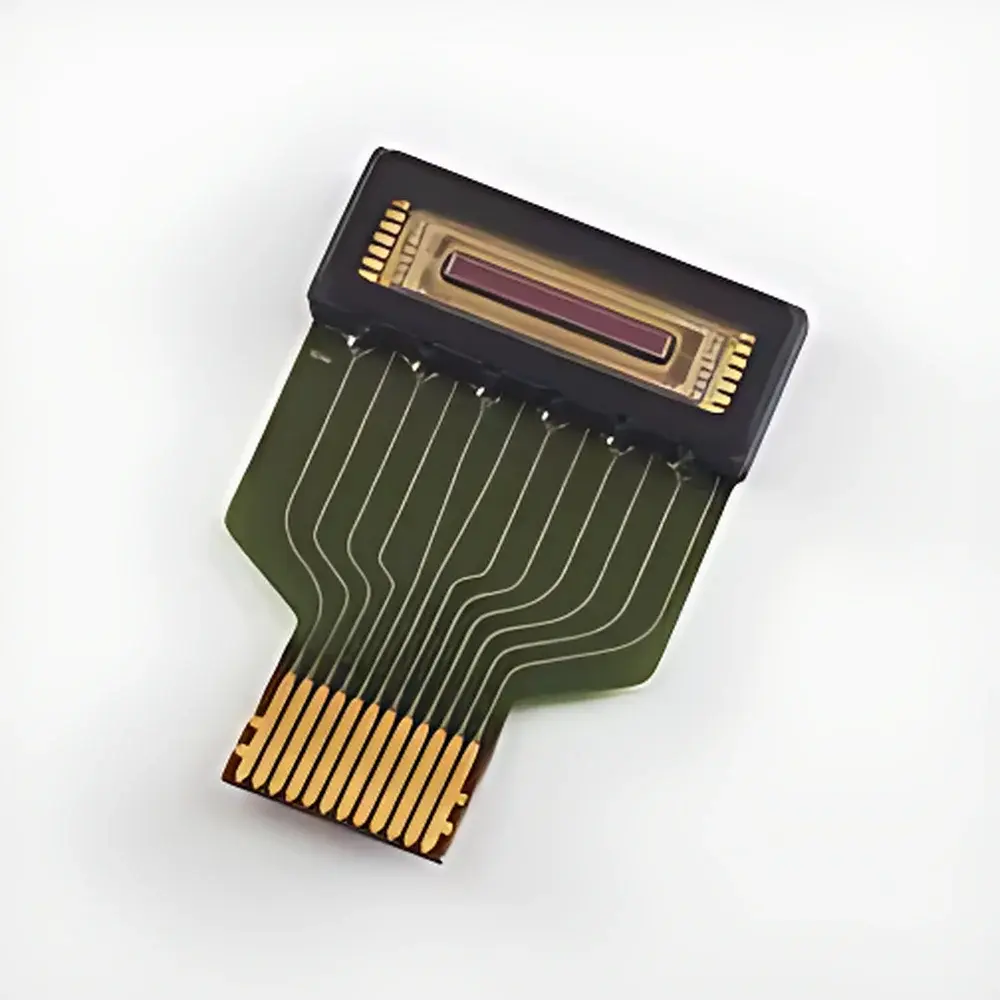
Hamamatsu G13913-256FG InGaAs Linear Image Sensor
| Brand | Hamamatsu |
|---|---|
| Origin | Japan |
| Manufacturer Type | Original Equipment Manufacturer (OEM) |
| Product Category | Imported |
| Model | G13913-256FG |
| Supply Mode | Factory-direct |
Overview
The Hamamatsu G13913-256FG is a high-performance, uncooled InGaAs linear image sensor engineered for integration into portable and benchtop near-infrared (NIR) spectroscopic systems. Operating across a spectral range of 950–1700 nm, it leverages indium gallium arsenide (InGaAs) photodiode technology to deliver stable quantum efficiency and low dark current in ambient-temperature environments—eliminating the need for thermoelectric or cryogenic cooling. Its monolithic ceramic package with integrated flexible printed circuit board (FPCB) enables direct mounting onto compact optical benches or handheld spectrometer modules. Designed as a drop-in replacement for legacy DIP-based sensors such as the G11620 series, the G13913-256FG reduces system power consumption while maintaining compatibility with standard 3.3 V logic interfaces and embedded timing control architectures.
Key Features
- 256-pixel linear array with 25 µm pitch and 25 × 250 µm pixel geometry, enabling high spatial resolution in dispersive NIR spectrometers
- Uncooled operation with typical dark current < 1 nA/pixel at 25 °C, supporting robust signal-to-noise performance in battery-powered field instruments
- Integrated timing generator eliminates external clock sequencing logic—simplifying FPGA or microcontroller interface design
- Programmable two-stage gain switching (low/high conversion gain) for dynamic range optimization across varying irradiance conditions
- Built-in anti-saturation circuitry prevents blooming and charge overflow during high-intensity illumination, preserving linearity up to 7290 lines/s readout rate
- Ceramic LCC package with flex-board termination ensures mechanical stability under thermal cycling and vibration—critical for transportable analytical platforms
- Compliant with JEDEC standards for moisture sensitivity level (MSL) 3, supporting reflow soldering in automated PCB assembly lines
Sample Compatibility & Compliance
The G13913-256FG is optimized for use with diffraction-grating-based NIR spectrometers employing fiber-coupled input optics (e.g., SMA905 or FC/PC interfaces). Its 6.4 × 0.25 mm active area aligns with common f/4–f/6 optical designs used in handheld pharmaceutical analyzers, agricultural moisture meters, and polymer identification tools. The sensor meets RoHS Directive 2011/65/EU and REACH Regulation (EC) No. 1907/2006 requirements. While not certified to IEC 61000-4 electromagnetic immunity standards as a standalone component, its low-voltage 3.3 V operation and internal ESD protection (HBM > 2 kV) facilitate compliance when embedded within properly shielded instrument enclosures meeting IEC 61326-1 for laboratory and industrial measurement equipment.
Software & Data Management
Hamamatsu provides the C13841 evaluation kit firmware and SDK (v3.2+) supporting Windows/Linux host platforms via USB 2.0 interface. The SDK includes calibrated dark-frame subtraction routines, non-uniformity correction (NUC) lookup tables, and pixel-wise responsivity compensation coefficients traceable to NIST-traceable reference sources. Raw 16-bit ADC output supports IEEE 754-compliant floating-point conversion in post-processing pipelines compliant with ASTM E131–22 (Standard Terminology Relating to Molecular Spectroscopy) and ISO/IEC 17025:2017 data integrity requirements. Audit trail functionality—including timestamped sensor configuration logs and gain-switching events—is available for GLP/GMP-regulated environments requiring 21 CFR Part 11 electronic record validation.
Applications
- Portable NIR spectrometers for real-time pharmaceutical tablet assay and excipient quantification (per USP )
- On-site soil organic carbon and moisture analysis in precision agriculture platforms
- In-line quality monitoring of polymer melt index and additive concentration in extrusion lines
- Non-destructive authentication of fuel blends (e.g., biodiesel content in diesel) using second-derivative spectral fingerprinting
- Lab-grade benchtop FT-NIR accessories where space-constrained detector arrays are required
- Research-grade hyperspectral imaging systems operating in SWIR band (1.0–1.7 µm)
FAQ
Is the G13913-256FG suitable for vacuum or high-humidity environments?
The ceramic LCC package is rated MSL-3 and qualified for storage at ≤60% RH; extended operation above 85% RH requires conformal coating per IPC-CC-830B Class 1.
Does Hamamatsu provide radiometric calibration data for this sensor?
Yes—each wafer lot undergoes spectral responsivity mapping at 10 nm intervals from 950–1700 nm using NIST-traceable tungsten-halogen and blackbody sources; calibration certificates are supplied with volume orders.
Can the sensor be operated at temperatures below 0 °C?
Specified operation is 0–50 °C ambient; sub-zero performance is not characterized and may exhibit increased dark current and timing skew without thermal stabilization.
What is the maximum allowable optical power density on the active area?
Damage threshold is 100 mW/mm² continuous-wave at 1550 nm; pulsed operation must remain below 1 J/cm² per pulse (10 ns width) to avoid localized heating-induced degradation.
Is there a recommended driver circuit layout for minimizing noise coupling?
Hamamatsu Application Note AN-217 specifies a star-ground topology, separate analog/digital power planes, and ≥3 mm clearance between clock traces and analog output lines to maintain SNR > 62 dB at full scale.






