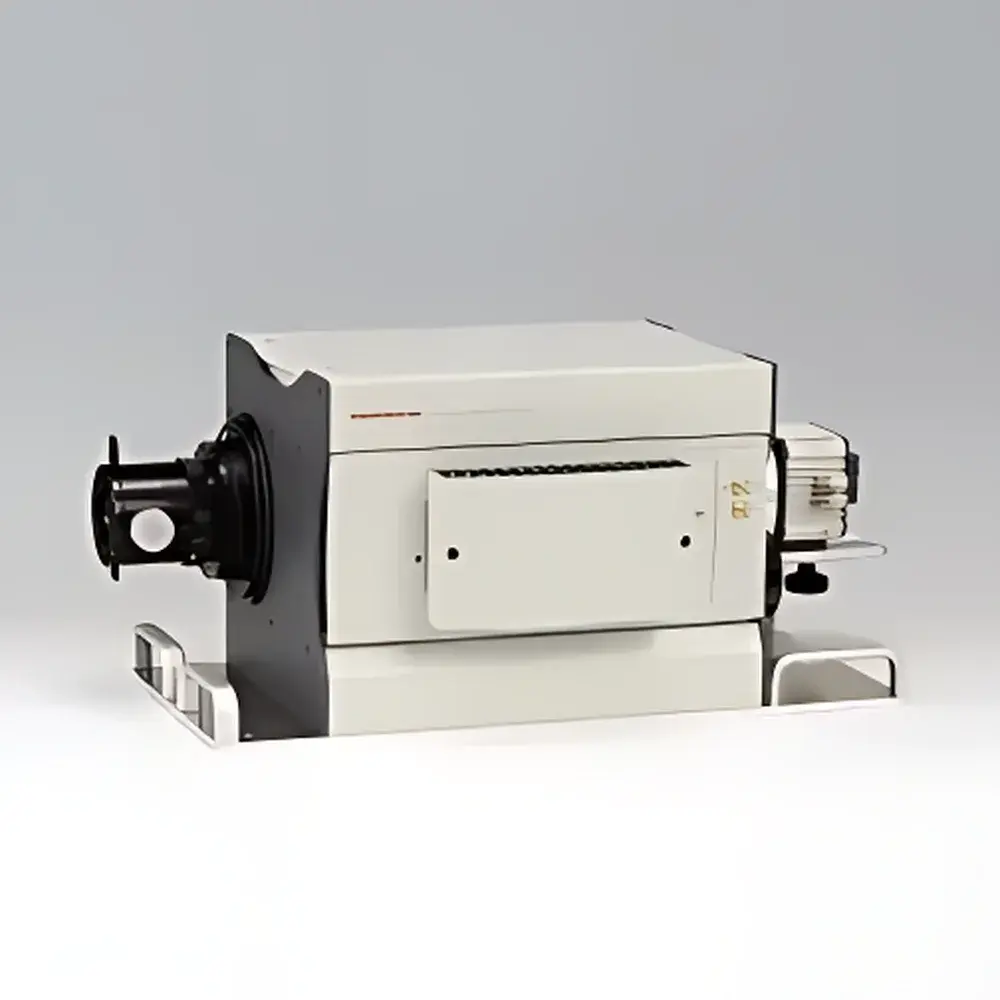
Hamamatsu C10910 Universal Streak Camera
| Brand | Hamamatsu |
|---|---|
| Origin | Japan |
| Manufacturer | Hamamatsu Photonics K.K. |
| Type | Imported Instrument |
| Model | C10910 |
| Pricing | Upon Request |
| Spectral Response | 200–850 nm |
| Time Resolution | <1 ps to <20 ps (depending on scan unit) |
| Scan Repetition Rate | Single-shot to 250 MHz |
| Scan Duration Range | 100 ps to 1 ms |
| Dynamic Range | >1:25 to >1:1000 |
| Effective Photocathode Length | 4.42 mm |
| Power Supply | AC 100–240 V, 50/60 Hz |
Overview
The Hamamatsu C10910 Universal Streak Camera is a high-performance electro-optical imaging instrument engineered for ultrafast temporal diagnostics of optical transients. Based on the principle of photoelectron deflection in a time-varying electric field within a vacuum streak tube, it converts temporal intensity profiles of light pulses into spatially resolved traces on a phosphor screen or CCD detector. This enables simultaneous acquisition of both temporal and spectral (or spatial) information with picosecond- to nanosecond-scale resolution—making it indispensable for characterizing transient photophysical, photochemical, and plasma-dynamic processes. Designed and manufactured in Japan by Hamamatsu Photonics—a pioneer in photodetection with over 35 years of streak tube R&D—the C10910 integrates rigorously qualified streak tubes, precision scan electronics, and modular optical interfaces to support flexible system integration in research laboratories and national facilities.
Key Features
- Modular architecture supporting interchangeable scan units (M10911-01, M10911-02, M10912-01, M10913-01) to optimize time resolution, scan repetition rate, and dynamic range per application requirement
- Sub-picosecond time resolution down to <1 ps (with M10911-01 and M10912-01 units), validated under controlled calibration conditions using femtosecond laser reference sources
- Broad spectral sensitivity from 200 nm (deep UV) to 850 nm (near-IR), compatible with standard fused silica and MgF₂ input optics
- Effective photocathode length of 4.42 mm ensures high spatial fidelity across the temporal axis without geometric distortion
- Stable, low-noise HV power supplies and synchronized trigger inputs (TTL/LVDS) enable deterministic single-shot or high-repetition-rate operation
- Robust mechanical housing and EMI-shielded design meet ISO 14644-1 Class 5 cleanroom compatibility requirements for synchrotron and FEL beamline integration
Sample Compatibility & Compliance
The C10910 accommodates free-space optical coupling via adjustable fiber-optic adapters or direct slit-based illumination. It supports both collimated and focused input beams with minimal aberration when paired with Hamamatsu’s matched spectrograph modules (e.g., PMA-12, C12880). The system complies with IEC 61000-6-3 (EMI emission) and IEC 61000-6-2 (immunity) standards. For regulated environments—including GLP-compliant analytical labs and FDA-audited photonics development workflows—the optional digital output interface supports timestamped frame metadata compliant with IEEE 1588-2019 (PTPv2) for traceable synchronization. While not certified as medical or industrial safety equipment per IEC 62366, its operational protocols align with ISO/IEC 17025:2017 guidelines for measurement uncertainty estimation in time-resolved optical metrology.
Software & Data Management
Control and data acquisition are managed via Hamamatsu’s proprietary StreakCube software (v4.2+), which provides real-time preview, hardware-triggered acquisition sequencing, and non-linear scan correction algorithms. Raw streak images are saved in 16-bit TIFF or HDF5 format with embedded EXIF-like metadata—including exposure timing, scan voltage ramp parameters, and photocathode quantum efficiency curves. Export modules support MATLAB (.mat), Python (NumPy .npy), and ASCII columnar formats for third-party analysis pipelines. Audit-trail logging (enabled by default) records all parameter changes, user logins, and acquisition timestamps—meeting basic ALCOA+ principles for data integrity in preclinical and academic research settings. Optional API access (C/C++ and Python SDKs) allows integration into LabVIEW, EPICS, or custom DAQ frameworks used at large-scale facilities such as DESY, SLAC, and JAEA.
Applications
- Fluorescence lifetime imaging (FLIM) and time-correlated single-photon counting (TCSPC) validation in biophotonics and semiconductor defect analysis
- Transient absorption spectroscopy for carrier dynamics in perovskite photovoltaics and 2D materials
- Time-resolved Raman and CARS measurements in combustion chemistry and catalytic surface reactions
- Electron bunch profiling in LINACs and storage rings via optical transition radiation (OTR) imaging
- Ultrafast diagnostics of laser-induced breakdown (LIBS), plasma ignition, and shockwave propagation in inertial confinement fusion experiments
- Backscatter lidar signal analysis for Thomson scattering diagnostics in magnetically confined plasmas (e.g., tokamaks)
- Characterization of quantum dot emission kinetics, single-photon source jitter, and superconducting nanowire detector response
FAQ
What is the minimum detectable pulse duration with the C10910?
The system achieves an intrinsic time resolution of <1 ps when configured with the M10911-01 or M10912-01 scan units—limited primarily by photocathode transit time spread and deflection plate bandwidth—not by detector readout.
Can the C10910 be synchronized to external laser systems?
Yes. It accepts TTL or LVDS trigger inputs with jitter <10 ps RMS and offers programmable delay (0–100 ns, 1-ps steps) relative to the master clock, enabling precise pump-probe alignment.
Is vacuum maintenance required by the end user?
No. All C10910 streak tubes are hermetically sealed during manufacturing and rated for >10-year operational lifetime under normal laboratory conditions (20–25 °C, <60% RH).
How is calibration traceability established?
Hamamatsu provides NIST-traceable calibration certificates for temporal axis linearity and spectral responsivity upon request, performed using femtosecond Ti:sapphire oscillators and calibrated photodiodes per ISO/IEC 17025-accredited procedures.
Are custom slit or fiber-coupling options available?
Yes. Hamamatsu offers OEM-integrated solutions including motorized slit widths (10–200 µm), UV-grade fused silica input windows, and SMA/FC-PC fiber adapters with AR coatings optimized for specific wavelength bands.