
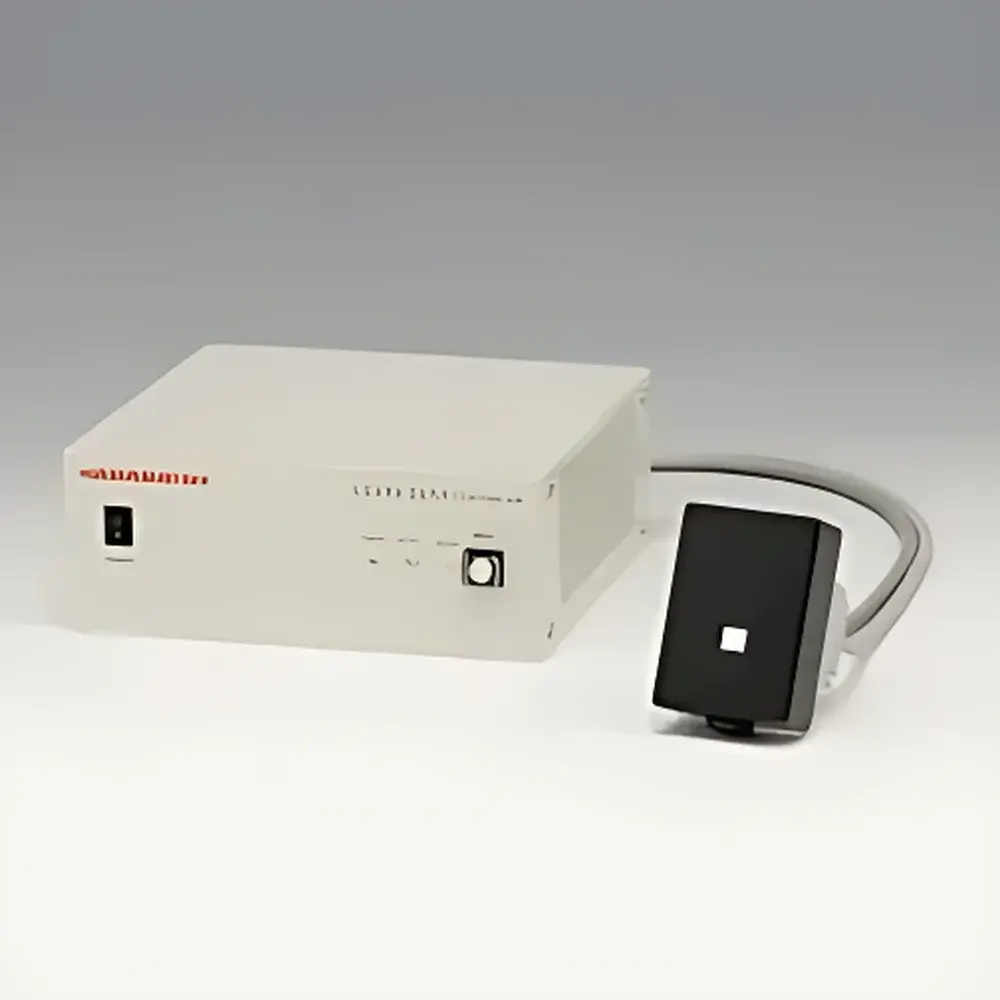
Hamamatsu X10 Series LCOS-Based Spatial Light Modulator
| Brand | Hamamatsu |
|---|---|
| Origin | Japan |
| Manufacturer Type | Original Equipment Manufacturer (OEM) |
| Import Status | Imported |
| Model | X10 |
| Component Category | Optical Element |
| Active Area | 16 × 12 mm |
| Wavelength Ranges | 400–700 nm, 410±10 nm, 510±50 nm, 620–1100 nm, 650±50 nm, 800±50 nm, 1000–1550 nm, 1050±50 nm |
| Diffraction Efficiency | 79–95% |
| Drive Interface | DVI from PC via CMOS backplane |
Overview
The Hamamatsu X10 Series is a high-performance, phase-only spatial light modulator (SLM) built upon liquid crystal on silicon (LCOS) technology. Unlike amplitude-modulating devices, the X10 operates exclusively in the phase domain—introducing precise, pixel-resolved wavefront phase delays without altering incident light intensity or polarization state. This capability stems from a monolithic integration of a reflective nematic liquid crystal layer atop a custom CMOS silicon backplane, enabling sub-millisecond electro-optic response and diffraction-limited optical performance. The device functions as a programmable diffractive optical element: when illuminated with coherent light, it generates user-defined holograms, beam shapers, vortex generators, or adaptive optical corrections by spatially encoding phase profiles with up to 1920 × 1080 pixel resolution (model-dependent). Its design adheres to fundamental principles of scalar diffraction theory and Jones matrix formalism for polarization-preserving operation—making it suitable for applications demanding high wavefront fidelity, such as quantum optics experiments, ultrafast pulse shaping, and closed-loop adaptive optics systems.
Key Features
- Phase-only modulation architecture ensures minimal intensity loss and preserves input polarization integrity across all operational wavelengths.
- Uniform 16 × 12 mm active aperture enables high-energy laser compatibility and supports large-field-of-view holographic projection.
- Multiple wavelength-optimized variants (X10468-01 through X10468-08) offer peak diffraction efficiencies ranging from 79% to 95%, calibrated per spectral band including visible (400–700 nm), near-infrared (800 ± 50 nm, 1050 ± 50 nm), and telecom bands (1000–1550 nm).
- DVI-based digital drive interface provides direct compatibility with standard PCs and real-time pattern generation software; no proprietary frame grabbers or FPGA controllers required.
- CMOS-integrated addressing enables true pixel-by-pixel phase control with 1000 Hz effective refresh rate under optimized timing conditions.
- Hermetically sealed package with AR-coated fused silica window ensures long-term stability in laboratory environments and resistance to ambient humidity and particulate contamination.
Sample Compatibility & Compliance
The X10 Series is compatible with continuous-wave (CW) and pulsed laser sources operating within its specified wavelength windows—including Ti:sapphire, Nd:YAG, fiber lasers, and supercontinuum sources. It supports both free-space and fiber-coupled illumination geometries. All models comply with IEC 61000-6-3 (EMC emission standards) and IEC 61000-6-2 (immunity requirements) for laboratory instrumentation. While not certified for medical or industrial safety-critical use, the device meets ISO 9001 manufacturing traceability standards at Hamamatsu’s Japanese production facility. For GLP/GMP-aligned workflows, the SLM can be integrated into validated optical setups where phase calibration protocols are documented per ASTM E2913 (Standard Guide for Characterization of Optical Components) and ISO/IEC 17025-compliant uncertainty budgets are applied to wavefront reconstruction measurements.
Software & Data Management
Hamamatsu provides the SLM Control Suite—a cross-platform application supporting Windows and Linux—for loading binary phase maps, generating Lissajous patterns, calibrating gamma curves, and performing real-time Fourier-plane monitoring. The suite exports phase data in standard formats (e.g., .bin, .tif, .h5) and supports scripting via Python API (PyHamamatsu-SLM) for integration into LabVIEW, MATLAB, or custom Python-based automation pipelines. Audit trails—including timestamped phase map uploads, exposure duration logs, and firmware version metadata—are retained locally and exportable for regulatory review. Though not natively compliant with FDA 21 CFR Part 11, the system supports external electronic signature solutions when deployed in regulated QC environments requiring ALCOA+ data integrity principles.
Applications
- Adaptive optics in astronomy: dynamic correction of atmospheric turbulence using Shack-Hartmann sensor feedback loops.
- Optical trapping and manipulation: generation of multiple optical tweezers or Bessel beams for single-cell handling.
- Quantum information processing: creation of spatially entangled photon states and programmable Bell-state analyzers.
- Ultrafast optics: spectral phase modulation for pulse compression, chirp compensation, and coherent control experiments.
- Holographic microscopy: off-axis digital holography, quantitative phase imaging, and synthetic aperture reconstruction.
- Laser materials processing: beam homogenization, multi-spot parallel drilling, and structured illumination for selective ablation.
FAQ
Is the X10 capable of amplitude modulation?
No—the X10 is engineered exclusively for phase-only modulation. Amplitude control requires cascaded configurations with polarizers or hybrid amplitude-phase SLMs, which are not supported by this series.
What is the maximum average optical power density the device can withstand?
For continuous-wave illumination, the recommended limit is 1 W/cm² at 532 nm; pulsed operation (e.g., 10 ns pulses at 10 Hz) permits up to 0.5 J/cm², subject to thermal management and beam uniformity.
Does Hamamatsu provide factory calibration certificates?
Yes—each unit ships with a traceable phase-response calibration report (wavelength-specific), including measured RMS wavefront error, pixel crosstalk matrix, and diffraction efficiency curve.
Can the X10 be synchronized with external triggers such as camera shutters or laser Q-switches?
Yes—via optional TTL trigger input (BNC), enabling hardware-synchronized frame updates with jitter <50 ns relative to external events.
Is custom firmware development available for OEM integration?
Hamamatsu offers limited firmware customization under NDA for volume OEM customers, including DVI protocol extensions and low-latency phase update modes.



