
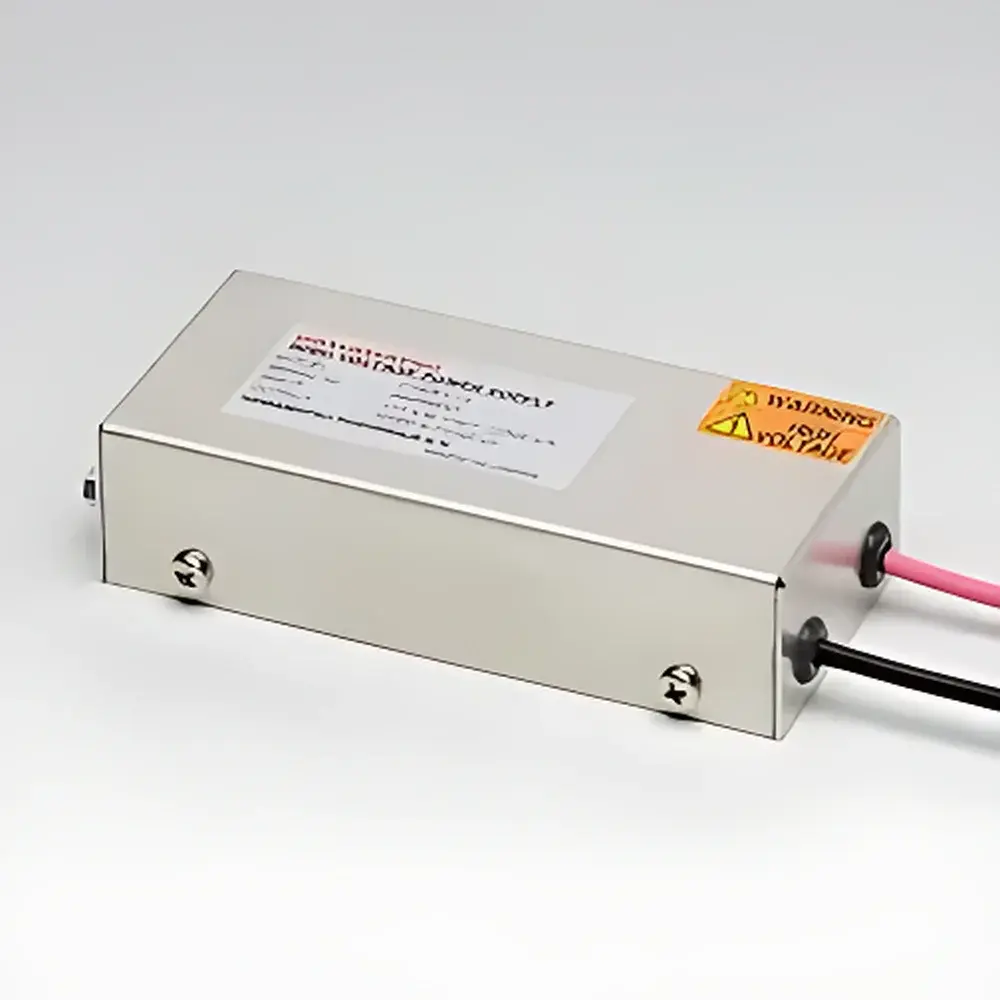
Hamamatsu High-Voltage Power Supply Module C14051-15
| Brand | Hamamatsu |
|---|---|
| Origin | Japan |
| Manufacturer Type | Original Equipment Manufacturer (OEM) |
| Import Status | Imported |
| Model | C14051-15 |
| Input Voltage Range | +11 V to +16 V DC |
| Max. Output Voltage | −10 kV |
| Max. Output Current | 0.2 mA |
| Guaranteed Output Range | −2000 V to −10000 V |
| Line Regulation | ±0.1 % (over input voltage variation from +11 V to +16 V) |
| Load Regulation | ±0.1 % |
| Ripple & Noise | ≤0.1 mV RMS |
| Operating Temperature | −10 °C to +60 °C |
| Tempco | ±0.01 %/°C |
| Storage Temperature | −20 °C to +70 °C |
| Storage Humidity | <80 % RH (non-condensing) |
| Dimensions (W × H × D) | 98 mm × 25 mm × 45 mm |
| Weight | 160 g |
| Form Factor | Compact OEM Module |
Overview
The Hamamatsu C14051-15 is a compact, high-voltage DC power supply module engineered for precision biasing and signal conditioning in mass spectrometry (MS) instrumentation—particularly in ion source subsystems, detector biasing (e.g., microchannel plates or electron multipliers), and electrostatic lens arrays. It operates on a low-voltage DC input (+11 V to +16 V) and delivers a highly stable, negative-polarity high-voltage output ranging from −2000 V to −10,000 V at up to 0.2 mA, with tight regulation and minimal noise. Its design adheres to the stringent requirements of analytical vacuum systems: ultra-low electromagnetic interference (EMI), thermal stability under continuous duty, and mechanical robustness for integration into OEM instrument chassis. Unlike general-purpose HV supplies, the C14051-15 incorporates proprietary feedback stabilization circuitry that maintains output fidelity across varying load conditions and ambient temperature fluctuations—critical for maintaining consistent ion transmission efficiency and detector gain calibration in time-of-flight (TOF), quadrupole, and orbitrap-based platforms.
Key Features
- High-efficiency DC–DC conversion architecture optimized for low input power consumption (typical full-load input current: 260 mA at +12 V)
- Integrated dual-monitoring analog outputs for real-time voltage and current sensing (0–10 V scaling, isolated)
- Comprehensive protection suite: overvoltage lockout (OVL), overcurrent shutdown (OCS), overtemperature cutoff, and arc detection with auto-recovery
- Ultra-low output ripple and noise (≤0.1 mV RMS), minimizing baseline drift and signal-to-noise degradation in sensitive amplification stages
- Compact OEM form factor (98 × 25 × 45 mm, 160 g) designed for PCB-mount integration or chassis mounting with minimal heatsinking
- Temperature coefficient of ±0.01 %/°C ensures long-term stability during extended MS acquisition runs (e.g., 24+ hr LC-MS methods)
Sample Compatibility & Compliance
The C14051-15 is compatible with standard high-vacuum feedthroughs (e.g., SHV or MHV connectors) and supports direct integration into mass spectrometer subassemblies requiring negative high-voltage biasing—including electrospray ionization (ESI), atmospheric pressure chemical ionization (APCI), and matrix-assisted laser desorption/ionization (MALDI) sources. Its electrical isolation, creepage, and clearance meet IEC 61010-1 requirements for measurement, control, and laboratory equipment. While not certified as a standalone medical or industrial safety device, its design aligns with functional safety expectations for Class I instruments used in ISO/IEC 17025-accredited laboratories. No external certification (e.g., UL, CE) is required when embedded within a fully certified host instrument per IEC 61326-1.
Software & Data Management
As a hardware-level OEM module, the C14051-15 does not include embedded firmware or digital communication interfaces (e.g., RS-232, USB, or CAN). It is intended for analog control and monitoring via external DAQ systems or instrument mainboards. Voltage setpoint is adjusted via a 0–10 V analog input (1 V = 1 kV nominal); current limit is fixed at factory (0.2 mA). The built-in voltage/current monitor outputs support closed-loop regulation in host firmware, enabling automated calibration routines compliant with GLP/GMP data integrity principles (e.g., 21 CFR Part 11 audit trails when logged by validated instrument software). Integration documentation includes pinout schematics, thermal derating curves, and EMC test reports for system-level compliance validation.
Applications
- Biasing of electron multipliers and discrete-dynode detectors in single-quadrupole and triple-quadrupole MS systems
- Acceleration and focusing electrode control in time-of-flight reflectron optics
- Negative-ion mode ESI source voltage stabilization (e.g., −3.5 kV to −5.0 kV range)
- High-stability gate voltage supply for Faraday cup amplifiers in isotope ratio MS
- OEM replacement or upgrade for legacy Hamamatsu PMT-based detector modules requiring −10 kV capability
FAQ
Is the C14051-15 suitable for use in ultra-high vacuum (UHV) environments?
Yes—its hermetically sealed construction and low outgassing materials comply with UHV-compatible assembly practices; however, final vacuum compatibility depends on integration method (e.g., potting, connector selection, and thermal management).
Can output polarity be reversed to deliver positive high voltage?
No—the C14051-15 is unidirectional and factory-configured for negative-polarity output only.
What is the recommended input power supply specification?
A well-regulated, low-noise +12 V DC supply with ≥350 mA current capacity and ≤10 mV peak-to-peak ripple is advised to maintain specified line regulation performance.
Does Hamamatsu provide application support for system integration?
Yes—Hamamatsu offers technical datasheets, reference design schematics, thermal simulation models, and engineering consultation for qualified OEM partners integrating the C14051-15 into certified analytical instruments.
Is there a version with digital interface (e.g., SPI or I²C)?
No—C14051-15 is an analog-controlled module. For digitally addressable HV supplies, consider Hamamatsu’s C13735 series or third-party programmable alternatives compatible with MS platform architectures.




