
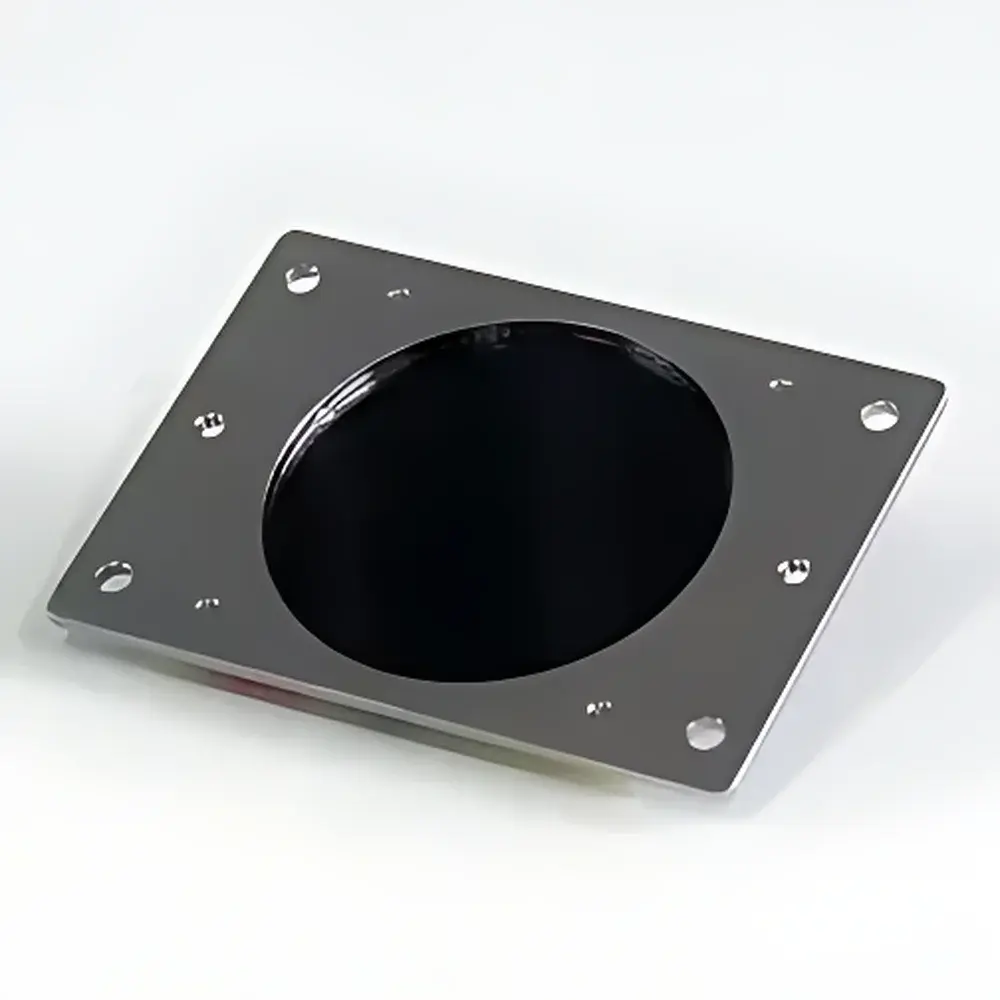
Hamamatsu Microchannel Plate (MCP) F12396-11
| Brand | Hamamatsu |
|---|---|
| Origin | Japan |
| Manufacturer Type | Original Equipment Manufacturer (OEM) |
| Product Category | Imported |
| Model | F12396-11 |
| Pricing | Available Upon Request |
| Shape | Rectangular |
| Construction | Demountable Type |
| MCP Stages | Dual (2-Stage) |
| Overall Dimensions | 52 × 72 mm |
| Active Area Diameter | 42 mm |
Overview
The Hamamatsu Microchannel Plate (MCP) F12396-11 is a high-performance, demountable dual-stage MCP detector component engineered for time-resolved detection in demanding mass spectrometry and vacuum ultraviolet (VUV)/soft X-ray instrumentation. Designed specifically to meet the temporal resolution requirements of Time-of-Flight (TOF) mass analyzers, this MCP delivers sub-nanosecond electron multiplication response with low timing jitter and high pulse-height uniformity. Its compact rectangular footprint (52 × 72 mm) and ultra-thin profile enable integration into space-constrained detector assemblies—particularly critical in reflectron TOF-MS, imaging MS, and synchrotron-based photoelectron spectroscopy systems. The active detection area features a 42 mm diameter circular region centered within the housing, ensuring optimal signal-to-noise ratio while maintaining mechanical compatibility with standard flange-mounted vacuum interfaces.
Key Features
- Dual-stage (2-stage) MCP configuration for enhanced gain stability and reduced ion feedback, supporting sustained operation at >10⁶ A/cm² peak current density
- Demountable mechanical design facilitates in-situ replacement without breaking main vacuum—ideal for maintenance-intensive analytical platforms
- Rectangular stainless-steel housing with precisely aligned input/output electrodes; compatible with standard CF-63 or KF-40 vacuum feedthroughs
- Two-point electrical connection architecture simplifies cabling layout and minimizes stray capacitance—critical for preserving rise time (<250 ps) and transit time spread (<150 ps)
- Optimized pore geometry and lead-glass composition yield high secondary electron yield (>3 × 10³ electrons per incident ion at 1 kV bias), with stable performance across 10⁻⁸–10⁻⁵ Torr operating pressure range
- Surface flatness tolerance ≤5 µm over active area, enabling direct coupling to phosphor screens or delay-line anodes without optical correction
Sample Compatibility & Compliance
The F12396-11 is validated for detection of singly and multiply charged ions (mass range up to m/z 10,000), VUV photons (10–200 nm), and soft X-rays (0.1–2 keV). It operates reliably under UHV conditions (≤1 × 10⁻⁹ Torr base pressure) and exhibits no measurable outgassing after 24 h bakeout at 150 °C. The device conforms to ISO 9001-certified manufacturing protocols and meets material restrictions outlined in RoHS Directive 2011/65/EU. While not a standalone instrument, its integration into TOF-MS systems supports compliance with ASTM E2228-22 (standard practice for calibration of time-of-flight mass spectrometers) and IEC 61000-6-3 (EMC emission requirements for laboratory equipment).
Software & Data Management
As a passive detector component, the F12396-11 does not incorporate embedded firmware or onboard processing. It interfaces directly with external timing electronics—including time-to-digital converters (TDCs), constant-fraction discriminators (CFDs), and multi-hit capable digitizers—via standard BNC or SHV connectors. When integrated into GLP/GMP-regulated environments, system-level software (e.g., TOFDAQ, SpecView, or custom LabVIEW-based acquisition suites) must implement audit-trail logging, user access control, and electronic signature functionality per FDA 21 CFR Part 11 requirements. Hamamatsu provides detailed pinout schematics, bias voltage sequencing guidelines, and aging characterization reports to support IQ/OQ/PQ validation protocols.
Applications
- Time-of-Flight Mass Spectrometry: Primary ion detector in orthogonal acceleration (oa-TOF) and reflectron configurations
- VUV Photoionization Spectroscopy: High-efficiency detection of photoelectrons generated by synchrotron or laser-based light sources
- Imaging Mass Spectrometry: Pixelated detection when coupled with delay-line anodes or resistive charge division readouts
- Soft X-ray Beamline Diagnostics: Intensity monitoring and pulse-resolved detection in EUV lithography development tools
- Ultrafast Laser-Matter Interaction Studies: Single-shot ion/electron burst detection with femtosecond temporal synchronization capability
FAQ
What vacuum compatibility specifications apply to the F12396-11?
The component is rated for continuous operation in pressures from 10⁻⁸ to 10⁻⁵ Torr; bakeout up to 150 °C is permitted for UHV integration.
Is the 42 mm active area centered on the 52 × 72 mm housing?
Yes—the circular active region is concentrically positioned with ±0.3 mm mechanical tolerance relative to housing datum edges.
Can this MCP be used in a triple-stage configuration?
No—the F12396-11 is a fixed dual-stage assembly; Hamamatsu offers custom tri-stage variants (e.g., F12396-13) upon technical consultation.
Does Hamamatsu provide mounting fixtures or HV feedthrough adapters?
Standard CF-63 flange-mounting kits and SHV-to-vacuum feedthrough adaptors are available as optional accessories (part numbers supplied upon request).
What is the typical lifetime under continuous ion bombardment?
At 1 pA average output current, mean time to 50% gain degradation exceeds 1.2 C/cm² total extracted charge—consistent with ISO/IEC 17025 traceable lifetime testing protocols.





