
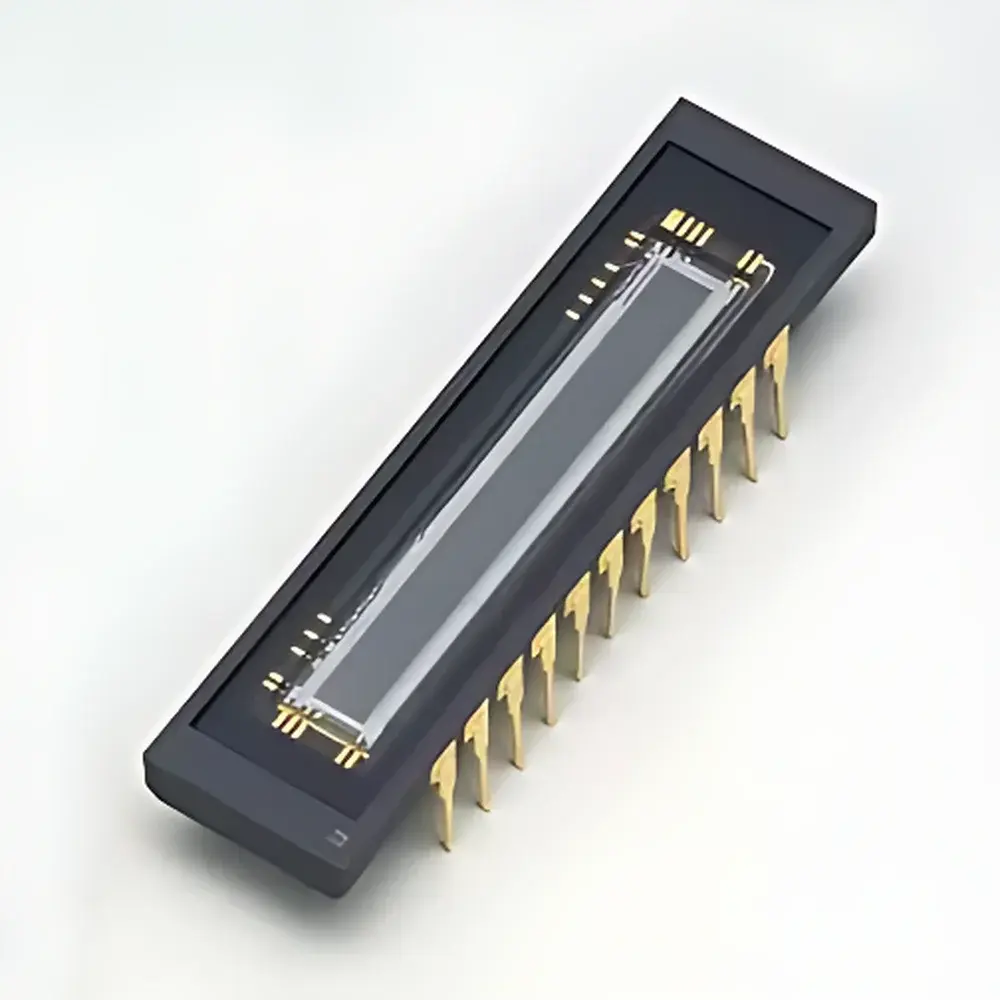
Hamamatsu CMOS Linear Image Sensor S10121-512Q-01
| Brand | Hamamatsu |
|---|---|
| Origin | Japan |
| Manufacturer Type | Original Equipment Manufacturer (OEM) |
| Product Category | Optical Component |
| Model | S10121-512Q-01 |
| Pixel Count | 512 × 1 |
| Pixel Pitch | 50 µm |
| Pixel Height | 2500 µm |
| Active Area | 25.6 × 2.5 mm |
| Spectral Response Range | 200–1000 nm |
| Window Material | Fused Quartz |
| Package Type | Ceramic |
| Cooling | Non-cooled |
| Typical Line Rate | 486 lines/s |
| Drive Circuit Compatibility | C10808 / C10808-01 |
| Operating Conditions | Ta = 25 °C, Vdd = 5 V, Vb = Vofd = 2 V, Vofg = 0.2 V, f(CLK) = 200 kHz |
Overview
The Hamamatsu S10121-512Q-01 is a high-performance, current-output CMOS linear image sensor engineered for precision spectroscopic applications requiring stable ultraviolet (UV) responsivity and flexible integration into compact optical systems. As a self-scanning photodiode array, it operates on a charge-integration principle where each of the 512 pixels features individually programmable integration time—enabling dynamic range optimization across heterogeneous spectral intensities without mechanical shuttering or external gain staging. Its 25.6 mm active length (50 µm pitch × 512 pixels) and 2.5 mm pixel height provide a large photosensitive area per element, directly enhancing photon collection efficiency—particularly critical in low-light UV-VIS spectrometry where quantum efficiency drops sharply below 300 nm. The fused quartz window ensures transmission down to 185 nm, supporting full coverage across the 200–1000 nm spectral band with minimal absorption or thermal drift. Designed for OEM integration, the sensor requires no active cooling and delivers consistent linearity (<1% nonlinearity typical) under standard laboratory conditions (Ta = 25 °C, Vdd = 5 V), making it suitable for benchtop, portable, and embedded spectrometer platforms compliant with ISO/IEC 17025 traceability requirements.
Key Features
- Individually addressable pixel integration timing—enables adaptive exposure control per spectral channel to mitigate saturation in high-intensity regions while preserving signal-to-noise ratio (SNR) in weak UV bands
- High UV quantum efficiency (>35% at 254 nm) achieved via optimized anti-reflective coating and shallow-junction photodiode architecture
- Stable spectral response flatness: ±5% deviation across 200–350 nm, verified per Hamamatsu’s internal calibration protocol traceable to NIST SRM 2036
- Ceramic hermetic package with fused quartz window—resistant to humidity-induced degradation and compatible with Class 100 cleanroom assembly
- Low-power scanning circuitry (typical IDD < 45 mA at 200 kHz clock) reduces thermal load and simplifies power supply design in battery-operated instruments
- Pin-compatible with Hamamatsu’s dedicated drive ICs C10808 and C10808-01, supporting both analog current output and synchronized digital timing signals
Sample Compatibility & Compliance
The S10121-512Q-01 is compatible with standard Czerny-Turner, crossed-beam, and concave grating spectrometer architectures. Its 2.5 mm pixel height accommodates collimated beams up to f/4 without vignetting, and its 200–1000 nm responsivity supports applications ranging from UV ozone monitoring (254 nm) to NIR moisture analysis (940 nm). The sensor meets RoHS Directive 2011/65/EU and REACH Annex XVII compliance. While not certified as a medical device component, its material composition and hermetic sealing support use in analytical instrumentation subject to FDA 21 CFR Part 11 data integrity requirements when integrated with audit-trail-capable firmware.
Software & Data Management
Raw analog current output requires external transimpedance amplification and ADC digitization (16-bit minimum recommended). Hamamatsu provides reference schematics and timing diagrams for synchronization with FPGA- or microcontroller-based acquisition systems. Third-party spectral software suites—including Ocean Insight’s OceanView, Avantes’ AvaSoft, and open-source libraries such as Python’s pyHamamatsu—support direct configuration of integration timing registers via SPI or parallel bus interfaces. All calibration metadata (pixel-wise dark current, relative responsivity, linearity coefficients) are delivered in IEEE 1584-compliant .csv format, enabling automated correction during post-processing in accordance with ASTM E275-22 (Standard Practice for Describing and Measuring Performance of UV-Visible Spectrophotometers).
Applications
- Compact UV-Vis spectrometers for environmental monitoring (e.g., NOx, SO2, dissolved organic carbon)
- Portable LIBS (Laser-Induced Breakdown Spectroscopy) detectors requiring fast line-rate acquisition and UV resilience
- In-line process analyzers in pharmaceutical manufacturing (e.g., real-time API concentration tracking per USP <857>)
- Plasma emission diagnostics in semiconductor etch chambers (193–365 nm DUV bands)
- Educational optics labs implementing Fourier-transform or dispersive spectroscopy experiments
FAQ
Is the S10121-512Q-01 suitable for vacuum-UV (VUV) applications below 200 nm?
No—the fused quartz window attenuates strongly below 185 nm; for VUV operation, Hamamatsu recommends the MgF2-windowed S7031 series.
What is the maximum allowable clock frequency for reliable line readout?
The absolute maximum is 500 kHz; however, stable operation at 486 lines/s is guaranteed only at 200 kHz per Hamamatsu’s datasheet test condition.
Does this sensor support binning or region-of-interest (ROI) readout?
No—it is a fixed 512-pixel linear array with sequential readout; ROI functionality must be implemented externally via FPGA-based pixel masking.
Can it be operated at temperatures below 0 °C?
Yes, but dark current increases exponentially below 15 °C; Hamamatsu specifies performance only within –10 to +60 °C ambient, with full calibration valid at 25 °C.
Is there an evaluation board available for rapid prototyping?
Yes—the C10808-01 evaluation module includes regulated power supplies, clock generation, and USB-to-SPI interface, supporting immediate characterization per Application Note AP-002.





