
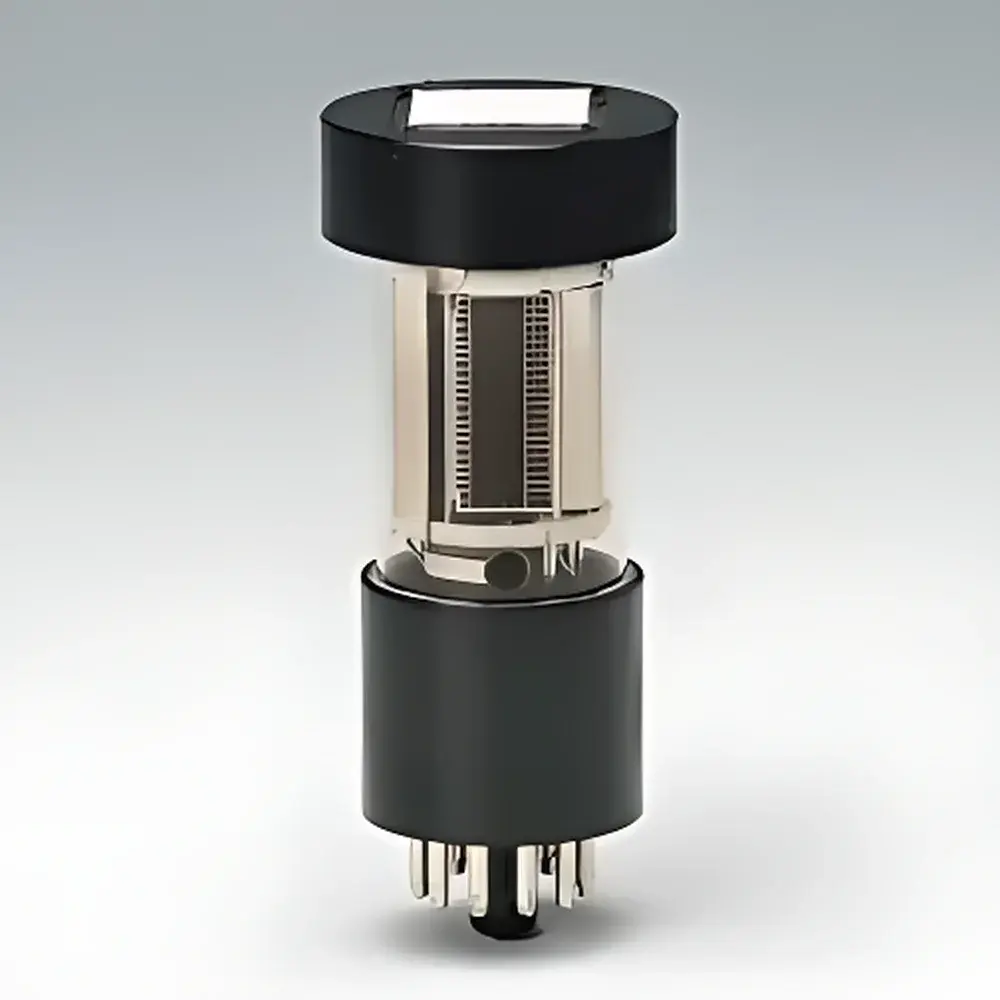
Hamamatsu Photomultiplier Tube R11715-01
| Brand | Hamamatsu |
|---|---|
| Origin | Japan |
| Manufacturer Type | Original Equipment Manufacturer (OEM) |
| Import Status | Imported |
| Model | R11715-01 |
| Spectral Range | 185–710 nm |
| Photocathode Shape | Rectangular |
| Photocathode Dimensions | 8 × 24 mm |
| Cathode Radiant Sensitivity (Typ.) | 70 mA/W |
| Anode Luminous Sensitivity (Min.) | 1000 A/lm |
| Anode Luminous Sensitivity (Typ.) | 1200 A/lm |
| Anode Radiant Sensitivity (Typ.) | 8.0 × 10⁶ A/W |
| Gain (Typ.) | 1.2 × 10⁷ |
| Dark Current (30 min, Typ.) | 0.2 nA (at −20 °C) / 0.02 nA (at −30 °C) |
| Dark Current (30 min, Max.) | 0.5 nA |
| Rise Time (Typ.) | 2.2 ns |
| Transit Time (Typ.) | 22 ns |
Overview
The Hamamatsu R11715-01 is a thermoelectrically cooled side-on photomultiplier tube (PMT) engineered for high-sensitivity, low-noise detection in demanding environmental monitoring and trace gas analysis applications. Designed with a rectangular multi-alkali (S-20) photocathode (8 × 24 mm active area), it delivers broad spectral responsivity from deep ultraviolet (185 nm) to visible light (710 nm), making it especially suitable for UV absorption spectroscopy, chemiluminescence detection, and ozone or NOx monitoring systems where weak photon fluxes must be resolved with high temporal fidelity. Its integrated Peltier cooler enables stable operation at −20 °C to −30 °C, significantly suppressing thermally generated dark current—critical for long-integration measurements in low-light gas-phase optical sensing.
Key Features
- Side-window configuration with 28 mm diameter envelope for compact integration into OEM gas analyzers and portable emission monitors
- Multi-alkali (Na-K-Sb-Cs) photocathode offering high quantum efficiency across 185–710 nm, optimized for UV–visible photon detection in atmospheric chemistry instrumentation
- Thermoelectric cooling system maintains cathode temperature at −20 °C (standard) or −30 °C (optional), reducing dark current by up to one order of magnitude versus uncooled equivalents
- High gain (1.2 × 10⁷, typical) and fast temporal response: 2.2 ns rise time and 22 ns transit time—enabling time-resolved detection in pulsed UV fluorescence or laser-induced breakdown spectroscopy (LIBS) configurations
- Low dark current specification: ≤0.5 nA (max) after 30 min stabilization at −20 °C; as low as 0.02 nA (typ.) at −30 °C—supporting sub-picoampere signal resolution in ultra-low-concentration gas quantification
- Rugged ceramic–metal sealed construction rated for continuous operation in industrial-grade environmental monitoring enclosures (IP54-compatible mounting)
Sample Compatibility & Compliance
The R11715-01 is not a standalone gas detector but a core optoelectronic sensor component embedded within certified gas analysis platforms. It interfaces with UV absorption cells (e.g., 10–200 cm pathlength Herriott-type cells), flow-through fluorescence chambers, or chemiluminescent reaction zones. As a critical subsystem, it contributes to compliance with international performance standards including ISO 12039 (continuous emissions monitoring for SO2/NOx), EN 14181 (QAL3 verification of automated measuring systems), and US EPA Method 6C (SO2 measurement via UV absorption). Its stable gain and calibrated radiant sensitivity support traceable photometric calibration per NIST-traceable reference sources, satisfying GLP data integrity requirements in regulatory QA/QC workflows.
Software & Data Management
When integrated into OEM gas analyzers, the R11715-01 operates under proprietary firmware-controlled high-voltage supplies (typically 800–1200 V) with real-time bias compensation algorithms. Output signals are digitized via 16–24-bit ADCs synchronized to lock-in or gated acquisition protocols. Raw pulse or analog current data streams comply with IEEE 1451.4 (smart transducer interface) metadata conventions when paired with TEDS-enabled base electronics. Full audit trails—including HV settings, cooling setpoint, gain drift logs, and dark current baselines—are recorded in accordance with FDA 21 CFR Part 11-compliant software architectures used in validated environmental monitoring systems.
Applications
- UV differential optical absorption spectroscopy (DOAS) for ambient ozone (O3) and sulfur dioxide (SO2) monitoring
- Chemiluminescent detection of nitrogen oxides (NO/NO2) in stack emissions and urban air quality stations
- Fluorescence-based mercury vapor analyzers (EPA Method 101A)
- Portable Fourier-transform UV spectrometers for field-deployable VOC speciation
- Calibration reference channels in dual-beam gas correlation radiometers
- Time-of-flight mass spectrometer ion detectors requiring sub-nanosecond timing resolution
FAQ
Is the R11715-01 compatible with standard NIM or CAMAC high-voltage bases?
Yes—it accepts standard negative high voltage (−800 V to −1200 V) via a 10-pin socket (JEDEC E10-10) and is fully compatible with Ortec, CAEN, and Berkeley Nucleonics HV modules.
What cooling interface does it require?
The tube integrates a built-in TEC (thermoelectric cooler) with two solder pads for external temperature controller connection (e.g., Thorlabs TED200C or Wavelength Electronics MPT-2000); no liquid cooling is needed.
Can it be used in vacuum environments?
No—the R11715-01 is designed for operation in dry, non-corrosive atmospheres only; its glass–metal seal is not rated for high vacuum (<10⁻³ Pa) or aggressive gas exposure without protective housing.
Does Hamamatsu provide NIST-traceable calibration data for this PMT?
Yes—certified spectral responsivity curves (185–710 nm) and absolute gain calibration reports are available upon request as optional add-ons (Hamamatsu Calibration Certificate C-11715-01).
How does its dark current compare to uncooled PMTs in continuous monitoring duty cycles?
At −20 °C, dark current stabilizes below 0.2 nA (typ.) after 30 minutes—approximately 5× lower than comparable uncooled S-20 PMTs operating at 25 °C, directly improving signal-to-noise ratio in 1–60 second averaging intervals typical of regulatory-grade gas analyzers.







