
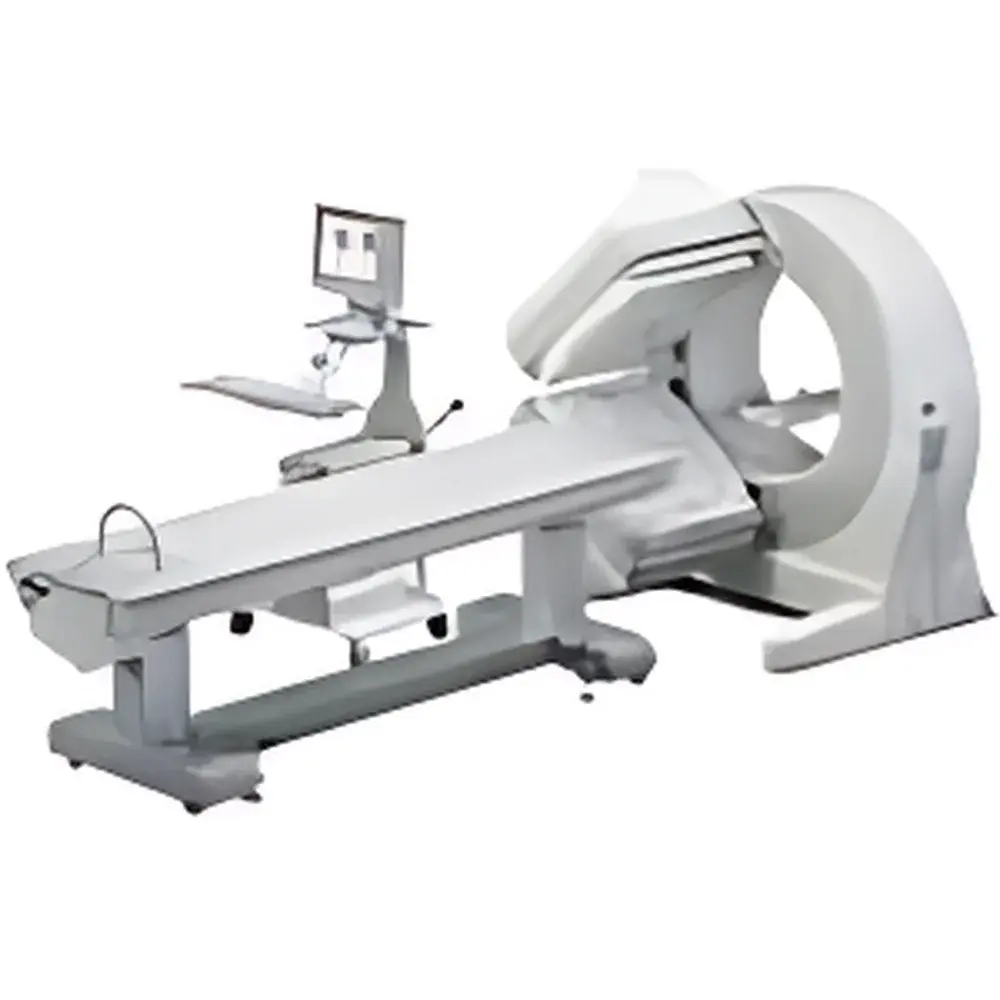
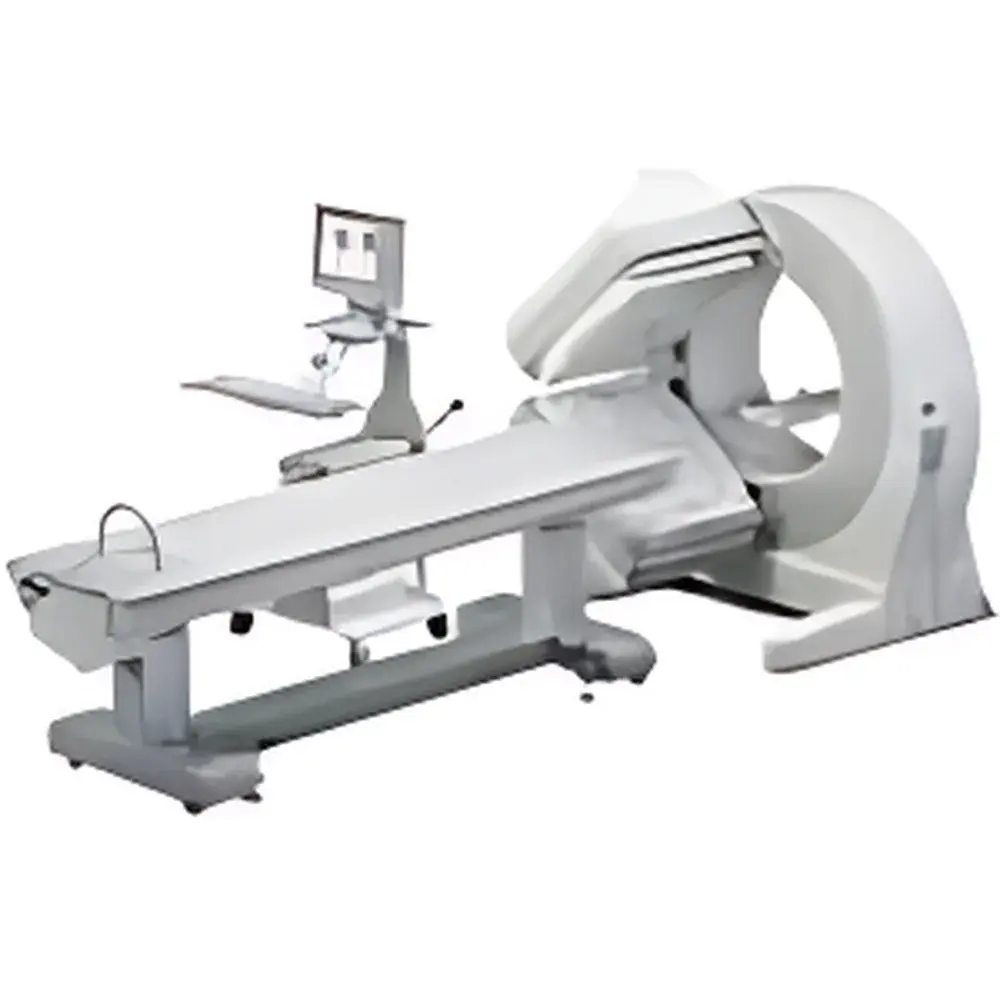
Hamamatsu SPIRIT-DHV Variable-Angle Dual-Head SPECT System
| Brand | Hamamatsu Photonics (BHP) |
|---|---|
| Origin | Hungary |
| Manufacturer | Mediso Medical Imaging Systems |
| Instrument Type | Nuclear Medicine SPECT Scanner |
| Detector Configuration | Dual-Head, Variable-Angle |
| Acquisition Modes | Planar & Tomographic (SPECT) |
| Key Hardware | Fully Digital High-Resolution Detectors, Integrated Single-Board Electronics, Motorized Collimator Changer, NIR-Based Patient Contour Mapping |
| Field of View (FOV) | ≥530 mm × 390 mm |
| Energy Range | 40–600 keV |
| Intrinsic Spatial Resolution | ≤3.6 mm FWHM |
| Maximum Count Rate | ≥220 kcps |
| Intrinsic Uniformity (Differential/Integral) | ≤1.9% / ≤2.4% |
| Intrinsic Spatial Linearity (Differential/Absolute) | ≤0.18 mm / ≤0.38 mm |
| Gantry Dimensions (L×W×H) | 1160 × 1520 × 1500 mm |
| Total System Weight | 2200 kg |
| Patient Table (L×W×H) | 2000 × 800 × 650 mm |
| Weight | 350 kg |
| Collimator Cart (L×W×H) | 750 × 560 × 1250 mm |
| Weight | 125 kg |
Overview
The Hamamatsu SPIRIT-DHV Variable-Angle Dual-Head SPECT System is a clinical-grade single-photon emission computed tomography platform engineered for high-fidelity functional and anatomical imaging in preclinical and translational small-animal research. Designed and manufactured by Mediso Medical Imaging Systems (Budapest, Hungary), the system employs dual NaI(Tl) scintillation detectors coupled with fully digital, high-resolution photomultiplier tube (PMT) readout electronics and advanced pulse processing architecture. Its core imaging principle relies on collimated gamma-ray detection following radiotracer administration (e.g., 99mTc, 123I, 111In), enabling quantitative planar scintigraphy and full 360° or step-and-shoot SPECT acquisition. The variable-angle gantry—configurable at 180°, 102°, or 90°—optimizes sensitivity and spatial sampling for diverse animal models (mouse to rabbit), while minimizing scatter and truncation artifacts inherent in fixed-angle geometries. Built to meet ISO 13485-certified quality management standards and compliant with IEC 62542 for nuclear medicine equipment safety, the SPIRIT-DHV serves as a validated platform for longitudinal studies requiring reproducible tracer kinetics and volumetric quantification.
Key Features
- Variable-angle dual-head gantry with motorized precision positioning (180°/102°/90° configurations) for adaptive geometry optimization per study protocol
- Fully digital detector modules featuring high-density NaI(Tl) crystals and integrated single-board electronics—eliminating analog signal degradation and enabling real-time energy windowing
- Near-infrared (NIR) body contour mapping system for automated patient/animal positioning and attenuation correction boundary definition
- Motorized collimator changer supporting interchangeable parallel-hole, pinhole, and fan-beam collimators without manual intervention
- Ultra-low attenuation carbon-fiber patient table with integrated motion control for precise axial and rotational alignment
- Dedicated acquisition workstation with DICOM-compliant protocol scripting, real-time projection preview, and hardware-triggered gating (ECG/respiratory)
- Processing workstation equipped with iterative reconstruction (OSEM), resolution recovery, scatter correction (Triple Energy Window), and quantitative SPECT calibration tools
Sample Compatibility & Compliance
The SPIRIT-DHV accommodates live small-animal subjects ranging from 15 g (neonatal mouse) to 4 kg (adult rabbit), with optional custom immobilization fixtures for longitudinal positioning repeatability. Its large effective FOV (≥530 × 390 mm) supports whole-body murine scans and multi-position rat imaging without repositioning. All acquisition and reconstruction workflows adhere to AAPM Report No. 220 guidelines for quantitative SPECT and are compatible with NEMA NU 4-2008 performance testing protocols. System software maintains audit trails and user access controls aligned with GLP and FDA 21 CFR Part 11 requirements for regulated preclinical studies. Collimator selection and energy window configuration comply with IAEA Safety Standards Series No. SSG-46 for radiation protection in biomedical research.
Software & Data Management
Acquisition and reconstruction are managed via Mediso’s proprietary InterView™ FX platform—a Windows-based, FDA-cleared (510(k) K193124) software suite supporting DICOM-RT, DICOM-SR, and vendor-neutral data export (NIfTI, Analyze). The system provides native support for list-mode acquisition with time-stamped event storage, enabling dynamic kinetic modeling and retrospective gating. Reconstruction includes GPU-accelerated OSEM with depth-dependent resolution modeling and Monte Carlo–based scatter estimation. Quantitative tools include absolute activity calibration using reference sources, partial volume correction, and voxel-wise SUV normalization. Data archives are stored in encrypted, timestamped project folders with SHA-256 integrity verification. Integration with PACS and LIMS is supported via HL7 v2.x and DICOM Query/Retrieve services.
Applications
- Cardiac perfusion and viability assessment using 99mTc-sestamibi or 201Tl, including gated SPECT for ejection fraction and wall motion analysis
- Osseous metastasis screening and skeletal turnover quantification via 99mTc-MDP whole-body planar and SPECT/CT fusion
- Thyroid uptake and nodule characterization with 123I or 99mTc-pertechnetate
- Renal dynamic function evaluation (GFR, split renal function) using 99mTc-MAG3 or 99mTc-DTPA
- Cerebral perfusion mapping and neuroreceptor occupancy studies with 99mTc-HMPAO or 123I-ioflupane
- Hepatobiliary excretion kinetics with 99mTc-Mebrofenin and biliary obstruction modeling
- First-pass radionuclide angiography and ventricular function assessment in rodent models of heart failure
FAQ
What radiotracers are compatible with the SPIRIT-DHV system?
The system supports all gamma-emitting isotopes within the 40–600 keV range, including 99mTc (140 keV), 123I (159 keV), 111In (171 & 245 keV), and 67Ga (93, 185, 300 keV), with configurable dual- or triple-energy window acquisition.
Does the system support hybrid imaging with CT or MRI?
The SPIRIT-DHV is designed as a standalone SPECT platform. Co-registration with external CT or MRI datasets is supported via rigid and affine transformation tools in InterView™ FX, using fiducial markers or anatomical landmarks.
Is the software validated for regulatory submissions?
Yes—InterView™ FX holds FDA 510(k) clearance and complies with ISO 14155 for clinical trial use. Audit trail functionality, electronic signatures, and data integrity controls satisfy ALCOA+ principles for GLP/GCP environments.
What maintenance and service options are available?
Hamamatsu Photonics provides global technical support, annual preventive maintenance contracts, and remote diagnostics via secure TLS-encrypted connections. All detector PMTs carry a 3-year warranty against gain drift exceeding ±5%.
Can the system perform dynamic SPECT acquisitions?
Yes—list-mode acquisition enables frame durations from 1 second to multiple minutes, supporting tracer kinetic modeling (e.g., Patlak, compartmental analysis) with time-activity curve extraction from user-defined VOIs.




