
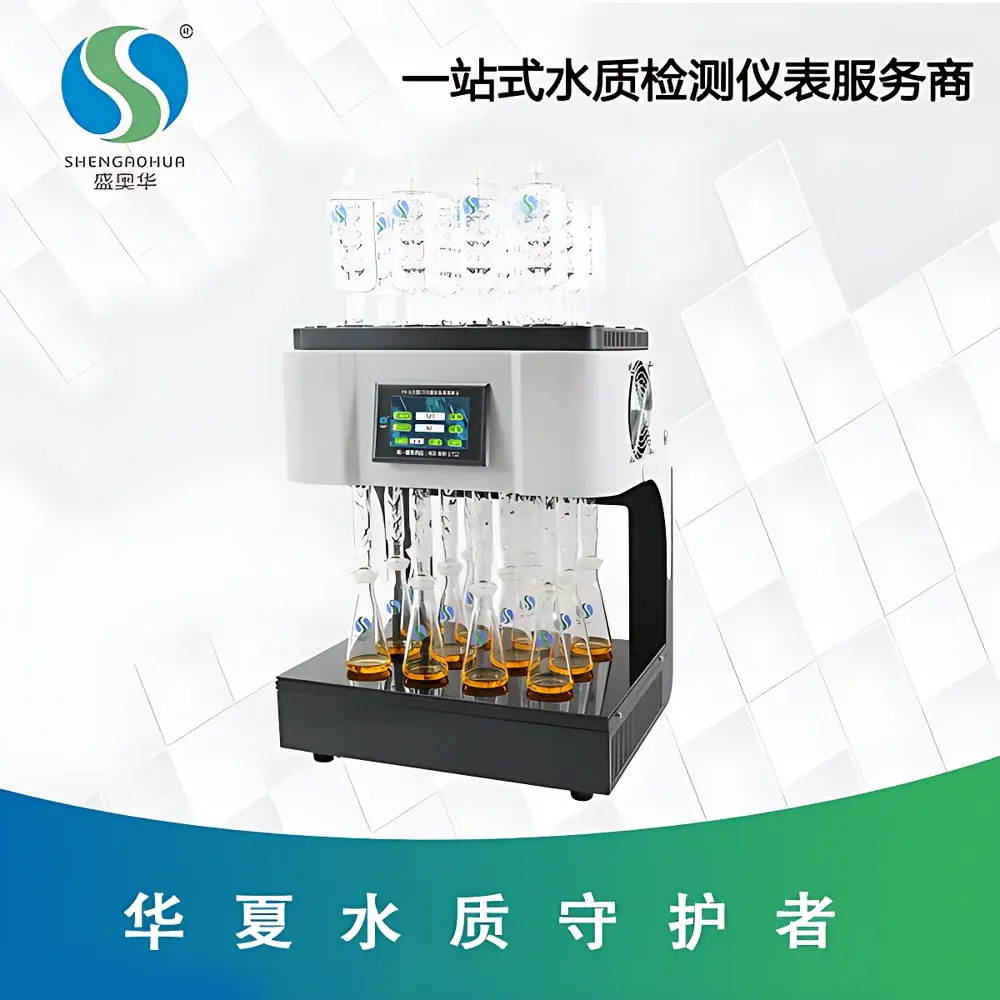
Shengaohua SH-6C/8C/10C/12S V11 COD Reflux Digestion System
| Brand | Shengaohua |
|---|---|
| Origin | Jiangsu, China |
| Manufacturer Type | Direct Manufacturer |
| Country of Origin | China |
| Model | SH-6C/8C/10C/12S |
| Digestion Method | Reflux Digestion |
| Heating Module | Single Heated Block |
| Batch Capacity | 6/8/10/12 samples |
| Temperature Range | 0–200 °C |
| Temperature Accuracy | ±1 °C |
| Digestion Vessel Volume | 100 mL |
| Timer Accuracy | ±1 s |
| Display | 5-inch Touchscreen (Chinese UI) |
| Cooling Method | Dual-fan Air Cooling + Optional Water Cooling |
| Heating Technology | Infrared with Microcrystalline Ceramic Panel |
| Power Adjustment | Adjustable (1200–1500 W) |
| Timer Range | 1–999 min |
| Dimensions | 490 × 390 × 625 mm |
| Operating Ambient | −5 to 40 °C |
Overview
The Shengaohua SH-6C/8C/10C/12S V11 COD Reflux Digestion System is a laboratory-grade, microprocessor-controlled digestion unit engineered for precise and reproducible chemical oxygen demand (COD) analysis in accordance with the Chinese national standard HJ 828–2017. It implements the classical open-reflux method using potassium dichromate under strongly acidic conditions at elevated temperature (typically 150–160 °C), enabling complete oxidation of organic matter in aqueous samples. The system maintains strict thermal stability during the mandatory 2-hour reflux period through intelligent time-sequence heating control, ensuring consistent reaction kinetics across all sample positions. Designed for routine environmental testing laboratories, it replaces manual hotplate-based reflux setups with standardized, automated thermal management—reducing operator variability, improving inter-laboratory comparability, and supporting GLP-aligned workflows.
Key Features
- Microcrystalline ceramic heating panel with infrared radiation technology: delivers rapid, uniform thermal transfer to digestion vessels, minimizing hot-spot formation and extending service life versus conventional coil or aluminum-block heaters.
- Dual independent high-efficiency axial fans for forced-air cooling: eliminates dependency on municipal water supply while achieving effective post-digestion heat dissipation; fan speed and activation timing are programmable via touchscreen interface.
- Modular single-heating-block architecture: supports interchangeable configurations for 6, 8, 10, or 12 sample positions using standard 250 mL ground-glass joint conical flasks—ensuring full compatibility with HJ 828–2017-compliant glassware assemblies.
- 5-inch capacitive touchscreen with localized Chinese menu navigation: enables intuitive setting of digestion time (1–999 min), target temperature (0–200 °C), and heating power (1200–1500 W); user-defined protocols can be saved and recalled.
- Automated end-of-cycle signaling: integrated audible alarm triggers upon timer completion, followed by automatic power cutoff to prevent over-digestion or thermal degradation of samples.
- Optimized thermal enclosure design: low external surface temperature (<50 °C at ambient 25 °C), compact footprint (490 × 390 × 625 mm), and reduced radiative heat loss contribute to energy efficiency and safe benchtop operation.
Sample Compatibility & Compliance
The SH-6C/8C/10C/12S is validated for use with domestic and industrial wastewater matrices—including municipal sewage, pharmaceutical effluents, textile dye baths, pulp and paper mill discharges, and food processing wastewaters—as specified in HJ 828–2017. Sample volume is adjustable (e.g., increased aliquots for low-COD samples ≤50 mg/L; dilution strategies for high-COD samples >700 mg/L). For chloride-rich samples (>1000 mg/L Cl⁻), the instrument supports implementation of the mercury-free alternative procedure described in Annex A of HJ 828–2017, requiring appropriate reagent substitution and titration adjustments. While not certified to ISO/IEC 17025 or ASTM D1252, its operational parameters align with the procedural rigor required for regulatory reporting under China’s Environmental Monitoring Technical Specifications. Routine calibration verification is performed using potassium hydrogen phthalate (KHP) standard solution (500 mg/L COD), yielding RSD ≤5.0% (n=6); repeatability for spiked industrial wastewater is ≤8.0% RSD.
Software & Data Management
This is a standalone hardware platform without embedded data export functionality (e.g., USB, Ethernet, or cloud connectivity). All operational parameters—including start time, set temperature, elapsed digestion duration, and power level—are displayed in real time on the touchscreen and retained in volatile memory only for current session reference. No audit trail, electronic signature, or 21 CFR Part 11 compliance features are implemented. Users must manually record run parameters and results in laboratory notebooks or external LIMS systems. Firmware updates (if released) require physical access and vendor-provided USB-based tools. The interface supports no language switching beyond pre-installed Simplified Chinese.
Applications
- Routine COD determination in municipal wastewater treatment plants for process control and discharge compliance monitoring.
- Environmental monitoring stations conducting statutory surface water and groundwater quality assessments per China’s Surface Water Environmental Quality Standards (GB 3838–2002).
- Research laboratories evaluating biodegradability of novel organic compounds or assessing pretreatment efficiency in advanced oxidation processes.
- Industrial QA/QC labs in sectors including petrochemical refining, brewing, dairy processing, and leather tanning—where organic load quantification informs effluent management decisions.
- Educational institutions teaching standard methods for water pollution analysis in undergraduate environmental engineering and analytical chemistry curricula.
FAQ
Does this instrument support ASTM D1252 or ISO 6060 compliance?
No. The SH-6C/8C/10C/12S is specifically engineered to meet HJ 828–2017 requirements. While its thermal performance and reflux geometry are functionally similar to ASTM/ISO reflux apparatuses, it lacks formal certification or validation documentation for those standards.
Can I use standard 250 mL Erlenmeyer flasks instead of ground-glass joint flasks?
No. The system requires conical flasks with standardized ground-glass joints (e.g., NS 29/32) to ensure leak-tight reflux condensation and compatibility with the included borosilicate glass condenser assembly.
Is water cooling mandatory, or is air cooling sufficient?
Air cooling via dual fans is fully functional for most applications. Water cooling is an optional auxiliary mode for high-throughput labs operating continuously in ambient temperatures >35 °C.
What maintenance is required for long-term reliability?
Routine cleaning of the microcrystalline panel with non-abrasive ethanol wipes; periodic inspection of fan filters and condenser tube integrity; annual verification of temperature sensor calibration using a NIST-traceable thermometer.
Is technical support available in English?
Manufacturer documentation and firmware are Chinese-language only. English-speaking users should engage local distributors for installation assistance and troubleshooting guidance.







